Elliot's Laughingthrush
Trochalopteron elliotii
Order: Passeriformes / Family: Leiothrichidae

Wikimedia Commons
About the Elliot's Laughingthrush
Elliot's Laughingthrush (Trochalopteron elliotii) is a fascinating songbird native to the forested regions of central China, particularly the provinces of Sichuan, Yunnan, and Guizhou. Known for its vibrant plumage and distinctive vocalizations, this bird plays a significant role in the ecosystem as both a predator of insects and a disperser of seeds. These laughingthrushes thrive in montane forests, preferring the dense undergrowth where they forage and socialize in small groups. With a penchant for altitudes ranging from 1,500 to 3,500 meters, they are well-adapted to the cooler temperatures and high humidity of these regions. Elliot's Laughingthrushes are not migratory, but they may undertake short altitudinal movements in response to seasonal changes. During the breeding season, which occurs from April to July, these birds become more vocal and territorial. Their presence in these ecosystems is vital, as they help control insect populations and contribute to the health of the forest environment. As omnivores, their diet varies with the seasons, relying heavily on insects and other invertebrates during the warmer months, while shifting to fruits and seeds in the winter. Their adaptability to changing food sources underlies their resilience in the face of seasonal challenges. Observations of Elliot's Laughingthrush offer invaluable insights into the complex interactions within montane ecosystems, highlighting the delicate balance between flora and fauna. Despite their adaptability, the ongoing threat of habitat loss due to deforestation and human encroachment poses significant challenges to their long-term conservation. Efforts to preserve their habitats are crucial not only for the survival of Elliot's Laughingthrush but also for maintaining the biodiversity of these unique mountainous regions.
The Elliot's Laughingthrush belongs to the family Leiothrichidae, within the order Passeriformes. These birds typically live typically 7-9 years, with some individuals living up to 13 years..
How to Identify a Elliot's Laughingthrush
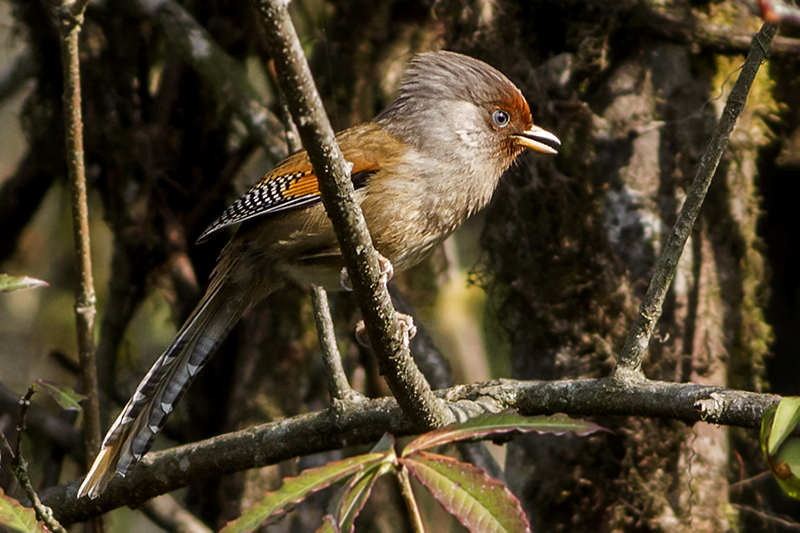
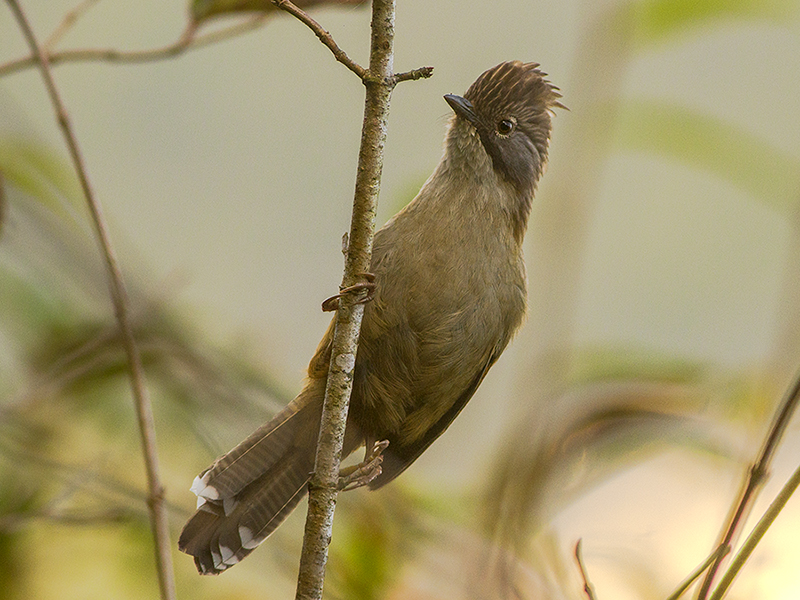
Elliot's Laughingthrush exhibits a striking plumage characterized by a blend of rich browns, grays, and subtle hints of orange and white. Adults showcase a rich chestnut-brown coloration on the upperparts, with a grayish-brown crown and nape. The wings and tail feature darker brown tones interspersed with pale streaks, adding to their distinct appearance. In contrast, the underparts are lighter, often displaying a creamy or pale buff hue. Both sexes appear similar, which can make field identification challenging based solely on plumage. Juveniles resemble adults but exhibit duller colors and less defined markings, often appearing more subdued overall. In terms of size, they are medium-sized passerines, measuring approximately 26 to 28 centimeters in length. While in flight, Elliot's Laughingthrush presents a compact silhouette with rounded wings and a steady, direct flight pattern. Perched, they maintain an alert posture, often seen hopping along the ground or low branches with their tails flicked upwards. Similar species, such as the Rufous-vented Laughingthrush, may cause confusion, though Elliot's can be distinguished by its less prominent rufous vent and overall lighter underparts.
Having trouble telling birds apart? Upload a photo to our bird identification tool for an instant species match.
Elliot's Laughingthrush Habitat and Range
Preferred Habitat
Elliot's Laughingthrush predominantly resides in the montane forests of central China, favoring areas with dense undergrowth and rich biodiversity. Within these forests, they occupy elevations ranging from 1,500 to 3,500 meters, where they find ample cover and food resources. These birds are well-suited to the cooler climate and high humidity of these altitudes. During the breeding season, they may be found in slightly lower elevations, taking advantage of the abundant insect prey available in such habitats. In winter, some populations may descend to lower altitudes as they search for fruits and seeds once other food sources become scarce. Unlike many birds, they show little inclination toward urban or suburban environments, remaining steadfast in their preference for natural, forested habitats. Their presence is most notable in undisturbed or lightly disturbed areas, where human activity has not significantly altered the landscape.
Geographic Range
The primary range of Elliot's Laughingthrush spans the mountainous regions of central China, encompassing provinces such as Sichuan, Yunnan, and Guizhou. These birds are residents of these regions year-round, showing no significant migratory behavior. Instead, they may move locally within their range in response to seasonal changes in food availability and weather conditions. Within this range, they are most commonly found in montane forests, where the combination of dense vegetation and diverse food sources provides an ideal environment. While their population is relatively stable in these areas, the highest densities occur in regions with minimal human disturbance. Their restricted range means they are not found outside of China, making them a species of particular interest to ornithologists and bird watchers visiting the region.
Want to know which birds visit your area? Browse our backyard birds by location guides for region-specific species lists.
What Does the Elliot's Laughingthrush Eat?
The diet of Elliot's Laughingthrush is diverse and shifts with the seasons, reflecting their adaptability as omnivores. During the warmer months, insects and other invertebrates form the bulk of their diet, providing essential proteins and nutrients for breeding and raising young. They employ a variety of foraging techniques, including gleaning from foliage, probing into crevices, and even catching prey mid-air. As autumn approaches and insect availability decreases, they transition to a diet more reliant on fruits and seeds, taking advantage of the seasonal abundance of berries and nuts. This dietary flexibility allows them to weather the leaner winter months, ensuring a consistent food supply throughout the year. Their foraging activity is primarily diurnal, with peak feeding periods occurring in the early morning and late afternoon, coinciding with the times of highest insect activity.
Elliot's Laughingthrush Behavior and Social Structure
Elliot's Laughingthrush exhibits a highly social and gregarious nature, often seen in small family groups or loose flocks. These associations offer protection and enhance foraging efficiency. During the breeding season, however, they become more territorial, with pairs establishing and defending nesting territories. Courtship involves a series of displays, including mutual preening, vocal exchanges, and food offerings. Their response to predators is swift and coordinated, often involving a chorus of alarm calls and mobbing behavior to deter intruders. Daily activity patterns include periods of intense foraging interspersed with rest and social interactions. While primarily terrestrial, they are adept at moving through the undergrowth, using their strong legs to hop and climb. Their vocalizations are a constant feature of their behavior, serving to maintain group cohesion and communicate a range of information, from food locations to predator threats.
Elliot's Laughingthrush Nesting and Reproduction
Elliot's Laughingthrush constructs its nest with care, favoring dense shrubs or low trees as nesting sites to provide concealment from predators. The nest itself is a cup-shaped structure, meticulously woven from twigs, grasses, and leaves, with softer materials like feathers and moss lining the interior. The typical clutch size ranges from two to five eggs, which display a pale blue or greenish hue with speckled markings. Incubation duties are primarily undertaken by the female, lasting about 14 to 16 days. During this period, the male plays a crucial role in providing food for the incubating female. Once hatched, both parents participate in feeding the chicks, which fledge approximately 12 to 15 days after hatching. Elliot's Laughingthrush may produce two broods per year, depending on food availability and environmental conditions.
Elliot's Laughingthrush Sounds and Vocalizations
The vocalizations of Elliot's Laughingthrush are both distinctive and melodious, characterized by a series of clear, ringing notes delivered in rapid succession. Their primary song consists of a rhythmic pattern, often described as a series of 'laughing' phrases, which can be heard echoing through their forested habitats. In addition to their songs, they produce a variety of call notes, including soft 'churrs' and more piercing alarm calls that serve to alert fellow group members to potential dangers. During the dawn chorus, their voices are among the most prominent, contributing to the vibrant soundscape of the montane forests. Comparatively, their calls resemble those of other laughingthrushes but are notably more musical and complex.
Interesting Facts About the Elliot's Laughingthrush
- 1Elliot's Laughingthrush was named after the American ornithologist Daniel Giraud Elliot, who contributed significantly to avian taxonomy.
- 2Unlike many birds, Elliot's Laughingthrush is known for its lack of sexual dimorphism, with males and females appearing remarkably similar.
- 3These birds have a diverse diet that changes seasonally, allowing them to exploit a wide range of food sources throughout the year.
- 4Elliot's Laughingthrushes often engage in 'anting,' a behavior where they allow ants to crawl over their feathers, possibly to eliminate parasites.
- 5The unique vocalizations of Elliot's Laughingthrush, particularly their 'laughing' calls, have made them a favorite among bird enthusiasts visiting China.
- 6Their nests are often built close to the ground, making them susceptible to predation yet cleverly concealed by dense vegetation.
- 7Elliot's Laughingthrush displays remarkable adaptability to environmental changes, thriving in a variety of montane forest conditions.
Elliot's Laughingthrush Conservation Status
Elliot's Laughingthrush is currently classified as Least Concern by the IUCN, with a stable population trend. However, habitat loss due to deforestation and land conversion for agriculture poses ongoing threats. Conservation efforts focus on preserving the montane forest habitats essential for their survival, with protected areas and reforestation initiatives playing key roles. Historical population changes have been relatively modest, though ongoing monitoring is necessary to ensure long-term stability. Efforts to educate local communities about the importance of these birds can also contribute to their conservation.