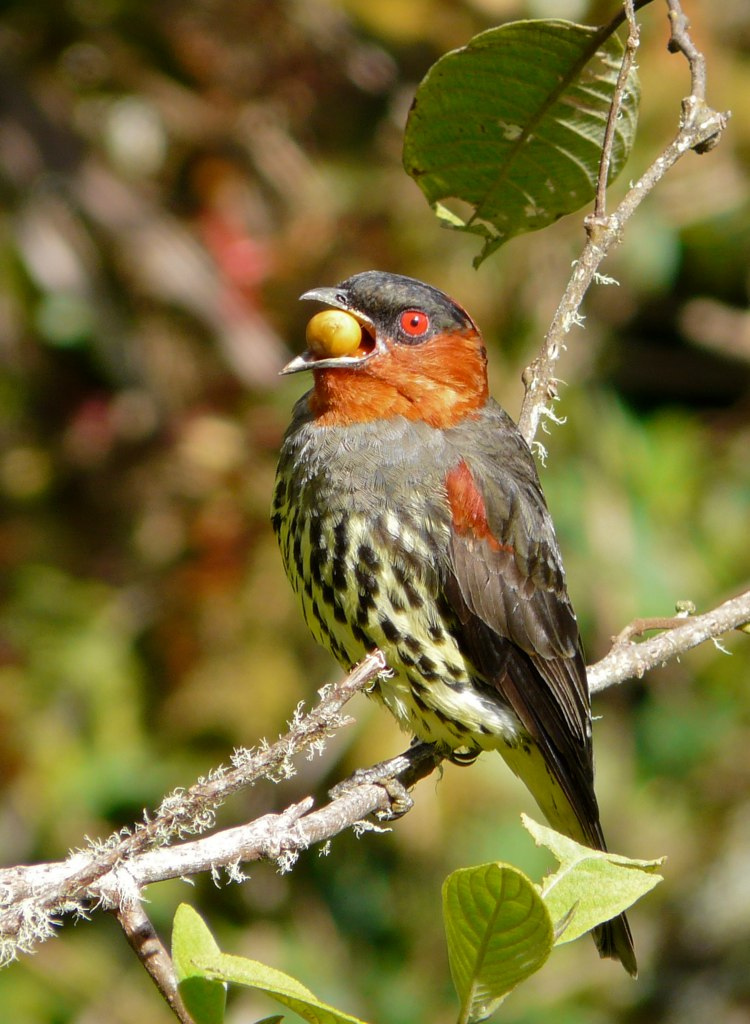
Foothill Schiffornis
Schiffornis aenea
Order: Passeriformes / Family: Cotingidae

Wikimedia Commons
About the Foothill Schiffornis
The Foothill Schiffornis, scientifically known as Schiffornis aenea, belongs to the family Cotingidae and is an intriguing species of passerine bird. Found primarily in the tropical and subtropical forests of Central and South America, it plays a unique role in the ecological tapestry of these regions. This bird is predominantly distributed in countries such as Costa Rica, Panama, Colombia, and Ecuador, often seen in the dense undergrowth of foothill forests. The Foothill Schiffornis is a medium-sized bird that expertly camouflages within its dense forest habitat.
The significance of the Foothill Schiffornis extends beyond its mere presence in these biodiverse regions. As an insectivore, it helps control insect populations in its environment, contributing to the balance of its ecosystem. This bird is an indicator of healthy forest environments as it requires rich, undisturbed habitats for its survival. It typically inhabits elevations ranging from 500 to 1,500 meters, although it can be found at lower elevations in some areas.
Seasonal behaviors of the Foothill Schiffornis include subtle shifts in location rather than extensive migrations. This bird may move to slightly lower elevations during the rainy season when food is more abundant and insects are plentiful. The Foothill Schiffornis is known for its beautiful vocalizations which become prominent during the breeding season. Its song, a series of melodious whistles and trills, echoes through the forest and serves as a key communication tool for attracting mates and defending territory.
Overall, the Foothill Schiffornis is a vital component of its habitat, aiding in the propagation of forest health through its ecological activities. Its presence is a testament to the rich biodiversity of the foothill forests of Central and South America, where it continues to thrive despite the encroaching threats of habitat loss and environmental change.
The Foothill Schiffornis belongs to the family Cotingidae, within the order Passeriformes. These birds typically live typically 4-6 years, with a maximum recorded lifespan of 8 years..
How to Identify a Foothill Schiffornis
The Foothill Schiffornis can be identified by its distinct greenish-brown plumage that blends seamlessly with the forest environment. Adult plumage features a subtle gradient from olive-green on the back to a lighter, more yellowish-green on the underparts. This coloration helps it remain inconspicuous in the dappled light of the forest understory.
Juvenile Foothill Schiffornis have a slightly duller plumage compared to the adults, with a more pronounced brownish tint. There is little sexual dimorphism, as males and females appear quite similar in coloration, making it challenging to distinguish between them in the field. However, careful observation may reveal subtle differences in size, with males typically being slightly larger.
In flight, the Foothill Schiffornis exhibits a silhouette typical of many forest-dwelling passerines, with broad, rounded wings and a somewhat short tail. Its perching posture is often upright, and it can be seen moving deliberately and quietly through the understory, making it difficult to spot unless one listens for its distinctive song or call notes.
Having trouble telling birds apart? Upload a photo to our bird identification tool for an instant species match.
Foothill Schiffornis Habitat and Range
Preferred Habitat
The Foothill Schiffornis thrives in the dense, humid environments of tropical and subtropical forests. It is predominantly found in the lower and mid-elevation forests of Central and South America, inhabiting regions such as the foothills of the Andes and the lush rainforests of Panama and Costa Rica. These areas provide a rich supply of food and cover, essential for its survival.
This bird typically prefers elevations between 500 and 1,500 meters, where the forest canopy provides ample cover. Its habitat choice is primarily dictated by the availability of food resources and suitable nesting sites. Although primarily a forest species, the Foothill Schiffornis may occasionally venture into secondary growth areas, especially where dense undergrowth is present.
Unlike some bird species that adapt well to urban environments, the Foothill Schiffornis remains largely restricted to rural and forested areas. Its presence in urban settings is rare, as it depends heavily on the intact forest ecosystem for both feeding and breeding.
Geographic Range
The Foothill Schiffornis' distribution spans several countries in Central and South America. It is commonly found in Costa Rica, Panama, Colombia, and Ecuador, where it inhabits the foothills and lower montane forests. This bird's presence is notably concentrated in the Andean foothills, a region known for its rich biodiversity and varied topography.
In Costa Rica, the Foothill Schiffornis is present in both the Pacific and Caribbean slopes, with populations thriving in protected areas like La Amistad International Park. In Panama, it can be found in national parks such as Soberanía and Darién.
Despite its relatively wide range, the Foothill Schiffornis does not engage in long-distance migrations. Instead, it may undertake short-range movements in response to seasonal changes in food availability. This behavior allows the species to remain within its preferred habitat year-round, contributing to its stable presence in these regions.
Want to know which birds visit your area? Browse our backyard birds by location guides for region-specific species lists.
What Does the Foothill Schiffornis Eat?
The diet of the Foothill Schiffornis primarily consists of insects and other small invertebrates, making it an essential insectivore within its ecosystem. It forages mainly in the lower to mid-levels of the forest understory, using its keen eyesight to detect prey among the foliage.
Seasonal variations in food availability can influence its diet. During the rainy season, when insects are more abundant, the Foothill Schiffornis may exhibit increased foraging activity, taking advantage of the plentiful resources. In drier periods, it may diversify its diet to include small fruits and seeds, though these constitute a minor portion of its overall intake.
The bird employs a sit-and-wait foraging strategy, often perching quietly and making short flights to capture prey. This method allows it to conserve energy while effectively targeting elusive or camouflaged insects. Its diet primarily includes beetles, caterpillars, and spiders, which provide the necessary nutrients for its energy-intensive lifestyle.
Foothill Schiffornis Behavior and Social Structure
The Foothill Schiffornis exhibits a range of behaviors that reflect its adaptation to forest life. It is generally solitary or found in pairs, rarely forming large flocks. This bird is territorial, often defending its chosen area through vocalizations and occasional displays of aggression.
During the breeding season, the male Foothill Schiffornis engages in elaborate courtship displays to attract a mate. These displays include vocal duets and synchronized movements, designed to showcase both its physical condition and territory quality. Once paired, the birds may remain together throughout the breeding season, working collaboratively in raising their young.
In terms of daily activity patterns, the Foothill Schiffornis is most active during the early morning and late afternoon, times when insect prey is most abundant. It tends to be less active during the heat of midday, when it remains in the shaded understory.
When faced with potential threats, the Foothill Schiffornis relies on its cryptic plumage to avoid detection. It may freeze on its perch or retreat silently into denser vegetation, behavior that underscores its reliance on camouflage as a primary defense mechanism.
Foothill Schiffornis Nesting and Reproduction
The nesting habits of the Foothill Schiffornis reveal its preference for secluded, well-hidden locations. Its nests are typically constructed in dense undergrowth or among the tangled vines of the forest understory. These nests are cup-shaped, built from materials such as leaves, moss, and small twigs, providing excellent camouflage against predators.
The typical clutch size for the Foothill Schiffornis is two to three eggs, which are incubated by the female over a period of approximately 18 to 20 days. During this time, the male may assist by bringing food to the female, although the division of parental duties can vary.
After hatching, the chicks remain in the nest for about 17 to 19 days before fledging. Both parents share responsibilities for feeding and protecting the young, ensuring their survival in the competitive forest environment. The number of broods raised per year is typically one, reflecting the significant investment required to successfully rear their offspring in such a challenging habitat.
Foothill Schiffornis Sounds and Vocalizations
The primary song of the Foothill Schiffornis is a series of rich, melodious whistles and trills that resonate through the forest. This song is often described as having a liquid quality, with a rhythm that rises and falls in a captivating pattern. These vocalizations play a crucial role in territory establishment and mate attraction.
In addition to its primary song, the Foothill Schiffornis produces a variety of call notes, including sharp, high-pitched chips and softer, more subtle contact calls. Alarm calls, which are harsher and more insistent, serve to alert other birds of potential dangers such as predators.
During the dawn chorus, the Foothill Schiffornis is among the early vocalizers, its song contributing to the symphony of sounds that characterize the forest at first light. This behavior underscores the bird's reliance on auditory communication in the dense, visually obstructive environment it inhabits.
Interesting Facts About the Foothill Schiffornis
- 1The Foothill Schiffornis is one of the few bird species whose song can be heard during both dawn and dusk, marking its territory.
- 2Unlike many songbirds, the Foothill Schiffornis often sings in duets, with pairs communicating through coordinated calls.
- 3This bird's camouflage is so effective that it is often heard before it is seen, blending perfectly with the forest understory.
- 4The Foothill Schiffornis plays a vital role in pest control by consuming a variety of insects that inhabit the forest.
- 5Despite its non-migratory nature, the Foothill Schiffornis adjusts its elevation range seasonally to optimize food availability.
Foothill Schiffornis Conservation Status
The Foothill Schiffornis is currently listed as Least Concern by the IUCN, with no immediate threats leading to a rapid population decline. However, its reliance on intact forest habitats makes it vulnerable to deforestation and habitat fragmentation, which are prevalent issues in many parts of its range. Conservation efforts focused on protecting large tracts of forest are essential for maintaining stable populations of the Foothill Schiffornis. Protected areas and national parks in countries like Costa Rica and Panama provide safe havens for this species, allowing it to thrive in relatively undisturbed environments. While the overall population trend appears stable, ongoing habitat loss could pose a future threat if not addressed. Continued monitoring and habitat preservation efforts are critical to ensure the long-term survival of this and other forest-dependent species.