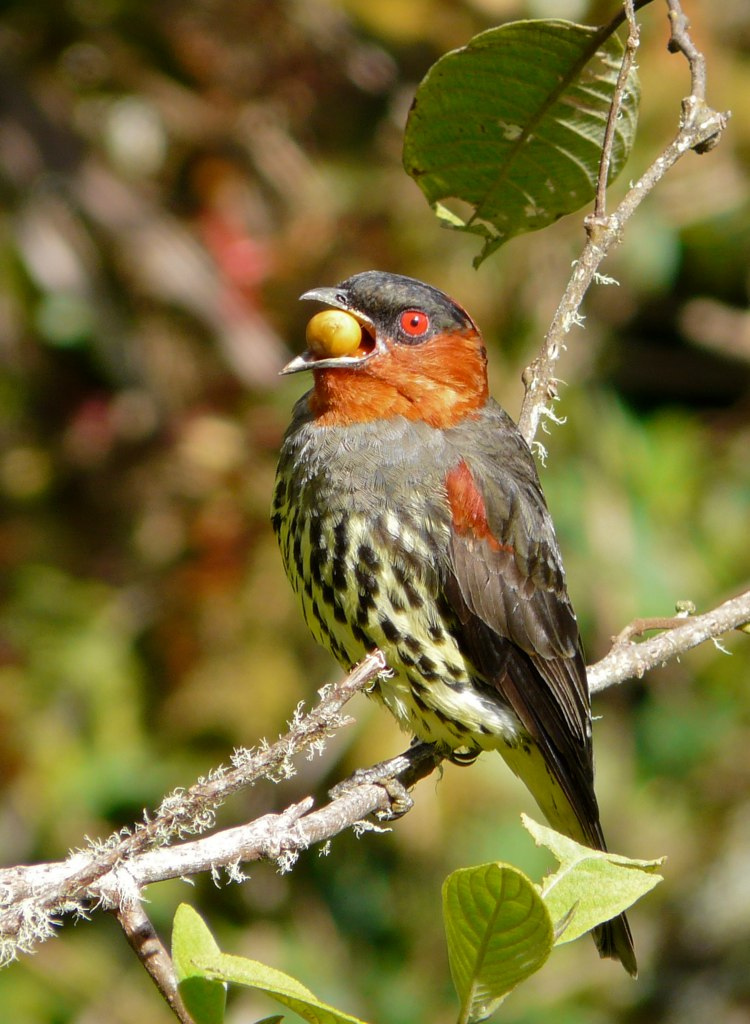
Golden-breasted Fruiteater
Pipreola aureopectus
Order: Passeriformes / Family: Cotingidae

Wikimedia Commons
About the Golden-breasted Fruiteater
The Golden-breasted Fruiteater (Pipreola aureopectus) is a striking member of the Cotingidae family, known for its vibrant plumage and intriguing behaviors. This species primarily inhabits the humid montane forests of the Andes, ranging from Venezuela through Colombia and into Ecuador. These forests, often shrouded in mist, provide the ideal microhabitat for the fruiteater, allowing it to thrive in the dense canopy where it is most often seen. The bird plays a crucial ecological role as a seed disperser, contributing to the health and regeneration of these biodiverse forests. The Golden-breasted Fruiteater is particularly significant for its relationship with a variety of fruit-bearing plants, which rely on the bird for seed distribution. During the breeding season, typically from March to July, the fruiteater becomes more vocal and visible as it engages in courtship activities. Outside of this period, it tends to be more secretive, blending into the foliage with its green back and wings. Observers can often spot the Golden-breasted Fruiteater sitting motionless for long periods, a behavior that aids in avoiding predators. Its ecological role extends beyond seed dispersal, as it also participates in maintaining the health of insect populations, consuming various arthropods when fruit is less abundant. Seasonal movements of this species are generally altitudinal rather than long-distance migrations, as it seeks out food resources. By adapting to the varying availability of food throughout the year, the Golden-breasted Fruiteater demonstrates impressive ecological flexibility. Conservationists consider this bird a species of least concern, though habitat loss due to deforestation poses a potential threat to its long-term survival.
The Golden-breasted Fruiteater belongs to the family Cotingidae, within the order Passeriformes. These birds typically live average 5-7 years, with a maximum recorded of 10 years..
How to Identify a Golden-breasted Fruiteater
The Golden-breasted Fruiteater stands out with its vivid yellow breast, contrasting sharply against the deep green of its back and wings. Males and females display slightly different plumage; males boast a more vibrant yellow and a black cap, while females tend to have a more subdued olive-green coloration that provides camouflage amidst the foliage. Juveniles resemble females but with even duller tones, lacking the distinctive black cap entirely. This sexual dimorphism aids in identification during field observations. Unlike many other birds, this species' short and stocky build is a key identifying feature, which, coupled with its habit of remaining stationary, can make it a challenge to spot. In flight, the Golden-breasted Fruiteater exhibits a direct and somewhat slow wingbeat, consistent with its lifestyle as a canopy dweller rather than a long-distance flyer. Its perching posture is typically upright, often on horizontal branches where it can scan for food or potential threats. While there are no close relatives within its immediate range that could cause identification confusion, its bright yellow chest is a reliable distinguishing mark among the avifauna of its habitat.
Having trouble telling birds apart? Upload a photo to our bird identification tool for an instant species match.
Golden-breasted Fruiteater Habitat and Range
Preferred Habitat
The Golden-breasted Fruiteater favors cloud forests, particularly those located at elevations ranging from 1,200 to 2,500 meters. These forests, characterized by high humidity and frequent cloud cover, are found along the Andean slopes, offering a rich tapestry of flora and fauna. This bird is typically associated with primary forests but can also be found in well-preserved secondary forests where the canopy remains dense. Unlike some species, the Golden-breasted Fruiteater does not usually venture into urban areas or open fields, preferring the seclusion and resources of forested environments. Seasonal shifts in habitat preference are minimal, as the bird's altitudinal movements are driven more by food availability than temperature changes. The dense fog and lush vegetation of its habitat provide excellent cover and feeding opportunities, allowing it to remain relatively hidden from predators while foraging.
Geographic Range
The Golden-breasted Fruiteater's range is confined to the northern Andes, extending from western Venezuela through Colombia and into northern Ecuador. It occupies a relatively narrow belt of cloud forest habitat, with population densities often higher in areas where fruiting trees are abundant. This species does not undertake long-distance migrations, but instead, performs altitudinal movements within its range to access seasonal food resources. In Colombia, it is found in several departments including Antioquia and Chocó, while in Ecuador, it is prevalent in the provinces of Carchi and Imbabura. These regions provide the necessary microhabitats that support the bird's year-round presence. Despite its limited geographic range, the species thrives where suitable habitat conditions prevail.
Want to know which birds visit your area? Browse our backyard birds by location guides for region-specific species lists.
What Does the Golden-breasted Fruiteater Eat?
The diet of the Golden-breasted Fruiteater primarily consists of fruits, with a particular preference for small berries and drupes found in the upper canopy. This frugivorous diet is supplemented by the occasional consumption of insects, especially during the breeding season when protein requirements increase. The bird employs a sit-and-wait foraging strategy, often perching quietly before making quick sallying flights to pluck fruit or catch insects. The size of prey items tends to be small, in line with its modest bill size, which is well adapted for handling its preferred diet. Feeding activity peaks in the early morning and late afternoon when fruit is most accessible and temperatures are cooler. Seasonal shifts in diet are common, with a greater reliance on insects and other invertebrates during times when fruit is scarce.
Golden-breasted Fruiteater Behavior and Social Structure
Golden-breasted Fruiteaters are typically solitary or found in pairs, especially during the breeding season. They exhibit a territorial nature, often defending key feeding areas from conspecifics. Courtship displays include subtle vocalizations and the male presenting food items to the female, a behavior that strengthens pair bonds. Unlike some other cotingas, the Golden-breasted Fruiteater does not form large flocks, though small family groups may occasionally be seen post-breeding. In response to predators, these birds rely on their cryptic plumage and stillness, making detection difficult. Daily activity patterns include periods of intense foraging interspersed with long bouts of rest, during which the bird remains inconspicuous among the foliage.
Golden-breasted Fruiteater Nesting and Reproduction
The Golden-breasted Fruiteater builds a small, cup-shaped nest typically located on a sturdy branch high in the canopy. The nest construction involves the use of fine twigs, moss, and lichens, which help it blend seamlessly with its surroundings. Clutch size generally consists of two eggs, which are incubated primarily by the female for about 18 days. During this time, the male may assist by providing food to the incubating female. After hatching, both parents participate in feeding the chicks, which fledge approximately 20-25 days post-hatching. This species generally raises one brood per year, though in areas with abundant food, a second brood is possible.
Golden-breasted Fruiteater Sounds and Vocalizations
The primary song of the Golden-breasted Fruiteater is a soft, melodious series of notes, delivered in a slow, deliberate rhythm. This song is often described as flute-like, with a gentle, almost mournful quality. In addition to its song, the fruiteater emits short, sharp call notes, particularly when alarmed or during interactions with other birds. Alarm calls are more abrupt and higher-pitched, serving as a warning to potential threats. The dawn chorus sees the bird most vocal, using its song to establish territory and attract mates.
Interesting Facts About the Golden-breasted Fruiteater
- 1The Golden-breasted Fruiteater can remain motionless for extended periods, making it difficult to detect.
- 2Despite its vivid plumage, the fruiteater's preference for dense foliage often keeps it hidden from view.
- 3Its diet primarily consists of fruit, but the bird adapts to eating more insects when fruit is scarce.
- 4The species' vibrant plumage serves not just for mating displays but also for camouflage among colorful foliage.
- 5Golden-breasted Fruiteaters contribute significantly to seed dispersal, aiding forest regeneration.
- 6This bird's range is limited to the northern Andes, highlighting its specialized habitat requirements.
- 7The species' song is uniquely soft and melodious, a contrast to the often harsh environment of its habitat.
Golden-breasted Fruiteater Conservation Status
The IUCN currently lists the Golden-breasted Fruiteater as a species of least concern, with populations considered stable. However, habitat destruction poses a significant threat to its long-term viability, particularly deforestation for agriculture and urban development. Conservation efforts focus on preserving critical cloud forest habitats and establishing protected areas to ensure the species' survival. Historical data indicate that the population has remained relatively stable, though localized declines have occurred in heavily deforested regions.