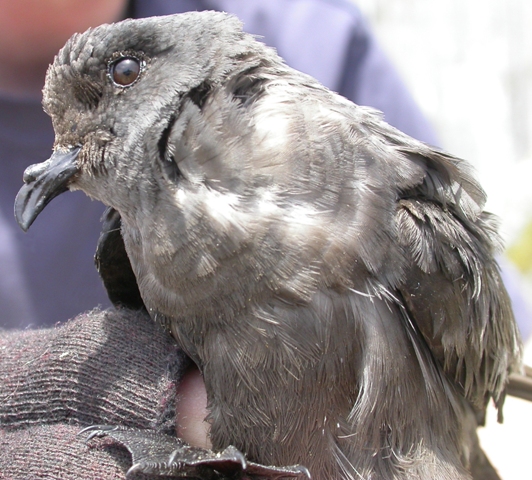
Gray-backed Storm-Petrel
Garrodia nereis
Order: Procellariiformes / Family: Hydrobatidae

Wikimedia Commons
About the Gray-backed Storm-Petrel
The Gray-backed Storm-Petrel, known scientifically as Garrodia nereis, is a small seabird that calls the southern oceans its home. This species belongs to the family Hydrobatidae and is one of the few storm-petrels with a distinctly gray back, which sets it apart from its relatives. The bird's presence in the harsh and often remote environments of the Southern Hemisphere makes it a fascinating subject of study for ornithologists and nature enthusiasts alike. These storm-petrels are most commonly sighted around the sub-Antarctic islands and the southern coasts of Australia and New Zealand, where they play a crucial role in the marine ecosystem. As part of the order Procellariiformes, they contribute to the nutrient cycles of the ocean by feeding on plankton and small marine organisms, subsequently distributing nutrients across vast oceanic spaces. While their small size and elusive nature make them challenging to study, the Gray-backed Storm-Petrel's ecological significance cannot be overstated. Seasonal behaviors are particularly interesting; during the breeding season, these birds form colonies on remote islands, with their activities primarily centered around nesting and feeding. Outside of the breeding season, the Gray-backed Storm-Petrel leads a pelagic lifestyle, spending most of its time on the open ocean, which can make tracking their movements and population dynamics a daunting task. Yet, their presence is vital to understanding the health of marine ecosystems, as they are seen as indicators of oceanic conditions. Their ability to thrive in such environments speaks to their adaptability and their important role within the food chain. With ongoing research and monitoring, scientists aim to gain deeper insights into the Gray-backed Storm-Petrel’s life cycle and the broader implications of their existence in the Southern Hemisphere's marine environments.
The Gray-backed Storm-Petrel belongs to the family Hydrobatidae, within the order Procellariiformes. These birds typically live average 8 years with max recorded 14 years..
How to Identify a Gray-backed Storm-Petrel
Identifying the Gray-backed Storm-Petrel involves noting its small size, typically around 15 to 20 centimeters in length, and its relatively light weight, which is usually under 50 grams. The adult Gray-backed Storm-Petrel displays a striking gray coloration on its back, contrasting with its predominantly white underparts. This feature is particularly important when distinguishing it from other storm-petrels, which often have darker backs. The bird's wings are long and narrow, aiding in its dynamic flight over ocean waves. Juveniles resemble adults but may show slightly duller plumage, lacking the sheen that adults possess. There are no significant plumage differences between males and females, which can make sexing the birds in the field difficult. When observing the bird in flight, its fluttering wingbeats and gliding are characteristic of storm-petrels, providing clues to its identification. The posture of the Gray-backed Storm-Petrel when perching is usually upright, often seen on rocky outcrops during breeding season. Similar species that might confuse observers include the Wilson's Storm-Petrel, but the latter typically lacks the gray back and has a different flight pattern. Attention to these details ensures accurate identification in the field.
Having trouble telling birds apart? Upload a photo to our bird identification tool for an instant species match.
Gray-backed Storm-Petrel Habitat and Range
Preferred Habitat
The Gray-backed Storm-Petrel primarily inhabits open ocean environments, thriving in the pelagic zones of the Southern Hemisphere. Its habitat includes the sub-Antarctic regions, ranging from the southern coasts of New Zealand and Australia to islands such as the Auckland Islands and Macquarie Island. These birds are rarely found inland or in urban areas, as they are highly adapted to marine life. During the breeding season, they congregate on remote islands with suitable nesting sites, often favoring coastal cliffs and rocky outcrops. These locations provide the necessary isolation and protection from predators. The elevation range for nesting is typically at sea level, although they may venture higher up on cliff faces to establish nests. Seasonal habitat shifts are minimal, as the Gray-backed Storm-Petrel remains largely pelagic outside the breeding season, only returning to land for reproduction.
Geographic Range
The Gray-backed Storm-Petrel's breeding range is concentrated in the sub-Antarctic and southern oceanic islands, where it forms colonies during the breeding season. These locations include the Chatham Islands, Snares Islands, and surrounding areas. Their wintering range extends across the Southern Ocean, where they are highly pelagic, spending most of their time at sea. The species is not known to undertake long migratory journeys like some other seabirds, but it may disperse over wide oceanic areas in search of food. Population density is higher around breeding colonies, but at sea, they are more sparsely distributed, often seen individually or in small groups. Regions such as the Tasman Sea and the waters surrounding southern New Zealand are hotspots for observing these birds.
Want to know which birds visit your area? Browse our backyard birds by location guides for region-specific species lists.
What Does the Gray-backed Storm-Petrel Eat?
The diet of the Gray-backed Storm-Petrel primarily consists of small marine organisms, including plankton, crustaceans, and small fish. They are opportunistic feeders, relying on the abundance of prey items in their environment. Seasonal changes in diet are minimal, as their food sources remain consistent throughout the year. The Gray-backed Storm-Petrel employs a unique foraging technique known as 'pattering,' where it hovers close to the water's surface and uses its feet to stir up prey, capturing it with quick, darting movements. This technique allows them to exploit food resources efficiently in the nutrient-rich waters of the Southern Ocean. Prey size is typically small, usually less than 5 centimeters in length. Feeding often occurs during daylight hours, although nocturnal feeding is not uncommon, especially when following swarms of nocturnal zooplankton.
Gray-backed Storm-Petrel Behavior and Social Structure
The Gray-backed Storm-Petrel exhibits a range of behaviors that reflect its adaptation to marine environments. Socially, these birds are generally solitary when at sea, but they display more social behavior during the breeding season when they form colonies. Territorial behavior is minimal, as they are non-aggressive and tend to focus on nesting and feeding. Courtship displays are subtle, involving aerial acrobatics and vocalizations to attract mates. Flocking patterns are not prominent in this species, as they tend to forage alone or in small groups. Their response to predators is typically evasive; they rely on their agile flight to escape threats. Daily activity patterns show a preference for feeding during daylight, although they are capable of nocturnal activity. Their ability to navigate vast oceanic spaces with precision is a testament to their exceptional orientation skills.
Gray-backed Storm-Petrel Nesting and Reproduction
The nesting habits of the Gray-backed Storm-Petrel are a key aspect of its life cycle. Nests are typically constructed in burrows or crevices on remote islands, providing protection from the elements and predators. The nesting materials are minimal, often consisting of natural materials like grass and feathers. The clutch size is usually one egg per breeding attempt, with both parents sharing incubation duties. The incubation period lasts approximately 40 to 50 days, after which the chick hatches and requires constant care. Fledging occurs after about 60 to 70 days, with both parents involved in feeding and protecting the young. The number of broods per year is typically one, as the energy investment in raising a chick is substantial. Nesting sites are often reused across breeding seasons, emphasizing the importance of stable breeding habitats.
Gray-backed Storm-Petrel Sounds and Vocalizations
The vocalizations of the Gray-backed Storm-Petrel are not as prominent as those of other seabirds, but they do produce distinctive calls during the breeding season. The primary song is a series of high-pitched, twittering notes that serve to strengthen pair bonds and communicate with colony members. Call notes are softer and more subdued, often heard during courtship and territorial interactions. Alarm calls are sharp and quick, used to warn of potential threats. Unlike many songbirds, storm-petrels do not participate in a dawn chorus, as their vocal activity is closely tied to breeding activities. The sounds of the Gray-backed Storm-Petrel are best compared to a high-pitched chirping, reminiscent of small passerines.
Interesting Facts About the Gray-backed Storm-Petrel
- 1The Gray-backed Storm-Petrel is one of the smallest seabirds, weighing less than 50 grams.
- 2Despite their size, these petrels can travel hundreds of kilometers in search of food each day.
- 3The species is named for its distinctive gray back, a rarity among storm-petrels.
- 4Gray-backed Storm-Petrels use a unique feeding technique called 'pattering' to catch prey.
- 5They primarily breed on remote sub-Antarctic islands, far from human disturbances.
- 6These birds are adept at gliding over ocean waves, a skill crucial for their survival.
- 7Their elusive nature makes them a challenging subject for ornithologists to study.
Gray-backed Storm-Petrel Conservation Status
The Gray-backed Storm-Petrel is currently classified as Least Concern by the IUCN. While their population is considered stable, ongoing monitoring is essential due to potential threats from climate change and human activities. Primary threats include introduced predators on breeding islands and changes in ocean conditions that could impact food availability. Conservation efforts focus on protecting breeding habitats and controlling invasive species. Historically, the population has remained relatively stable, but continued vigilance is necessary to ensure their long-term survival.