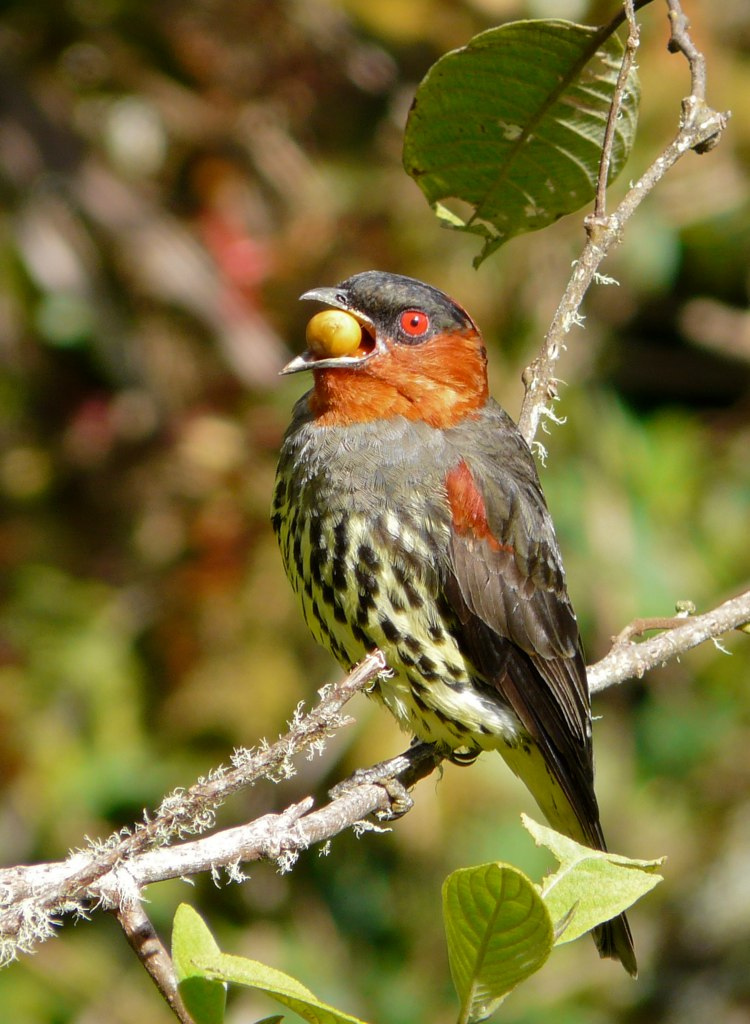
Gray-collared Becard
Pachyramphus major
Order: Passeriformes / Family: Cotingidae

Wikimedia Commons
About the Gray-collared Becard
The Gray-collared Becard (Pachyramphus major) is a notable member of the Cotingidae family, predominantly found in the subtropical and tropical forests of Mexico and Central America. This species plays a crucial role in the ecosystem as both predator and prey within its habitat. It inhabits regions ranging from southern Mexico through Honduras, often dwelling in areas of dense vegetation where it can forage and nest with relative safety. The ecological significance of the Gray-collared Becard extends beyond its immediate environment, as it contributes to the control of insect populations, thus aiding in the maintenance of ecological balance. Seasonal behaviors of the Gray-collared Becard are particularly interesting. During the breeding season, which typically spans from March to July, these birds become more conspicuous due to their vocalizations and active courtship displays. Outside the breeding season, the Gray-collared Becard may be less noticeable, often blending into the foliage due to its muted coloration. Despite this, it remains an important part of the avian community throughout the year, with a stable presence across its range. The Gray-collared Becard's ability to thrive in diverse habitats, from lowland forests to montane regions, underscores its adaptability. However, like many species, it faces threats from habitat destruction and fragmentation caused by agricultural expansion and urbanization. Conservation efforts focus on preserving its natural habitat to ensure the continued survival of this species and the myriad other creatures that share its environment. Understanding the Gray-collared Becard's role in its ecosystem is vital for both conservationists and bird enthusiasts, as this bird symbolizes the intricate connections within forest ecosystems.
The Gray-collared Becard belongs to the family Cotingidae, within the order Passeriformes. These birds typically live average 6 years with a max recorded of 10 years.
How to Identify a Gray-collared Becard
The Gray-collared Becard can be identified by its medium size, with an average length of 18-20 cm. Males and females exhibit slight differences in plumage, with males showcasing a more prominent gray collar and darker upperparts compared to the subdued tones of the females. Both sexes have a distinctive black cap and a white throat, which contrasts with their grayish underparts. Juveniles resemble females but are typically duller and lack the full development of the adult's color patterns. When attempting to identify this species in the field, look for its characteristic flight silhouette, which is compact with a slight curve to the wings. Its perching posture is often upright, allowing for a clear view of its unique collar. The Gray-collared Becard can be confused with similar species such as the Rose-throated Becard, but the latter has a more reddish hue on the throat, aiding in differentiation. This species' muted yet specific coloration makes it easier for experienced birders to spot amidst the lush greenery of its habitat.
Having trouble telling birds apart? Upload a photo to our bird identification tool for an instant species match.
Gray-collared Becard Habitat and Range
Preferred Habitat
The Gray-collared Becard thrives primarily in subtropical and tropical moist lowland forests and montane regions. It is commonly found at elevations ranging from sea level up to 1500 meters. This bird prefers dense, mature forests that provide ample cover and foraging opportunities. Seasonal shifts do occur, with some populations moving to slightly different elevations to exploit varying food resources. While not typically found in urban environments, the Gray-collared Becard may occasionally inhabit rural areas where forest patches remain intact. Conservation of these habitats is crucial for maintaining healthy populations.
Geographic Range
The Gray-collared Becard's range extends from southern Mexico, through Guatemala, El Salvador, and Honduras, reaching as far south as Nicaragua. It primarily occupies regions that offer suitable forested habitats, with a higher population density observed in areas with less human disturbance. While not migratory, the species may exhibit minor altitudinal movements to optimize resource availability throughout the year. These movements, however, do not constitute long-distance migrations typical of other passerine birds. Its range is relatively stable, although ongoing habitat loss poses a concern for future distribution.
Want to know which birds visit your area? Browse our backyard birds by location guides for region-specific species lists.
What Does the Gray-collared Becard Eat?
The diet of the Gray-collared Becard primarily consists of insects and other arthropods, reflecting its role as an insectivore. It employs a technique known as 'gleaning,' where it picks off prey from foliage and branches. During the breeding season, its diet may expand to include more varied prey to meet the nutritional demands of raising young. The bird's feeding schedule is diurnal, with peak activity occurring in the early morning and late afternoon when insect activity is highest. Occasionally, the Gray-collared Becard may consume fruit, which supplements its diet and provides necessary nutrients.
Gray-collared Becard Behavior and Social Structure
The Gray-collared Becard exhibits a range of social behaviors, often found in pairs or small family groups during the breeding season. Males engage in courtship displays that include vocalizations and physical displays to attract mates. Territorial behavior is observed, particularly during nesting, with males defending their chosen areas vigorously. Flocking behavior is less common, but during non-breeding periods, these birds may loosely associate with mixed-species flocks to enhance foraging efficiency. The Gray-collared Becard responds to predators with alarm calls, alerting others to potential threats. Daily activity peaks during cooler parts of the day, aligning with optimal foraging conditions.
Gray-collared Becard Nesting and Reproduction
The nesting habits of the Gray-collared Becard are fascinating, with a preference for building cup-shaped nests in tree branches at varying heights. The nest's composition includes twigs, leaves, and other plant materials, providing a sturdy structure for the eggs. Clutch size typically ranges from two to four eggs, with an incubation period of approximately 15-17 days. Both parents partake in feeding the young, ensuring rapid growth and development. Fledging occurs about 20 days post-hatching, after which the young gradually gain independence. Generally, the Gray-collared Becard raises one to two broods per year, influenced by environmental conditions and food availability.
Gray-collared Becard Sounds and Vocalizations
The Gray-collared Becard's primary song is a series of melodious whistles, often described as sweet and clear, with a rhythmic pattern that carries well through dense foliage. Its call notes include short, sharp whistles used for communication between mates and to maintain contact within family groups. Alarm calls differ in tone, being harsher and more abrupt, signaling the presence of predators. This bird participates in the dawn chorus, contributing its distinct voice to the symphony of forest sounds, particularly during the breeding season.
Interesting Facts About the Gray-collared Becard
- 1The Gray-collared Becard is one of the few becards with a distinct gray collar, making it easier to identify in the field.
- 2This species is adept at catching insects mid-flight, showcasing its agility and precision as a hunter.
- 3The Gray-collared Becard's nests are often built at strategic heights to protect against predators and environmental elements.
- 4During the breeding season, the male's vocalization frequency increases, making them more detectable by birdwatchers.
- 5Despite its relatively small range, the Gray-collared Becard adapts well to varying forest types, from lowland to montane regions.
- 6The Gray-collared Becard's diet occasionally includes small vertebrates, showcasing its opportunistic feeding habits.
- 7Both male and female Gray-collared Becards participate in nest building, reflecting their collaborative approach to parenting.
Gray-collared Becard Conservation Status
The Gray-collared Becard currently holds a status of 'Least Concern' according to the IUCN, with its populations considered stable. However, habitat destruction due to deforestation and agricultural expansion presents ongoing threats. Conservation efforts focus on habitat protection and restoration to ensure long-term viability. While historical population data is limited, current trends suggest that maintaining forested areas will be crucial for the continued survival of this species. Community engagement and sustainable land-use practices are integral components of effective conservation strategies.