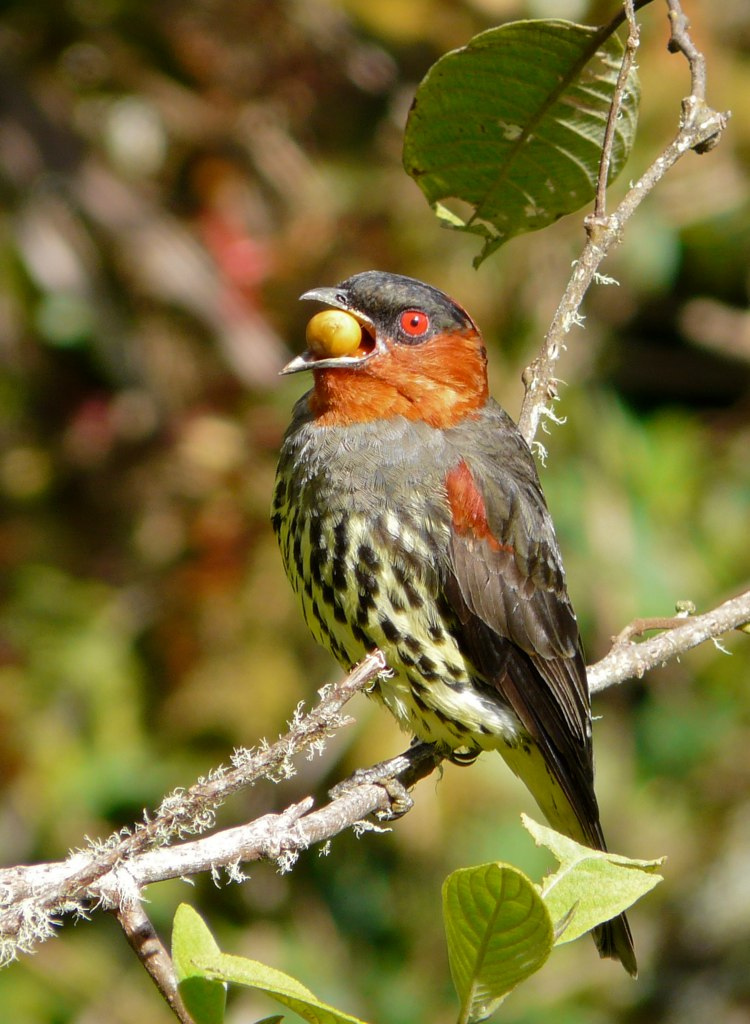
Gray-headed Piprites
Piprites griseiceps
Order: Passeriformes / Family: Cotingidae

Wikimedia Commons
About the Gray-headed Piprites
The Gray-headed Piprites (Piprites griseiceps) is a fascinating species within the Cotingidae family, known for its unique appearance and behavior. This bird inhabits the tropical and subtropical forests of Central and South America, particularly thriving in the dense understory of humid lowland and montane forests. Its presence is noted in countries such as Costa Rica, Panama, Colombia, and Ecuador, where it plays a significant ecological role as both a seed disperser and an insect predator. These birds contribute to the health and diversity of their forest habitats by controlling insect populations and aiding in plant reproduction.
Gray-headed Piprites are typically non-migratory, though some local movements occur in response to food availability and climatic conditions. During the breeding season, which varies by region but generally occurs during the wettest months, these birds are more vocal and visible. Outside of the breeding season, they tend to be more solitary and elusive, blending seamlessly into the lush foliage. Their role within the ecosystem is underscored by their interactions with other species, both predator and prey, and their contribution to the complex food web of the tropical forest.
The significance of the Gray-headed Piprites extends beyond its ecological contributions. This bird serves as an indicator species for the health of its forest environment. Changes in its population numbers or behavior can signal shifts in forest health or the impacts of habitat fragmentation. As such, the presence and well-being of the Gray-headed Piprites are closely monitored by conservationists aiming to preserve the rich biodiversity of the Neotropical forests. Its continued existence is intertwined with the health of its habitat, highlighting the importance of conservation efforts in these regions.
The Gray-headed Piprites belongs to the family Cotingidae, within the order Passeriformes. These birds typically live average 5 years with a maximum recorded of 8 years..
How to Identify a Gray-headed Piprites
The Gray-headed Piprites is easily recognizable by its distinct plumage. Adults feature a gray head, which starkly contrasts with their olive-green back and wings. The underparts are generally paler, often with a slight yellowish wash that becomes more prominent during the breeding season. Juvenile birds resemble adults but may display a slightly duller coloration, with less pronounced gray on the head. Both sexes appear similar in plumage, which can make field identification based on sex challenging without observing behavioral cues during the breeding season.
In flight, the Gray-headed Piprites exhibits a compact silhouette with a relatively short tail and broad wings. Its flight pattern is typically undulating, characterized by a series of rapid wingbeats followed by short glides. When perched, it maintains an upright posture, often flicking its wings or tail, which can help in distinguishing it from similar species. Observers may confuse it with other small, greenish forest birds, but the gray cap and unique vocalizations set it apart.
The Gray-headed Piprites is not often mistaken for other members of its family, as its combination of colors and patterns is quite distinctive. However, birders should be aware of potential confusion with certain flycatchers or vireos that share its habitat, although these species generally lack the characteristic gray head and have different vocalizations.
Having trouble telling birds apart? Upload a photo to our bird identification tool for an instant species match.
Gray-headed Piprites Habitat and Range
Preferred Habitat
Gray-headed Piprites thrives in the dense, humid forests of Central and South America. It prefers lowland tropical forests and montane forests up to elevations of about 1,800 meters. Within these habitats, it favors the mid-levels to lower canopy, where it can forage and nest among dense foliage. The bird is particularly associated with primary forests, although it can be found in well-preserved secondary forests with sufficient canopy cover.
While primarily a forest dweller, the Gray-headed Piprites occasionally ventures into forest edges and clearings, especially when searching for food. Unlike some birds adapted to urban environments, it rarely appears in human-modified landscapes, making its presence a reliable indicator of relatively untouched forest habitats. Seasonal changes in habitat use are minimal, as the bird is largely sedentary, with any movements typically limited to local shifts within its range in response to food availability.
Geographic Range
The Gray-headed Piprites has a moderately broad range across the Neotropical region. It is resident in parts of Central and South America, with a breeding range that includes Costa Rica, Panama, Colombia, and Ecuador. The species is particularly associated with the Andean foothills and nearby lowland forests. While non-migratory, the bird may exhibit some altitudinal movements, especially in response to seasonal food abundance.
Population density is generally highest in areas with intact and diverse forest ecosystems. In Costa Rica, for instance, it is more frequently observed in the rich forests of the Caribbean slope than in fragmented habitats. Similarly, in Colombia, the bird is most commonly found in the western Andean slopes, where forest cover remains relatively dense. Although the Gray-headed Piprites does not engage in long-distance migrations, it may move slightly to exploit local food resources and suitable nesting sites, contributing to its spatial resilience across its range.
Want to know which birds visit your area? Browse our backyard birds by location guides for region-specific species lists.
What Does the Gray-headed Piprites Eat?
The diet of the Gray-headed Piprites primarily consists of insects and other small invertebrates, making it an important insectivore within its ecosystem. It also consumes a significant amount of fruit, particularly during the wet season when fruit availability peaks. The bird forages actively in the mid-story and lower canopy, employing a variety of techniques to capture its prey, including gleaning and occasional sallying flights.
Insects such as beetles, caterpillars, and spiders form the bulk of its diet. The Gray-headed Piprites often searches for food alone or in pairs, although it may join mixed-species flocks to exploit abundant food sources. This behavior not only increases foraging efficiency but also provides safety in numbers against predators. During the dry season, when insects become less abundant, its diet shifts more heavily toward fruits and berries, which provide both sustenance and moisture.
Gray-headed Piprites Behavior and Social Structure
The Gray-headed Piprites exhibits a range of intriguing behaviors that reflect its adaptation to the forest environment. It is generally solitary or found in pairs, especially during the breeding season when territoriality is heightened. Males engage in subtle displays to assert dominance and attract mates, often involving vocalizations and posturing. Territorial disputes are typically resolved through song and visual displays rather than physical confrontations.
Socially, the species shows flexibility by occasionally joining mixed-species foraging flocks. This behavior allows it to benefit from the collective vigilance and foraging success of such groups, although it maintains a degree of independence within the flock. The Gray-headed Piprites is diurnal, with peak activity occurring during the early morning and late afternoon when it forages and defends its territory. At night, it roosts quietly in dense foliage, minimizing the risk of predation.
In response to predators, the Gray-headed Piprites relies on its cryptic coloration and the safety of the forest canopy. It often remains still and silent when threats are detected, using the surrounding foliage as cover. The bird's daily routine includes regular preening and maintenance behaviors to keep its plumage in top condition, essential for both insulation and communication.
Gray-headed Piprites Nesting and Reproduction
The Gray-headed Piprites constructs a cup-shaped nest, typically placed in the fork of a branch within dense foliage. Nests are often located at mid-levels of the forest, between 2 to 6 meters above ground, providing both concealment and protection from ground-based predators. The nest itself is crafted from fine materials such as grass, moss, and small twigs, sometimes lined with softer materials like feathers or plant down.
A typical clutch consists of 2 to 3 eggs, with incubation lasting approximately 16 to 18 days. Both parents participate in feeding and caring for the chicks, ensuring a rapid growth rate and successful fledging. The young leave the nest around 15 to 17 days after hatching, at which point they are still dependent on the parents for food and protection. The Gray-headed Piprites may raise one or two broods per year, depending on food availability and environmental conditions.
Parental roles are relatively equal, with both male and female involved in nest building, incubation, and feeding of the young. This cooperative breeding strategy enhances the survival rates of offspring and allows the species to maintain its population in the dynamic forest environment.
Gray-headed Piprites Sounds and Vocalizations
The vocalizations of the Gray-headed Piprites are distinctive, characterized by a series of melodious whistles and trills. The primary song consists of a clear, rising whistle followed by a series of descending notes, often described as musical and flute-like in quality. These songs are most frequently heard during the early morning hours, especially in the breeding season, when males use them to establish territories and attract mates.
In addition to its song, the Gray-headed Piprites produces a variety of call notes, including a sharp 'chip' used in communication between mates or to signal alarm. When threatened, it may emit a rapid series of short, harsh notes that serve as an alarm call to alert nearby conspecifics. The dawn chorus, a time of peak vocal activity, showcases the bird's vocal talents and highlights the acoustic richness of its forest habitat.
Interesting Facts About the Gray-headed Piprites
- 1The Gray-headed Piprites is one of the few species within its family that exhibits a striking gray head, making it a unique and easily identifiable member of the Cotingidae.
- 2Unlike many other tropical birds, the Gray-headed Piprites does not engage in long-distance migrations, choosing instead to remain within its forest home year-round.
- 3This bird's melodic song is a key tool for territory establishment and mate attraction, particularly during the competitive breeding season.
- 4The Gray-headed Piprites often participates in mixed-species foraging flocks, a behavior that enhances its foraging efficiency and predator vigilance.
- 5With a diet that shifts seasonally, the Gray-headed Piprites helps control insect populations during the wet season and contributes to seed dispersal during the dry season.
- 6The choice of nest location by the Gray-headed Piprites, often in dense foliage, provides critical protection against predators and harsh weather conditions.
- 7The bird's ability to thrive in both primary and well-preserved secondary forests highlights its adaptability, though it remains vulnerable to extensive habitat loss.
Gray-headed Piprites Conservation Status
The Gray-headed Piprites is currently classified as 'Least Concern' by the IUCN, though its population is experiencing a slow decline due to habitat loss and degradation. Deforestation for agriculture, logging, and infrastructure development poses the most significant threat to its forest habitats. Conservation efforts focus on preserving large tracts of contiguous forest and restoring degraded areas to ensure viable habitats for the species. Historically, the population has experienced fluctuations in response to changes in forest cover and climate conditions. Protection of national parks and reserves in parts of its range has provided some sanctuary for the species and contributed to stabilizing local populations. Ongoing research and monitoring are crucial to understanding the impacts of environmental changes and guiding effective conservation strategies.