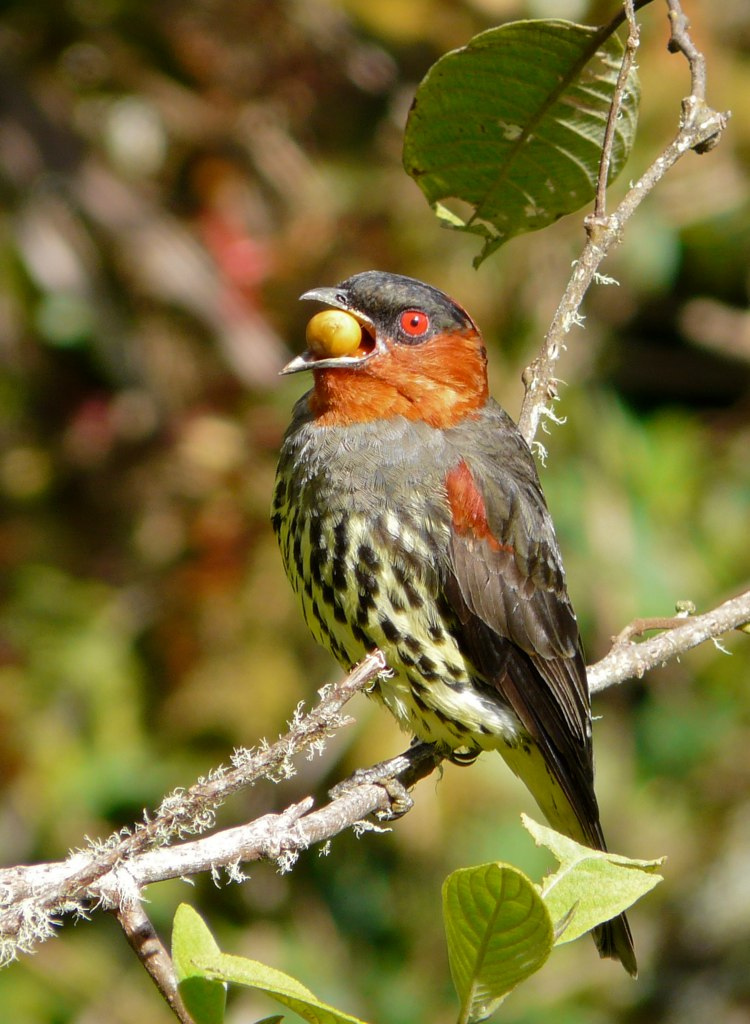
Gray-winged Cotinga
Tijuca condita
Order: Passeriformes / Family: Cotingidae

Wikimedia Commons
About the Gray-winged Cotinga
The Gray-winged Cotinga, scientifically known as Tijuca condita, is a fascinating and rare member of the Cotingidae family, endemic to the cloud forests of southeastern Brazil. This elusive bird is primarily found in the Serra dos Órgãos and Serra do Tinguá mountain ranges within the state of Rio de Janeiro. The Gray-winged Cotinga's habitat is characterized by montane cloud forests, which are rich in biodiversity and offer a unique ecosystem where these birds thrive.
The significance of the Gray-winged Cotinga extends beyond its rarity. As an inhabitant of the cloud forests, it plays a crucial role in the ecosystem by contributing to seed dispersal, particularly for the fruiting trees and shrubs it frequents. The bird's presence indicates a healthy forest environment, as it relies on a well-preserved habitat for survival. Conservation efforts are vital for this species, as its limited range and specific habitat requirements make it vulnerable to habitat loss and climate change.
During the breeding season, which typically occurs from October to February, the Gray-winged Cotinga can be seen engaging in courtship displays among the dense foliage. The males are known to perform aerial displays to attract females, an essential behavior for maintaining their population. Outside the breeding season, these birds are less conspicuous, often remaining hidden within the forest canopy, making them a challenge to observe. Their elusive nature and the dense forest habitat make them a sought-after sighting for birdwatchers visiting the region.
The Gray-winged Cotinga's ecological role in its montane cloud forest habitat cannot be understated. By participating in seed dispersal, it aids in maintaining the forest's plant diversity, which in turn supports a wide array of other wildlife. Its presence in these forests is an indicator of the health of the ecosystem, emphasizing the importance of preserving these unique environments. As conservation efforts continue to focus on protecting cloud forests, the survival of the Gray-winged Cotinga remains a priority for ornithologists and conservationists alike.
The Gray-winged Cotinga belongs to the family Cotingidae, within the order Passeriformes. These birds typically live typically 5-8 years, with some living up to 10 years..
How to Identify a Gray-winged Cotinga
Identifying the Gray-winged Cotinga requires a keen eye, as its plumage is designed to blend seamlessly into the forest canopy. The adult Gray-winged Cotinga exhibits a predominantly dark gray plumage, with the most distinctive feature being its paler gray wings, which provide a stark contrast to the rest of its body. This coloration is particularly useful for distinguishing it from other forest birds. The bird measures approximately 24 centimeters in length, making it a medium-sized member of the Cotingidae family.
Juvenile Gray-winged Cotingas are similar in appearance to adults but can sometimes display slightly less distinct wing coloration. Both males and females share similar plumage, though males may appear slightly more vibrant during the breeding season due to subtle changes in feather glossiness. This subtle sexual dimorphism makes it challenging to differentiate between the sexes based solely on appearance.
The Gray-winged Cotinga can occasionally be confused with other members of the Cotingidae family, such as the Black-and-gold Cotinga, due to overlapping ranges. However, the Gray-winged Cotinga's unique wing pattern and overall darker plumage offer clear differentiating features. In flight, this bird exhibits a strong, direct silhouette with broad wings, often seen gliding between the dense canopy levels. Perched, it maintains an upright posture, blending with the shadowy understory.
Having trouble telling birds apart? Upload a photo to our bird identification tool for an instant species match.
Gray-winged Cotinga Habitat and Range
Preferred Habitat
The Gray-winged Cotinga is strictly associated with montane cloud forests, predominantly found within the Serra dos Órgãos and Serra do Tinguá mountain ranges in Rio de Janeiro, Brazil. These forests are characterized by high humidity, frequent mist, and a rich diversity of plant life, providing an ideal environment for the species' fruit-based diet. The bird thrives at elevations ranging from 1,000 to 2,000 meters, where it finds ample food sources and suitable nesting sites.
Throughout the year, the Gray-winged Cotinga remains within these cloud forests, with no significant seasonal habitat shifts. Its presence is mostly restricted to undisturbed primary forests, where the complex structure of the canopy and understory supports its elusive lifestyle. Unlike some other members of the Cotingidae family, the Gray-winged Cotinga shows no tendency to inhabit urban areas, remaining a true forest dweller.
Given the specificity of its habitat requirements, conservation of these cloud forests is crucial for the survival of the Gray-winged Cotinga. Habitat destruction due to logging, agriculture, and urban expansion poses significant threats to these delicate ecosystems, underscoring the need for targeted conservation efforts to protect this species and its unique environment.
Geographic Range
The range of the Gray-winged Cotinga is highly restricted, as it is endemic to the montane cloud forests of southeastern Brazil. More specifically, this bird is found only in the Serra dos Órgãos and Serra do Tinguá mountain ranges within the state of Rio de Janeiro. These areas represent the entirety of the Gray-winged Cotinga's known habitat, making it a species of particular conservation concern due to its limited geographic distribution.
The Gray-winged Cotinga does not migrate, instead residing year-round within its restricted range. Its home range is primarily centered around altitudes of 1,000 to 2,000 meters, where the unique cloud forest ecosystem supports its dietary and breeding needs. The lack of migration and small geographical range emphasize the species' reliance on local environmental conditions.
Within its narrow range, population density hotspots are found in areas where forest conditions are most pristine. These hotspots often correspond with regions where conservation efforts have been most successful in preserving the native cloud forest habitat. As such, the bird serves as a flagship species for conservation initiatives aimed at protecting the biodiversity of southeastern Brazil's montane forests.
Want to know which birds visit your area? Browse our backyard birds by location guides for region-specific species lists.
What Does the Gray-winged Cotinga Eat?
The diet of the Gray-winged Cotinga consists primarily of fruits, which it forages from the mid to upper canopy levels of its cloud forest habitat. The bird's feeding habits play a vital role in seed dispersal, contributing to the regeneration and diversity of the forest ecosystem. It favors a variety of fruiting trees and shrubs, such as those from the Lauraceae and Myrtaceae families, which are abundant in its montane environment.
While fruit forms the bulk of its diet, the Gray-winged Cotinga occasionally supplements its intake with small insects and arthropods, particularly during the breeding season when additional protein is beneficial. This dietary shift ensures that the bird meets its nutritional needs when energy demands are heightened. The bird employs a methodical foraging technique, often seen hopping and flitting through the foliage as it searches for ripe fruits and hidden insects.
Feeding activities typically occur during the cooler hours of the morning and late afternoon when the bird is most active. At these times, it can often be heard rustling through the leaves as it feeds, although it remains well-camouflaged against the dense forest backdrop. The Gray-winged Cotinga's reliance on fruiting plants underscores its role as a keystone species in its ecosystem, directly influencing plant community dynamics through its feeding behavior.
Gray-winged Cotinga Behavior and Social Structure
The Gray-winged Cotinga displays a variety of intriguing behaviors, particularly during the breeding season, which occurs from October to February. During this time, males engage in elaborate courtship displays to attract females. These displays often involve a combination of vocalizations and aerial maneuvers, showcasing the male's agility and stamina. Such displays are crucial in pair formation and play a vital role in the reproductive success of the species.
Socially, the Gray-winged Cotinga tends to be solitary or found in pairs, especially outside the breeding season. It maintains a well-defined territory, which it defends against intruders, primarily through vocalizations and visual displays. These territories are rich in food resources and suitable nesting sites, ensuring the bird's survival and reproductive success.
In response to predators, the Gray-winged Cotinga relies heavily on its cryptic plumage to blend into the forest environment. When threatened, it remains motionless, relying on camouflage as its primary defense mechanism. Its daily activity pattern revolves around foraging during the cooler parts of the day and resting during the midday heat, a behavior common among many cloud forest inhabitants.
Gray-winged Cotinga Nesting and Reproduction
The Gray-winged Cotinga constructs its nest high in the canopy of cloud forests, utilizing a variety of materials such as moss, lichen, and small twigs. These nests are typically well-hidden among the dense foliage, providing protection from both predators and the elements. The choice of nesting sites is crucial for the survival of the offspring, as it minimizes the risk of predation and exposure.
A typical clutch consists of two to three eggs, which the female incubates for approximately 18 to 20 days. During this period, the male plays a supportive role, providing food for the female and helping to defend the territory. Once the eggs hatch, both parents are involved in feeding the chicks, which fledge about 21 to 25 days after hatching.
The nesting cycle of the Gray-winged Cotinga is tightly aligned with the fruiting patterns of its habitat, ensuring that ample food resources are available for the growing chicks. The species typically raises one brood per year, although favorable conditions might lead to occasional attempts at a second brood. This reproductive strategy reflects the bird's adaptation to its stable, yet resource-limited, montane environment.
Gray-winged Cotinga Sounds and Vocalizations
The Gray-winged Cotinga is known for its distinctive song, which is a melodious series of whistles and trills. The primary song consists of a rhythmic sequence, often described as a clear, rising whistle followed by a series of descending notes. This song serves both as a territorial marker and a courtship display, particularly during the breeding season.
In addition to its primary song, the Gray-winged Cotinga produces a variety of call notes, including short, sharp chirps used for communication between mates and warning of potential predators. Alarm calls are more abrupt and harsh, effectively alerting nearby individuals to danger.
During the dawn chorus, the Gray-winged Cotinga's song is most prominent, echoing through the montane forest as it establishes its presence. The song's quality and rhythm make it a recognizable sound for birdwatchers venturing into its habitat, often providing the first clue to the bird's elusive presence.
Interesting Facts About the Gray-winged Cotinga
- 1The Gray-winged Cotinga was once considered a subspecies of the Black-and-gold Cotinga until genetic studies in 1980 revealed its distinct status.
- 2This bird's entire known population resides within an area smaller than the city of Los Angeles, highlighting its critical conservation status.
- 3The Gray-winged Cotinga's diet of fruit makes it an important seed disperser, influencing the composition of its cloud forest habitat.
- 4Despite its name, the Gray-winged Cotinga's plumage is predominantly dark, with only its wings showing the characteristic gray color.
- 5The bird's primary song, a series of whistles and trills, is often mistaken for the call of a distant songbird rather than a member of the Cotingidae family.
- 6The Gray-winged Cotinga is most active at dawn and dusk, times when it can be heard singing and seen foraging.
- 7This species is more often detected by sound than sight, given its secretive nature and the dense forest environment it inhabits.
Gray-winged Cotinga Conservation Status
The Gray-winged Cotinga is classified as Endangered on the IUCN Red List, primarily due to its extremely limited range and the continuing threat of habitat loss. Deforestation for agriculture, logging, and urban development poses significant risks to the cloud forests of southeastern Brazil, where this species resides. Population trends for the Gray-winged Cotinga indicate a decline, driven by the degradation and fragmentation of its habitat. Conservation efforts focus on protecting and restoring these cloud forest environments. Establishing protected areas and implementing sustainable land-use practices are essential for the long-term survival of this species. Historically, the Gray-winged Cotinga's population has fluctuated in response to habitat quality. Recent conservation initiatives have aimed to stabilize and even increase populations by focusing on habitat preservation and restoration. Continued research and monitoring are necessary to adapt conservation strategies to the changing environmental conditions and threats.