Greater Necklaced Laughingthrush
Ianthocincla pectoralis
Order: Passeriformes / Family: Leiothrichidae

Wikimedia Commons
About the Greater Necklaced Laughingthrush
The Greater Necklaced Laughingthrush (Ianthocincla pectoralis) is a distinctive member of the Leiothrichidae family, known for its vibrant vocalizations and social nature. This species inhabits the subtropical and tropical forests of southern Asia, including countries such as India, Nepal, Bangladesh, Bhutan, and Myanmar. The bird's name derives from its elegant black-and-white necklacing, a key feature that sets it apart from other laughingthrushes. The ecological role of the Greater Necklaced Laughingthrush is significant, as it contributes to seed dispersal and insect control within its habitat. These birds are often observed foraging in mixed-species flocks, which enhances their ability to locate food and evade predators. In terms of seasonal behavior, the Greater Necklaced Laughingthrush demonstrates limited migratory patterns, primarily moving in response to food availability and breeding conditions. During the breeding season, which generally extends from March to August, these birds exhibit increased territoriality and vocalization. This period coincides with the monsoon season in many parts of their range, providing ample food resources. Outside the breeding season, the Greater Necklaced Laughingthrush remains fairly sedentary, with some altitudinal movement observed in regions with varied elevation. Throughout the year, this species showcases its adaptability to different forest types, from dense evergreen forests to open woodland areas. The bird's presence in a range of forest environments underscores its resilience and the importance of preserving these habitats to ensure the species' continued survival.
The Greater Necklaced Laughingthrush belongs to the family Leiothrichidae, within the order Passeriformes. These birds typically live average 7-10 years with max recorded at 15 years.
How to Identify a Greater Necklaced Laughingthrush
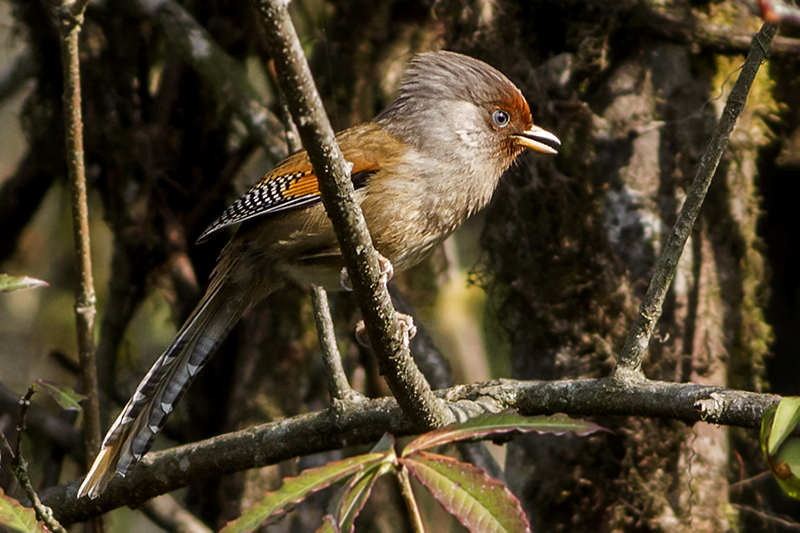
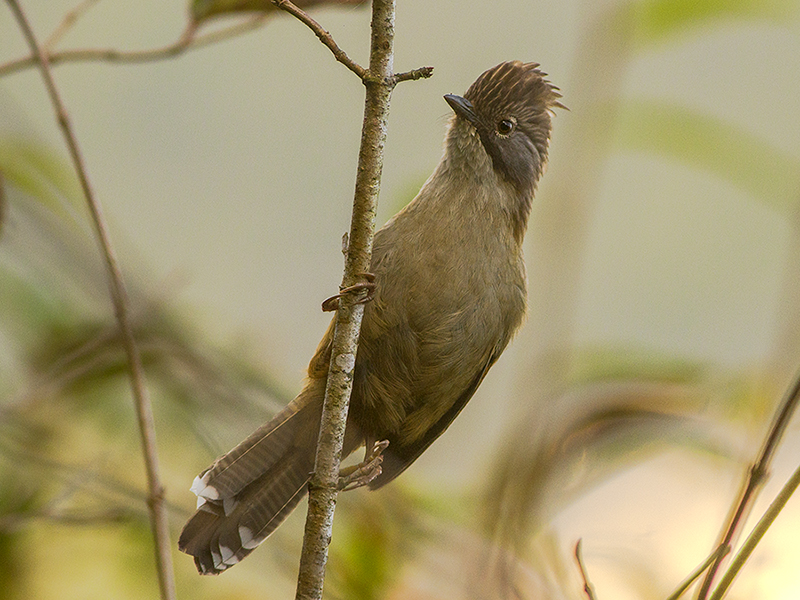
The Greater Necklaced Laughingthrush is a medium-sized bird, measuring approximately 28 to 30 cm in length. Adults display a striking plumage with a chestnut-brown back and wings, contrasted by a white belly and a prominent black-and-white necklace across the chest. The head is marked by a buff face and dark lores, with a pale eye-ring that accentuates the bird's expressive eyes. In terms of sexual dimorphism, males and females appear similar, though males may exhibit slightly brighter plumage during the breeding season. Juveniles resemble adults but have a duller overall coloration and less distinct necklacing. When perched, the Greater Necklaced Laughingthrush holds a slightly upright posture, often active and alert. In flight, its rounded wings and long tail are noticeable, providing a distinctive silhouette. The bird's flight is generally low and undulating, typical of laughingthrushes. It may be confused with the Lesser Necklaced Laughingthrush, but the Greater species is larger and has a more pronounced necklacing. Careful observation of these field marks can aid in accurate identification.
Having trouble telling birds apart? Upload a photo to our bird identification tool for an instant species match.
Greater Necklaced Laughingthrush Habitat and Range
Preferred Habitat
The Greater Necklaced Laughingthrush inhabits a variety of forested areas, favoring dense undergrowth in evergreen and deciduous forests. It thrives at elevations ranging from 200 to 2,000 meters. In India, the bird is often found in the dense forests of the Western Ghats and the Eastern Himalayas. It also occupies secondary forests and sometimes ventures into wooded areas near human settlements. Though primarily a forest bird, it occasionally forages in cultivated lands and gardens, particularly when food is scarce in its natural habitat. Seasonal habitat shifts are minimal, as the bird remains largely sedentary, though it may move to lower elevations during colder months.
Geographic Range
The Greater Necklaced Laughingthrush has a broad range across southern Asia. It breeds in the foothills of the Himalayas, stretching from Nepal and Bhutan through northeastern India to Myanmar. In India, populations are concentrated in the states of Assam, Arunachal Pradesh, and Meghalaya. Although not a long-distance migrant, the bird exhibits some local movement in response to environmental conditions, such as changes in food availability. This species is relatively common within its range, with higher population densities in areas with undisturbed forest cover.
Want to know which birds visit your area? Browse our backyard birds by location guides for region-specific species lists.
What Does the Greater Necklaced Laughingthrush Eat?
The diet of the Greater Necklaced Laughingthrush is diverse, consisting primarily of insects, berries, and seeds. Seasonal variations influence its diet, with an increased reliance on insects and other invertebrates during the breeding season to provide protein-rich food for chicks. The bird forages in the understory and on the forest floor, often hopping and probing leaf litter for hidden prey. Its foraging technique is methodical, characterized by short, jerky movements and a keen sense of observation. Prey size ranges from small insects to larger arthropods, which the bird captures with precision. Feeding occurs throughout the day, with peaks in activity during early morning and late afternoon.
Greater Necklaced Laughingthrush Behavior and Social Structure
The Greater Necklaced Laughingthrush is inherently social, often seen in small flocks of up to 12 individuals. These birds exhibit strong territorial behavior, particularly during the breeding season, when pairs defend their nesting area aggressively. Courtship displays involve mutual preening and synchronized movements, strengthening pair bonds. The species engages in cooperative breeding, with non-breeding individuals assisting in raising chicks. When faced with predators, the birds exhibit alarm calls and mobbing behavior, often driving away threats through persistent harassment. Daily activity patterns include periods of intense foraging interspersed with rest and social interaction, reflecting their complex social structure.
Greater Necklaced Laughingthrush Nesting and Reproduction
Nesting habits of the Greater Necklaced Laughingthrush involve constructing cup-shaped nests from twigs, leaves, and grass. These nests are typically placed in dense shrubs or low trees, offering protection and concealment from predators. Clutch size ranges from two to four eggs, with an incubation period of about two weeks. Both parents share incubation duties and feeding responsibilities once the chicks hatch. The fledging timeline is approximately 14 to 16 days post-hatching, after which the young remain dependent on parental care for several weeks. The species generally raises one to two broods per year, with the possibility of more in favorable conditions.
Greater Necklaced Laughingthrush Sounds and Vocalizations
The Greater Necklaced Laughingthrush is known for its loud, melodious song, which consists of a series of fluty whistles and chattering notes. These vocalizations are often delivered in rapid succession, creating a lively and cheerful soundscape within its habitat. Call notes include distinctive 'chuk-chuk' sounds, which serve as communication between flock members. The bird's alarm calls are sharp and piercing, effectively alerting conspecifics to potential threats. During the dawn chorus, the Greater Necklaced Laughingthrush contributes prominently, its song resonating through the forest and marking its territory.
Interesting Facts About the Greater Necklaced Laughingthrush
- 1The Greater Necklaced Laughingthrush's vocal range is so extensive that it can mimic the calls of other bird species.
- 2Despite its name, the Greater Necklaced Laughingthrush is not a true thrush, but rather a member of the Leiothrichidae family.
- 3During the breeding season, these birds often form cooperative breeding groups, a trait not common among all bird species.
- 4The bird's necklace-like markings vary slightly between individuals, making it possible to identify specific birds by their unique patterns.
- 5Greater Necklaced Laughingthrushes are known to participate in mixed-species foraging flocks, benefiting from the vigilance and foraging success of other bird species.
- 6These birds are highly adaptable, sometimes venturing into urban gardens and parks in search of food.
- 7Their melodious song is a staple of the morning chorus in many Asian forests, adding to the rich soundscape of their habitats.
Greater Necklaced Laughingthrush Conservation Status
The IUCN currently lists the Greater Necklaced Laughingthrush as a species of Least Concern, with population trends considered stable. However, habitat loss due to deforestation poses a significant threat to its long-term survival. Conservation efforts focus on preserving essential forest habitats and promoting sustainable land-use practices. Historically, the species has maintained a stable population thanks to its adaptability, but continued vigilance is necessary to ensure that these birds remain a vibrant part of their ecosystem.