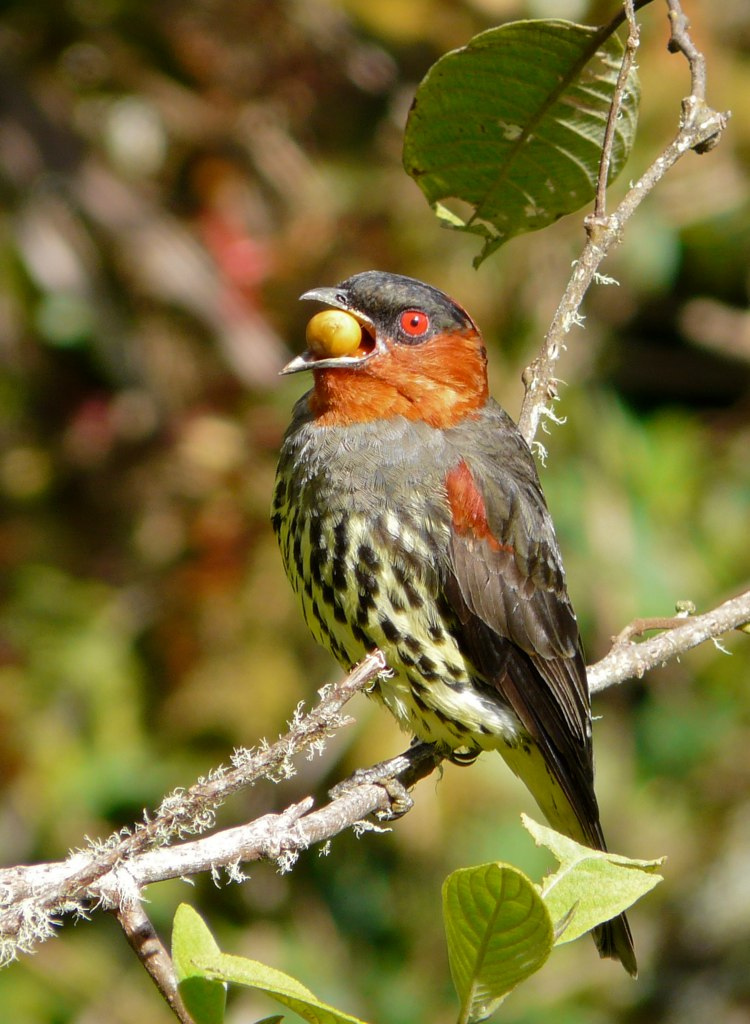
Green-and-black Fruiteater
Pipreola riefferii
Order: Passeriformes / Family: Cotingidae

Wikimedia Commons
About the Green-and-black Fruiteater
The Green-and-black Fruiteater, scientifically known as Pipreola riefferii, is a captivating member of the Cotingidae family, found primarily in the humid montane forests of the Andes. This species plays a vital role in its ecosystem by aiding in seed dispersal, which is crucial for maintaining the diversity of plant life in these biodiverse regions. Its presence is most prominent across countries such as Colombia, Ecuador, Peru, and Venezuela. The bird thrives at elevations ranging from 1,500 to 3,000 meters, where the lush canopy of the cloud forests provides ample food sources and nesting sites. These fruiteaters are particularly significant in the context of tropical montane ecosystems, habitats that are often susceptible to climate change. During the breeding season, which usually occurs from February to May, the Green-and-black Fruiteater becomes particularly vocal, a behavior that helps in territory establishment and mate attraction. Outside of the breeding season, these birds may move slightly to lower elevations, following the availability of fruiting trees. Their ecological role extends beyond mere seed dispersal; by participating in the food web, they also support the predator species that rely on them as prey. Observations of these birds contribute to a broader understanding of the health of montane ecosystems, making their study a significant aspect of ornithology in the Neotropics.
The Green-and-black Fruiteater belongs to the family Cotingidae, within the order Passeriformes. These birds typically live typically up to 10 years, with some individuals reaching 12 years in the wild.
How to Identify a Green-and-black Fruiteater
The Green-and-black Fruiteater exhibits a striking appearance, with males and females showcasing subtle differences. Males flaunt a vivid green plumage with a distinctive black head and upper breast, while their belly is a rich yellow-green. Females, on the other hand, present a more subdued palette, featuring olive-green tones with less pronounced black markings. Juveniles resemble females but often appear duller and may lack the crispness of adult plumage. In terms of size, these medium-sized birds typically measure around 18 cm in length. When perched, the Green-and-black Fruiteater maintains an upright posture, which is characteristic of many fruiteaters. Its flight is direct yet somewhat sluggish, often involving short bursts interspersed with gliding. Identifying this species in the field can be challenging due to its similarity to other fruiteaters, such as the Black-chested Fruiteater. However, the Green-and-black stands out due to its distinctive black head in males and its more vibrant green in both sexes. Birders should note its rounded wings and relatively short tail when observing its silhouette in flight.
Having trouble telling birds apart? Upload a photo to our bird identification tool for an instant species match.
Green-and-black Fruiteater Habitat and Range
Preferred Habitat
The Green-and-black Fruiteater inhabits the lush montane forests of the Andes, a habitat characterized by dense vegetation and high humidity. These forests are often cloaked in mist, creating a unique cloud forest environment. The bird thrives at elevations between 1,500 and 3,000 meters, where it finds the dense canopy and abundant fruiting trees that are critical to its survival. This fruiteater shows a preference for primary forests but can also be found in well-preserved secondary growth. During the non-breeding season, it may descend to slightly lower elevations, although it remains predominantly within forested areas. Unlike some other species, the Green-and-black Fruiteater is not commonly found in urban or heavily altered landscapes, preferring the seclusion and resources provided by its native montane forests.
Geographic Range
The Green-and-black Fruiteater's range extends along the Andes mountain range, primarily within western South America. Its presence is recorded in Colombia, Ecuador, Peru, and Venezuela, with each country hosting distinct populations. Within these regions, the bird is a resident species, exhibiting little to no long-distance migration. Instead, it may engage in altitudinal movements, shifting from higher to lower elevations in response to seasonal changes in food availability. Population densities are typically higher in areas with abundant fruiting trees, such as the cloud forests of Ecuador. Despite its relatively restricted range, the Green-and-black Fruiteater remains a common sight within suitable habitats, benefiting from the diverse flora of the Andean montane forests.
Want to know which birds visit your area? Browse our backyard birds by location guides for region-specific species lists.
What Does the Green-and-black Fruiteater Eat?
The diet of the Green-and-black Fruiteater is primarily frugivorous, consisting mainly of various berries and small fruits. These birds forage methodically in the forest canopy, often selecting ripe fruits from trees such as figs and other native species. Seasonal changes in fruit availability can lead to slight dietary shifts, with the fruiteater occasionally supplementing its diet with insects and small invertebrates during leaner periods. Its foraging technique involves short flights and perching, where it frequently inspects the foliage for food. Unlike some other birds, the Green-and-black Fruiteater does not often feed on the ground, preferring the safety and abundance of the treetops. Its feeding schedule remains consistent throughout the day, with peak activity observed in the early morning and late afternoon.
Green-and-black Fruiteater Behavior and Social Structure
The Green-and-black Fruiteater typically exhibits a solitary or pair-based social structure, particularly during the breeding season. These birds are known for their territorial behavior, with males often engaging in vocal displays to assert dominance and attract mates. Courtship displays may include a combination of calls and physical displays, such as wing fluttering and posturing. Outside the breeding season, these fruiteaters can be observed in small mixed-species flocks, which provide increased vigilance against predators. While generally quiet, they emit soft calls to maintain contact with their mate or group. In response to predators, the Green-and-black Fruiteater relies on camouflage and remaining motionless rather than aggressive defense tactics. Their daily activity pattern involves foraging during the cooler parts of the day and resting during midday heat, a strategy that maximizes energy efficiency.
Green-and-black Fruiteater Nesting and Reproduction
The Green-and-black Fruiteater constructs its nest in the dense foliage of the Andean montane forests, typically choosing sites that offer concealment from predators. Nests are cup-shaped and crafted from twigs, moss, and leaves, often situated on a horizontal branch or a fork in a tree. The typical clutch consists of two eggs, which are incubated by both parents over a period of approximately 20 days. During the incubation period, adults take shifts, ensuring the eggs are never left unattended. After hatching, both parents participate in feeding the chicks, delivering a diet rich in small fruits and occasionally insects. The fledging period lasts about 25 days, during which the young fruiteaters gradually gain independence. The Green-and-black Fruiteater typically raises one brood per year, although favorable conditions may occasionally permit a second.
Green-and-black Fruiteater Sounds and Vocalizations
The primary song of the Green-and-black Fruiteater is a series of soft, melodious whistles, often described as a rising and falling 'whee-oo' pattern. This song, though not as loud as those of some other birds, carries well through the dense forest, aiding in mate attraction and territorial defense. In addition to its song, the fruiteater emits a variety of call notes, including short, sharp 'chip' sounds used for communication between mates or within small flocks. Alarm calls are less frequent but consist of rapid, higher-pitched notes that alert others to potential danger. During the dawn chorus, the Green-and-black Fruiteater's song blends harmoniously with the calls of other forest inhabitants, contributing to the rich acoustic tapestry of the Andean montane forests.
Interesting Facts About the Green-and-black Fruiteater
- 1The Green-and-black Fruiteater's striking plumage helps it blend into the lush forest canopy, providing excellent camouflage from predators.
- 2Despite its vibrant appearance, the Green-and-black Fruiteater's song is surprisingly soft, making it a challenge to locate by sound alone.
- 3This species plays a vital role in seed dispersal, as it consumes a wide variety of fruits and passes seeds through its digestive system.
- 4The Green-and-black Fruiteater is a member of the Cotingidae family, which includes some of the most colorful and diverse tropical birds.
- 5In addition to fruits, the Green-and-black Fruiteater occasionally eats small insects, especially during times of fruit scarcity.
- 6While primarily solitary, the Green-and-black Fruiteater may join mixed-species flocks outside the breeding season for better protection.
- 7The bird thrives in the Andean cloud forests, a unique ecosystem known for its rich biodiversity and frequent mist.
Green-and-black Fruiteater Conservation Status
Currently, the International Union for Conservation of Nature (IUCN) lists the Green-and-black Fruiteater as a species of Least Concern, indicating a stable population trend. Despite this designation, the bird faces threats from habitat loss due to deforestation and agricultural expansion in the Andean region. Conservation efforts focus on preserving the montane forest habitats that are essential for the fruiteater's survival. Initiatives include the establishment of protected areas and sustainable forestry practices. Historical data suggest that while the overall population remains stable, localized declines may occur where habitat degradation is most severe. Continued monitoring and habitat conservation are crucial in ensuring the long-term viability of this vibrant forest species.