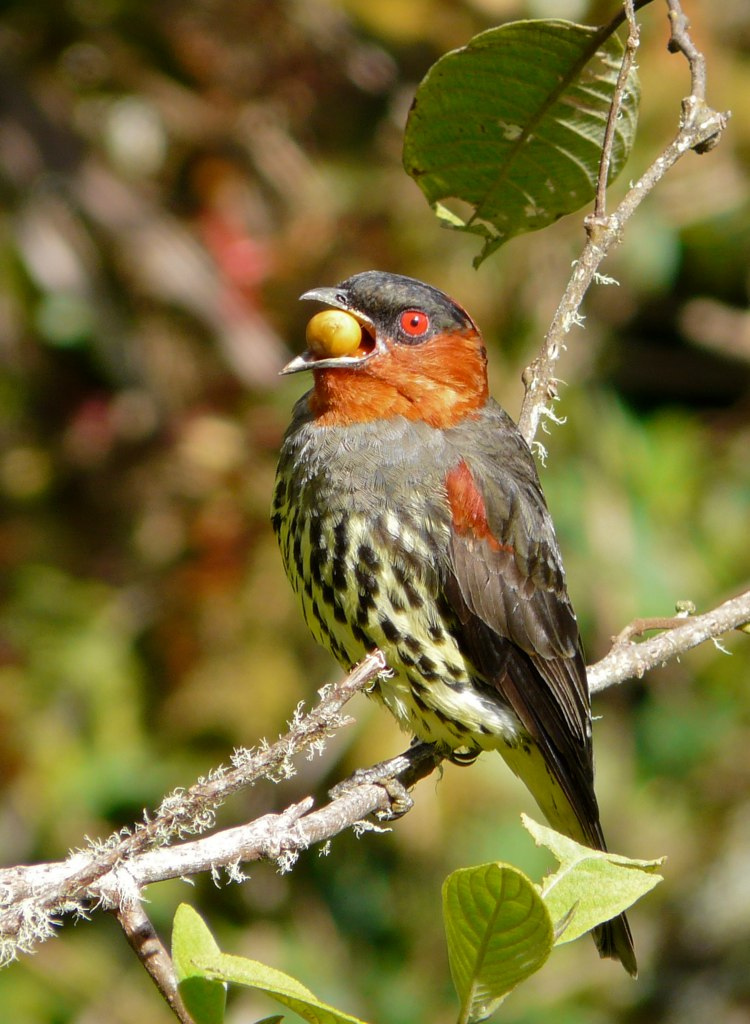
Green-cheeked Becard
Pachyramphus griseigularis
Order: Passeriformes / Family: Cotingidae

Wikimedia Commons
About the Green-cheeked Becard
The Green-cheeked Becard (Pachyramphus griseigularis) is a fascinating bird that belongs to the Cotingidae family. This species primarily resides in the montane forests of South America, where it plays a crucial role in the ecosystem as both a predator and prey. Its presence is most commonly observed in the Andean regions of Colombia, Ecuador, and Peru. The Green-cheeked Becard is a mid-sized bird, usually measuring between 15 to 17 centimeters in length. It is characterized by its subtle yet striking plumage that blends seamlessly with the forest canopy. The bird's ecological significance lies in its role as a seed disperser, thanks to its fruit-based diet. By consuming various fruits, the becard facilitates the growth of native plant species, which in turn supports a diverse array of fauna. In addition to fruits, the Green-cheeked Becard also consumes insects, providing pest control within its habitat. Seasonal behaviors of the Green-cheeked Becard are noteworthy, particularly during the breeding season when males engage in elaborate courtship displays to attract mates. These displays often involve a mix of vocalizations and physical maneuvers, which serve to establish territory and demonstrate fitness. The bird remains largely sedentary in its preferred habitat, with some slight altitudinal movements in response to food availability. The Green-cheeked Becard's ability to adapt to various microhabitats within the forest makes it a resilient species, although habitat destruction poses a significant threat. The role of the Green-cheeked Becard in its ecosystem extends beyond its dietary habits. During the breeding season, the bird constructs intricate nests that provide shelter and safety for its offspring. These nests, often built in the forks of trees, are crafted from an assortment of plant materials and exemplify the bird's resourcefulness. The Green-cheeked Becard's nesting behavior not only ensures the survival of its young but also contributes to the structural complexity of the forest environment. Observations of this bird reveal a creature that is both an integral component of its ecosystem and a subject of aesthetic appreciation. With its muted colors and secretive nature, the Green-cheeked Becard invites both seasoned ornithologists and amateur birdwatchers to explore the dynamic world of subtropical forests.
The Green-cheeked Becard belongs to the family Cotingidae, within the order Passeriformes. These birds typically live average 5 years with a max recorded of 9 years.
How to Identify a Green-cheeked Becard
Identifying the Green-cheeked Becard requires observing several key features. Adults generally display a soft olive-green color on their upperparts, which blends into a lighter, grayish hue on the throat and breast. This gray throat is a distinguishing feature that helps separate it from similar species. The underparts are typically whitish with a slight yellow tinge, making its subtle yet elegant appearance stand out to the trained eye. Male and female Green-cheeked Becards exhibit sexual dimorphism, with males often showing slightly brighter coloration than females. Juveniles resemble adults but tend to have duller plumage overall. It is crucial to note the bird's compact size, as it measures about 15 to 17 centimeters in length, making it a medium-sized bird. In flight, the Green-cheeked Becard often appears stocky with a short, rounded tail and broad wings. Its flight silhouette is distinctive due to these proportions, and its flight style is typically undulating. When perched, this becard tends to maintain an upright posture, often seen scanning its surroundings for insects or small fruits. In terms of confusion with similar species, the Green-cheeked Becard may be mistaken for other becards within its range. However, its gray throat and combination of olive-green and whitish-yellow plumage help differentiate it. The bird's quiet demeanor and preference for staying within the leafy canopy add to the challenge of spotting it, making patience a necessary virtue for birders attempting to observe and identify this elusive species.
Having trouble telling birds apart? Upload a photo to our bird identification tool for an instant species match.
Green-cheeked Becard Habitat and Range
Preferred Habitat
The Green-cheeked Becard inhabits subtropical and tropical montane forests, where it prefers elevations ranging from 1,000 to 2,500 meters. These forests, characterized by dense foliage and a rich understory, provide the ideal environment for the bird to forage and nest. Particularly, it thrives in regions with abundant fruit-bearing trees, as these are crucial to its diet. The bird exhibits some flexibility in habitat choice, occasionally venturing into secondary forests and forest edges, especially when searching for food. Seasonal habitat shifts are minimal, as the Green-cheeked Becard typically remains in its montane forest environment year-round. However, it may engage in altitudinal movements within its range based on the availability of resources. While this species is not commonly found in urban areas, it may occasionally appear in rural settings that have maintained significant forest cover. The presence of the Green-cheeked Becard in these habitats underscores its adaptability and its reliance on forest ecosystems. Its preference for well-vegetated areas with a mix of tree species supports its feeding and nesting behaviors, ensuring the bird has access to the necessary resources for survival and reproduction.
Geographic Range
The Green-cheeked Becard's range is predominantly confined to the Andean regions of South America, specifically in countries such as Colombia, Ecuador, and Peru. Its breeding range aligns closely with these areas, where it occupies the subtropical montane forests year-round. Unlike some other bird species, the Green-cheeked Becard does not engage in long-distance migrations. Instead, it may perform minor altitudinal movements within its established range depending on seasonal food availability. Population density hotspots for the Green-cheeked Becard are most often located in areas where forest cover remains intact and diverse. For instance, the cloud forests along the eastern slopes of the Andes provide an ideal environment, thanks to their rich biodiversity and abundant resources. Although the bird is not considered migratory, its range is somewhat restricted, making conservation of its habitat critical for its continued survival. In terms of population distribution, the Green-cheeked Becard is generally more concentrated in regions where human activity has minimally impacted forest ecosystems. These areas offer the stability and resources necessary for the bird to maintain its population and ecological role.
Want to know which birds visit your area? Browse our backyard birds by location guides for region-specific species lists.
What Does the Green-cheeked Becard Eat?
The Green-cheeked Becard primarily feeds on a diet of fruits and insects, demonstrating a flexible foraging strategy. This dietary diversity allows it to exploit different food sources depending on seasonal availability. Fruits constitute the majority of its diet, with the bird often targeting small to medium-sized berries and drupes found in its forest habitat. By consuming these fruits, the Green-cheeked Becard plays a role in seed dispersal, contributing to forest regeneration. Insects, particularly arthropods such as beetles and caterpillars, make up the secondary component of its diet. The bird employs a sit-and-wait tactic for capturing prey, often perching quietly before making a quick sally to snatch insects from foliage or in mid-air. This opportunistic feeding behavior ensures the Green-cheeked Becard can adjust to fluctuations in food availability. Its feeding schedule is diurnal, with peak foraging activity occurring in the early morning and late afternoon when temperatures are cooler, and insect activity is higher. The bird's adaptability in diet not only supports its survival but also highlights its role in controlling insect populations and sustaining the ecological balance within its habitat.
Green-cheeked Becard Behavior and Social Structure
The Green-cheeked Becard exhibits a range of behaviors that reflect its adaptability and ecological niche. Socially, the bird is generally solitary or found in pairs, particularly during the breeding season. It establishes and defends a territory, where the male performs courtship displays to attract a mate. These displays often involve a combination of vocalizations and visual cues, such as wing flicking and body posturing, to demonstrate fitness and establish pair bonds. Territorial behavior is most pronounced during breeding periods when resources such as food and nesting sites must be protected. The Green-cheeked Becard's response to predators involves a cautious approach, often remaining still and silent to avoid detection. It may also join mixed-species flocks, where the collective vigilance of multiple bird species offers increased protection. Daily activity patterns of the Green-cheeked Becard show a preference for foraging during cooler parts of the day, with periods of rest during midday heat. This diurnal routine supports efficient energy use and aligns with the availability of prey and fruits. The bird's overall behavior reflects its adaptation to a life within dense forest environments, where keen senses and strategic interactions with other species enhance its survival prospects.
Green-cheeked Becard Nesting and Reproduction
Nesting for the Green-cheeked Becard involves constructing a spherical nest using a variety of plant materials. Preferred locations for these nests are in the forks of trees or among dense foliage, where they are well-camouflaged from predators. The nest is typically made from twigs, leaves, and fibers, reflecting the bird's resourceful use of available materials. Clutch size for the Green-cheeked Becard usually ranges from two to three eggs, with both parents sharing responsibilities for incubation and feeding the young. The incubation period lasts approximately two weeks, during which the parents take turns keeping the eggs warm. Once hatched, the fledging period extends for another two to three weeks, during which the chicks are carefully tended by both parents. Parental roles involve feeding the chicks a diet rich in insects and occasionally fruits to ensure proper growth and development. The number of broods per year is typically limited to one, as the bird invests significant time and energy into raising each clutch. This focused approach to nesting supports the survival and health of the offspring, contributing to the stability of the species' population.
Green-cheeked Becard Sounds and Vocalizations
The Green-cheeked Becard produces a variety of vocalizations, with its primary song being a series of soft, whistling notes. These notes often have a rhythmic quality, delivered in a sequence that can be described as both melodic and deliberate. This song serves to establish territory and communicate with mates, particularly during the breeding season. In addition to its song, the bird emits call notes that are shorter and sharper, used in everyday communication and alerting conspecifics to potential threats. Alarm calls are more urgent and higher-pitched, signaling the presence of predators. During the dawn chorus, the Green-cheeked Becard's song contributes to the vibrant tapestry of sounds within its forest habitat. It is comparable in quality to the calls of other becard species, yet distinct in its particular tonal pattern, aiding in the bird's identification by sound.
Interesting Facts About the Green-cheeked Becard
- 1The Green-cheeked Becard often uses silk from spider webs to bind its nest materials together.
- 2This bird is an adept mimic, capable of imitating the calls of other bird species within its range.
- 3Despite its name, the Green-cheeked Becard's cheeks are not distinctly green, reflecting the complexity of avian naming conventions.
- 4It can be found at altitudes up to 2,500 meters, demonstrating adaptability to high-elevation environments.
- 5The Green-cheeked Becard is known to participate in mixed-species flocks, enhancing its foraging success and protection.
- 6Its diet shifts seasonally, with a greater reliance on insects during breeding to provide protein for growing chicks.
- 7The Green-cheeked Becard's song is less prominent than that of many passerines, making its vocalizations a challenge to detect.
Green-cheeked Becard Conservation Status
The Green-cheeked Becard currently holds a status of Least Concern on the IUCN Red List, indicating a stable global population. However, ongoing threats such as habitat destruction and fragmentation, primarily due to agricultural expansion and logging, pose significant risks to its continued stability. Conservation efforts focus on preserving its montane forest habitat, with initiatives aimed at sustainable land-use practices and the establishment of protected areas. Historical population changes have been relatively modest, yet localized declines have occurred where habitat degradation is most severe. Continued monitoring and habitat protection are essential to counteract these threats and ensure the species' long-term viability.