Guianan Cock-of-the-rock
Rupicola rupicola
Order: Passeriformes / Family: Cotingidae
Wikimedia Commons
About the Guianan Cock-of-the-rock
The Guianan Cock-of-the-rock (Rupicola rupicola) stands out as one of South America's most striking bird species. Its vivid orange plumage and unique courtship displays make it a fascinating subject for both ornithologists and birdwatchers. This bird is primarily found in the humid lowland rainforests of the Guiana Shield, which spans parts of Venezuela, Guyana, Suriname, French Guiana, and northern Brazil. These regions offer the dense, humid environments that the Guianan Cock-of-the-rock requires for feeding and breeding. The species plays a critical ecological role as a seed disperser. By consuming a diet rich in fruit, it helps maintain the health of its forest habitat. Seasonal changes in fruit availability influence its foraging behavior and territory size. During the wet season, when fruits are plentiful, these birds can be seen more frequently as they search for mates and establish breeding territories. In contrast, the dry season may prompt them to expand their foraging range in search of food. Their presence often indicates a healthy, biodiverse forest, underscoring their ecological importance. The Guianan Cock-of-the-rock also holds cultural significance in the regions it inhabits. Indigenous tribes and local communities often revere this bird, and it features prominently in folklore and myth. Its striking appearance, coupled with its elusive nature, fuels both admiration and curiosity. Efforts to preserve the rainforests of the Guiana Shield not only protect the Cock-of-the-rock but also safeguard countless other species that share its habitat. Observing the Guianan Cock-of-the-rock in its natural environment offers unparalleled insights into the complex dynamics of tropical ecosystems and highlights the intricate interactions between fauna and flora.
The Guianan Cock-of-the-rock belongs to the family Cotingidae, within the order Passeriformes. These birds typically live typically 5-8 years, with a maximum recorded lifespan of 10 years..
How to Identify a Guianan Cock-of-the-rock
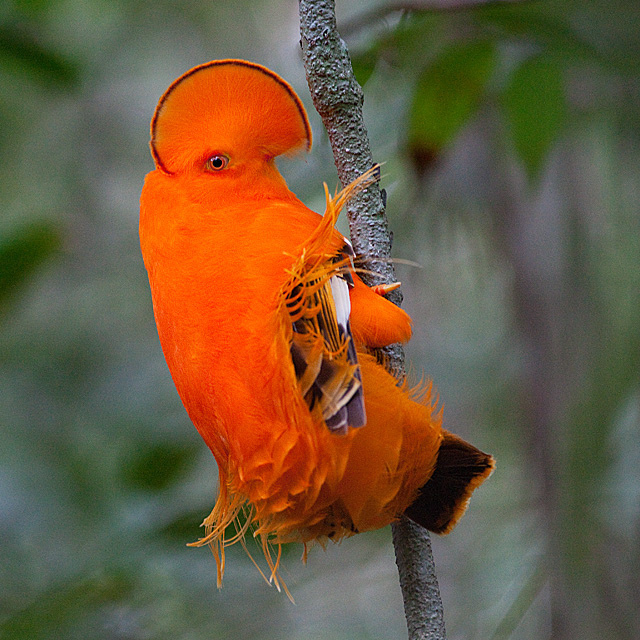
The Guianan Cock-of-the-rock is unmistakable with its brilliant orange plumage, which is most pronounced in adult males. The males are adorned with a half-moon shaped crest that extends over their beak, adding to their distinctive profile. Their wings and tail have black markings that contrast starkly with the bright orange body. Females and juveniles, however, are more subdued in coloration, exhibiting a muted brownish-orange hue that provides them with better camouflage. This sexual dimorphism aids in field identification. Males are particularly easy to spot during their elaborate courtship displays, where they showcase their bright plumage and crest. In flight, the Guianan Cock-of-the-rock presents a robust silhouette, with broad wings and a relatively short tail, allowing for agile maneuvering through dense forest canopies. When perched, they exhibit a characteristic upright posture, often remaining motionless among the foliage. The bird can sometimes be confused with the Andean Cock-of-the-rock, a close relative. However, the Andean species is typically found at higher elevations and possesses a more crimson coloration compared to the Guianan Cock-of-the-rock's orange hue. Observers should note these color distinctions and habitat preferences to correctly identify the Guianan Cock-of-the-rock in the field.
Having trouble telling birds apart? Upload a photo to our bird identification tool for an instant species match.
Guianan Cock-of-the-rock Habitat and Range
Preferred Habitat
The Guianan Cock-of-the-rock inhabits the humid lowland rainforests of the Guiana Shield, thriving in regions with dense canopy cover and abundant fruiting trees. These birds favor areas near rocky outcrops and cliffs, which they use for nesting. They are typically found at elevations ranging from sea level to about 1,200 meters. The presence of large boulders and rocky ledges is crucial for their breeding activities. During the wet season, they remain within the lush, fruit-rich forest interior, but may venture slightly into secondary forests or edge habitats during the dry months when food becomes scarce. Unlike some avian species, the Guianan Cock-of-the-rock is rarely found in urban or heavily disturbed areas, as it relies heavily on the complex structure and resources of intact forest ecosystems. Preservation of these habitats is critical for their survival, as deforestation and habitat fragmentation pose significant threats to their populations.
Geographic Range
The Guianan Cock-of-the-rock's range is largely confined to the Guiana Shield region, encompassing parts of southern Venezuela, Guyana, Suriname, French Guiana, and northern Brazil. It is a resident species, meaning it does not undertake long-distance migrations like some other birds. The bird's distribution is closely tied to the availability of suitable nesting cliffs and abundant fruiting trees. While it occupies a relatively narrow geographical range, within these areas it can be locally common, particularly in undisturbed forest habitats. Population densities are highest in protected areas where deforestation is minimal and food resources are plentiful. These birds do not migrate seasonally, but they may adjust their range slightly within the forest to exploit seasonal changes in fruit availability. Conservation of the rainforests in these regions is critical to maintaining the Guianan Cock-of-the-rock's habitat and supporting its long-term viability.
Want to know which birds visit your area? Browse our backyard birds by location guides for region-specific species lists.
What Does the Guianan Cock-of-the-rock Eat?
The Guianan Cock-of-the-rock primarily feeds on a variety of fruits, making it an important seed disperser within its ecosystem. Its diet includes fruits from trees such as figs, palms, and various berry-producing plants. During the wet season, when fruits are abundant, these birds can consume a significant quantity of fruit daily, often targeting trees with the highest fruit yield. They employ a methodical foraging technique, moving systematically through the canopy in search of ripe offerings. In addition to fruit, they occasionally consume small insects, which provide essential protein, especially during the breeding season. The size of the prey varies, but generally includes small arthropods that can be easily captured and consumed. Feeding activity peaks in the early morning and late afternoon, coinciding with the availability of fresh fruit. This dietary pattern reflects the bird's adaptation to its tropical environment, where fruit availability can fluctuate with seasonal changes.
Guianan Cock-of-the-rock Behavior and Social Structure
The Guianan Cock-of-the-rock is renowned for its extraordinary courtship displays, where males gather in groups known as leks to compete for female attention. During these displays, males exhibit a series of behaviors including head bobbing, wing flapping, and vocalizations, all designed to showcase their vibrant plumage and attract a mate. These leks are typically located near rocky outcrops or cliffs, which provide suitable nesting sites. Outside of the breeding season, the Guianan Cock-of-the-rock tends to be more solitary, although it may form small groups when foraging. These birds are highly territorial, with males often defending their display sites vigorously against intruders. When threatened by predators, they may employ a range of alarm calls to alert other birds in the vicinity. Daily activity patterns reveal a preference for early morning and late afternoon foraging, taking advantage of cooler temperatures and lower predation risk during these times.
Guianan Cock-of-the-rock Nesting and Reproduction
The Guianan Cock-of-the-rock constructs its nests on rocky ledges and outcrops, often under overhanging rocks that provide some protection from the elements. The nests are composed of mud, plant material, and saliva, creating a sturdy structure that adheres to rock surfaces. These locations are chosen for their inaccessibility to potential predators. The female lays a clutch of two eggs, which she alone incubates for approximately 27-28 days. During this period, the male plays no role in incubation or chick rearing. Once hatched, the chicks remain in the nest for several weeks, receiving regurgitated fruit from the female. Fledging occurs around 45 days after hatching, although young birds may stay near the nest site for some time afterward, gradually learning to forage independently. Typically, the species raises one brood per year, although favorable conditions may occasionally allow for a second.
Guianan Cock-of-the-rock Sounds and Vocalizations
The Guianan Cock-of-the-rock's vocal repertoire includes a series of sharp, metallic calls used primarily during courtship. These calls are characterized by a distinct, rhythmic pattern that can be heard echoing through the forest during lekking displays. The primary song consists of a series of rapid 'peep' notes followed by a trilling sequence. In addition to their mating calls, these birds emit short, harsh alarm calls when threatened by predators or disturbances. The dawn chorus is particularly vibrant, as males vie for attention amid the chorus of other forest dwellers. Compared to other birds in its habitat, the Guianan Cock-of-the-rock's vocalizations are less melodious but stand out due to their volume and distinctive pattern.
Interesting Facts About the Guianan Cock-of-the-rock
- 1The Guianan Cock-of-the-rock's vivid orange plumage is due to carotenoid pigments in their diet.
- 2Males spend up to 3 weeks preparing their display sites at leks, clearing leaves and debris.
- 3These birds can eat over 100 different fruit species, showcasing their adaptability in diet.
- 4Despite their striking appearance, females choose mates based on subtle display differences.
- 5The Guianan Cock-of-the-rock's lekking behavior is one of the most elaborate in the bird world.
- 6Their nests, stuck to rocky cliffs, are incredibly resilient to rain and wind.
- 7Young males take up to 3 years to acquire their full adult plumage and crest.
Guianan Cock-of-the-rock Conservation Status
Currently listed as Least Concern by the IUCN, the Guianan Cock-of-the-rock's population remains stable, though it faces pressure from habitat destruction due to deforestation and mining activities in the Guiana Shield. Conservation efforts focus on protecting primary forest habitats and curbing deforestation rates. Establishing and maintaining protected areas within its range is crucial for ensuring the continued survival of this species. Historically, population trends have remained relatively stable, but ongoing environmental threats could impact future viability. Conservationists advocate for increased awareness and sustainable land use practices to mitigate these threats.