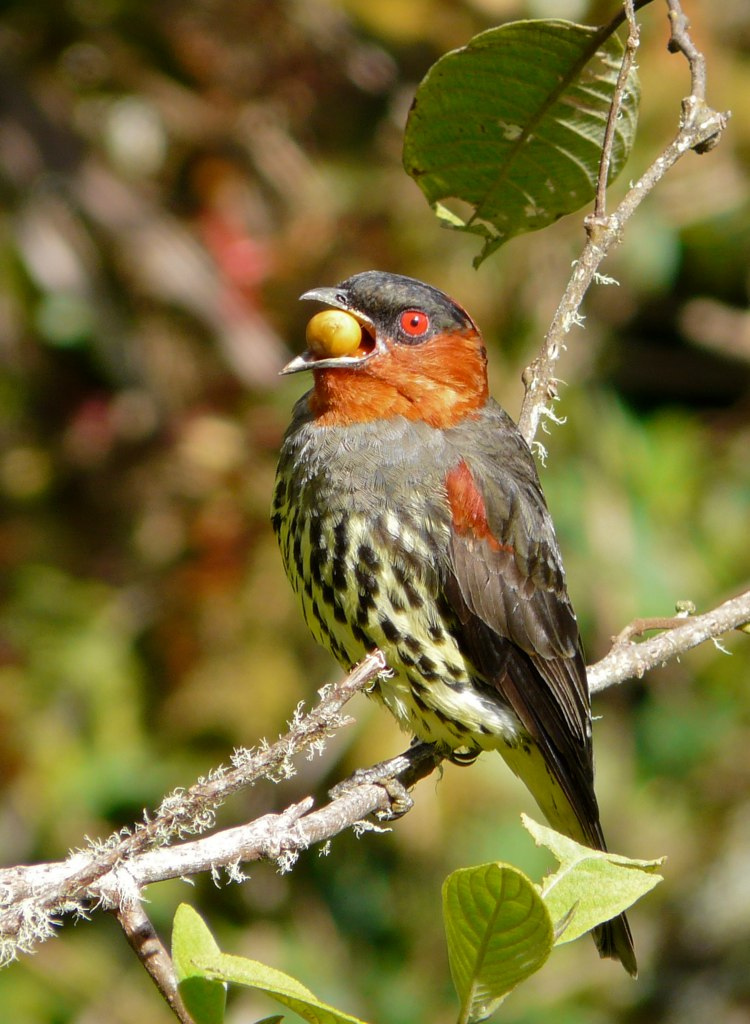
Handsome Fruiteater
Pipreola formosa
Order: Passeriformes / Family: Cotingidae

Wikimedia Commons
About the Handsome Fruiteater
The Handsome Fruiteater, scientifically recognized as Pipreola formosa, belongs to the Cotingidae family and is a captivating sight in the Neotropical forests. This medium-sized bird is distinguished by its vibrant green plumage, which serves as excellent camouflage amidst the verdant canopies it frequents. The bird's striking orange throat patch adds a dash of color, making it one of the most visually appealing members of its genus.
The Handsome Fruiteater inhabits the humid montane forests of the northern Andes, specifically in regions such as the Sierra Nevada de Santa Marta in Colombia and the Mérida Andes in Venezuela. Its presence in these biodiverse areas indicates its role as an integral component of the ecosystem, where it participates in seed dispersal, a crucial ecological function. This bird is primarily frugivorous, feeding extensively on a variety of fruits, which it helps to propagate throughout its habitat.
Seasonal behaviors of the Handsome Fruiteater reflect the dynamic nature of its environment. During the breeding season, which typically spans from February to May, males engage in elaborate displays to attract mates. These displays often involve a combination of vocalizations and posturing, set against the backdrop of dense forest foliage. Outside of the breeding season, the Handsome Fruiteater may be observed moving to slightly lower elevations, following fruiting patterns of its preferred food sources.
The Handsome Fruiteater plays a significant ecological role within its habitat. As a seed disperser, it contributes to the regeneration and maintenance of forest diversity. Its presence also offers insight into the health of the montane ecosystems it inhabits. Conservationists monitor this species as a bioindicator, assessing the impacts of deforestation and climate change on these critical habitats. The Handsome Fruiteater's ecological significance, combined with its striking appearance, makes it a species of both scientific interest and conservation priority.
The Handsome Fruiteater belongs to the family Cotingidae, within the order Passeriformes. These birds typically live average 7-9 years, with a maximum recorded of 12 years..
How to Identify a Handsome Fruiteater
The Handsome Fruiteater can be identified by its vibrant green plumage, which covers most of its body. This coloration is particularly advantageous for blending into the dense foliage of its forest habitat. A distinctive feature of this bird is its bright orange throat, a key field mark that sets it apart from other green birds in its range.
Males and females are generally similar in appearance, though females may exhibit slightly duller tones. Juveniles, however, are distinguishable by their less pronounced orange throats and a more muted overall coloration. Observers may note their less defined features when compared to adults.
In flight, the Handsome Fruiteater displays broad, rounded wings and a relatively short tail, contributing to a compact silhouette. It often perches upright on branches, where its green plumage provides effective camouflage against predators. While similar species such as the Green-and-black Fruiteater share its habitat, the Handsome Fruiteater's unbroken green plumage and orange throat make it easier to distinguish during field observations.
Having trouble telling birds apart? Upload a photo to our bird identification tool for an instant species match.
Handsome Fruiteater Habitat and Range
Preferred Habitat
The Handsome Fruiteater is found predominantly in humid montane forests, specifically within the elevational range of 1500 to 2800 meters. These forests provide the dense canopy and abundant fruiting trees that are essential for its survival. Examples of such habitats include the cloud forests of the Sierra Nevada de Santa Marta in Colombia and the Mérida Andes in Venezuela.
Seasonally, the Handsome Fruiteater might shift habitats slightly, moving to lower elevations in search of fruiting trees, especially outside of the breeding season. Its preference for primary forests means it is less frequently found in heavily disturbed or urbanized areas. While it is primarily a forest dweller, it occasionally visits forest edges, particularly where fruiting trees are plentiful.
Geographic Range
The Handsome Fruiteater is endemic to the northern Andes, with its breeding range confined to specific regions in Colombia and Venezuela. In Colombia, it is found in the Sierra Nevada de Santa Marta and the Eastern Andes. In Venezuela, its range includes the Mérida Andes.
This bird does not undertake long migrations, but it may engage in altitudinal movements, particularly in response to seasonal variations in food availability. As such, its presence in certain locations may fluctuate slightly with changes in local fruiting patterns.
Population density is generally higher in undisturbed forest areas where fruit resources are abundant. While its range is relatively limited, the Handsome Fruiteater occupies a crucial niche within its ecosystem, and its presence is a good indicator of forest health.
Want to know which birds visit your area? Browse our backyard birds by location guides for region-specific species lists.
What Does the Handsome Fruiteater Eat?
The Handsome Fruiteater primarily consumes a diet of fruits, favoring those from trees such as Lauraceae and Melastomataceae. Its frugivorous diet plays a critical role in seed dispersal, as it moves between fruiting trees in its montane forest habitat.
During the dry season, when fruits may be less abundant, the Handsome Fruiteater adapts by expanding its diet to include insects and small invertebrates. This opportunistic feeding behavior ensures its survival during times of resource scarcity.
Foraging typically occurs within the forest canopy, where the bird gleans fruits directly from branches. It employs a combination of visual cues and memory to locate fruiting trees, often returning to known food sources. Feeding generally occurs during the early morning and late afternoon, coinciding with peak activity periods in its forest environment.
Handsome Fruiteater Behavior and Social Structure
The Handsome Fruiteater exhibits a solitary or loosely social behavior, often seen alone or in pairs rather than in large flocks. During the breeding season, males perform courtship displays that include vocalizations and visual displays to attract females.
Territorial behavior is evident as males establish and defend breeding territories through song and display. Outside the breeding season, these territorial boundaries may become less rigid, with birds focusing on foraging rather than defending specific areas.
In response to predators, the Handsome Fruiteater relies on its cryptic coloration and the dense foliage of its habitat for protection. It exhibits a strong preference for remaining in the upper canopy, where it can keep a watchful eye on its surroundings while remaining concealed. Activity peaks during the cooler parts of the day, aligning with the availability of fruit and the activity of potential insect prey.
Handsome Fruiteater Nesting and Reproduction
The Handsome Fruiteater constructs cup-shaped nests from twigs, moss, and leaves, typically situated in the forks of small branches within the forest canopy. These nests are often positioned at heights ranging from 5 to 15 meters, providing safety from ground-dwelling predators.
A typical clutch consists of two eggs, which both parents incubate. The incubation period lasts approximately 18 to 20 days, during which time the parents share duties, including feeding and protecting the young.
After hatching, the chicks remain in the nest for about 20 to 25 days before fledging. Parental care continues post-fledging, with both parents involved in feeding and teaching the young birds how to forage independently. The Handsome Fruiteater generally produces one brood per year, aligning its breeding efforts with peak fruit availability.
Handsome Fruiteater Sounds and Vocalizations
The primary song of the Handsome Fruiteater is a series of melodious whistles, characterized by a clear, rising pitch. These calls serve both territorial and courtship purposes, often heard at dawn or during the early morning hours.
In addition to its song, the Handsome Fruiteater produces a variety of call notes, including soft chattering sounds used for communication between mates or family members. Alarm calls are sharper and more abrupt, alerting nearby conspecifics to potential threats.
The Handsome Fruiteater's vocalizations contribute to the acoustic landscape of its montane forest habitat, often blending with the songs of other forest-dwelling species to create a rich chorus.
Interesting Facts About the Handsome Fruiteater
- 1The Handsome Fruiteater's vivid green and orange plumage provides excellent camouflage among the forests' colorful fruits and foliage.
- 2Despite its vibrant coloring, the Handsome Fruiteater can be surprisingly difficult to spot due to its preference for high forest canopies.
- 3The species plays a vital role in seed dispersal, consuming and later excreting seeds to help regenerate forest habitats.
- 4The Handsome Fruiteater is endemic to the northern Andes, thriving in Colombia and Venezuela's unique cloud forests.
- 5It pairs monogamously, with both parents sharing responsibilities for incubating eggs and feeding the chicks.
- 6The Handsome Fruiteater's song consists of melodious whistles that can travel long distances through dense forest canopies.
- 7Although not a migratory bird, it may move to different elevations in response to seasonal fruit availability.
Handsome Fruiteater Conservation Status
Currently, the Handsome Fruiteater is classified as Least Concern by the IUCN, with a stable population trend. However, its reliance on montane forest habitats makes it vulnerable to deforestation and habitat fragmentation, which are ongoing threats in its range. Conservation efforts focus on protecting and preserving these critical habitats through the establishment of protected areas and sustainable land management practices. Historical population data suggests that while the bird's numbers have remained relatively stable, continued habitat loss could pose future risks. Engagement in conservation initiatives by local communities and international organizations is crucial. Efforts to monitor population trends and habitat conditions help ensure the long-term survival of the Handsome Fruiteater and the biodiversity of the montane forests it inhabits.