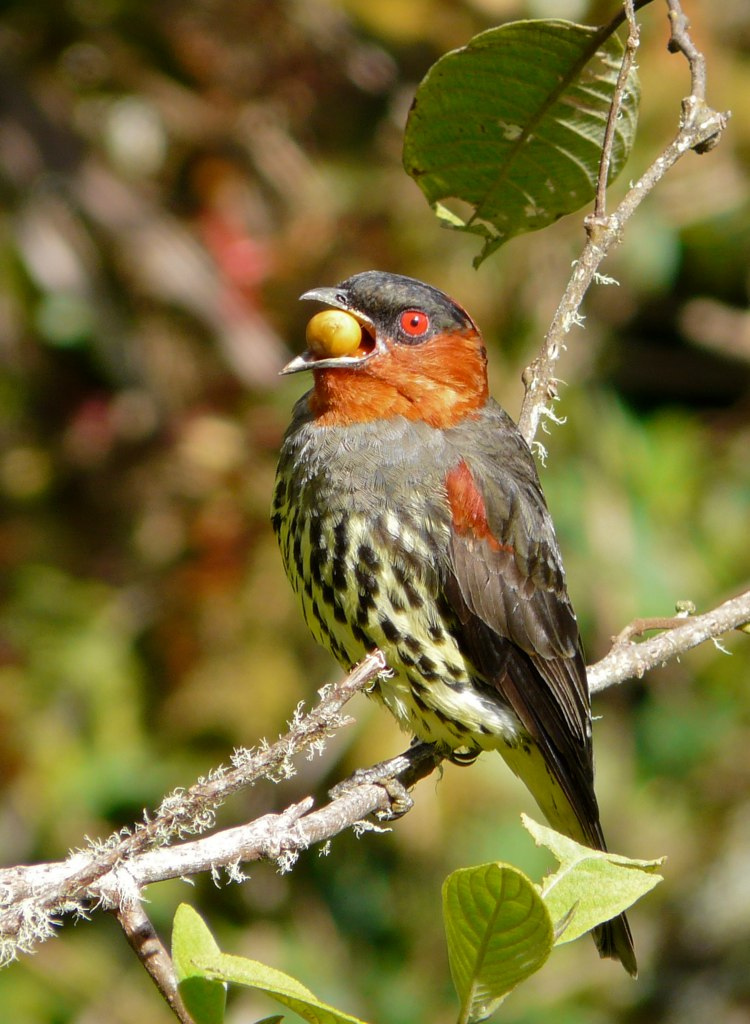
Jamaican Becard
Pachyramphus niger
Order: Passeriformes / Family: Cotingidae

Wikimedia Commons
About the Jamaican Becard
The Jamaican Becard, scientifically named Pachyramphus niger, is a captivating bird native to the island of Jamaica. This species belongs to the family Cotingidae and the order Passeriformes. It is a medium-sized songbird with a distinctive silhouette and striking black plumage that sets it apart from other birds in the region. The Jamaican Becard plays an essential role in the island's ecosystem, primarily inhabiting forested areas and contributing to the intricate web of biodiversity. It often frequents the mid-canopy of forests, where it forages for insects and fruit, aiding in seed dispersal and insect population control. This bird is an integral part of Jamaica's natural heritage, and its presence indicates the health of its forest habitats.
The Jamaican Becard is a non-migratory species, residing year-round on the island. Its ecological significance extends to its role in maintaining the balance of the local ecosystem. By preying on insects, the Jamaican Becard helps control pest populations, which is beneficial for maintaining the health of trees and plants in its habitat. Additionally, as a frugivore, it plays a crucial role in seed dispersal, promoting the regeneration of native plant species.
Found in various regions of Jamaica, the Jamaican Becard typically inhabits lowland and montane forests. It exhibits a preference for areas with dense foliage, where it can find ample food resources and nesting sites. The bird's adaptability to different forest types within its range underlines its ecological resilience. Despite facing habitat loss due to deforestation and land development, the Jamaican Becard remains a symbol of the island's rich avian diversity.
The Jamaican Becard's seasonal behaviors are relatively consistent throughout the year due to its non-migratory nature. However, slight variations in its diet and foraging behavior may occur in response to seasonal changes in food availability. During the breeding season, which typically coincides with the wetter months, the Jamaican Becard becomes more vocal and active, engaging in courtship displays and territorial defense.
The Jamaican Becard belongs to the family Cotingidae, within the order Passeriformes. These birds typically live average 5-7 years; max recorded 10 years.
How to Identify a Jamaican Becard
The Jamaican Becard is readily identifiable by its predominantly black plumage, which is a defining characteristic of both males and females. The adult male exhibits a glossy black coloration, with subtle iridescence that becomes prominent under direct sunlight. In contrast, the female's plumage is slightly duller, with shades of gray intermingling with the black feathers. Juveniles resemble females but with even more muted tones, presenting as grayish-black.
In terms of morphology, the Jamaican Becard has a robust build typical of the Pachyramphus genus, with a stout body and a short, thick bill designed for its insectivorous and frugivorous diet. Its wings are rounded, and the tail is moderately long, aiding in maneuverability through dense foliage. When perched, the Jamaican Becard often appears hunched, with its head pulled close to its body, which is a distinctive posture among becards.
Though confusion with similar species is possible, such as the Black-capped Becard, the Jamaican Becard's entirely black coloration and lack of a distinct cap or contrasting breast colors help in distinguishing it in the field. Its flight silhouette is characterized by rapid wingbeats interspersed with short glides, allowing it to navigate efficiently through its forested habitat.
Having trouble telling birds apart? Upload a photo to our bird identification tool for an instant species match.
Jamaican Becard Habitat and Range
Preferred Habitat
The Jamaican Becard predominantly inhabits the island's tropical forests, thriving in both lowland and montane ecosystems. These birds are most commonly found in dense, humid forest areas, which provide abundant food and nesting opportunities. They show a preference for mid-canopy levels, where they forage for insects and fruits.
The elevation range for the Jamaican Becard typically spans from sea level up to around 1200 meters, accommodating its presence in a variety of forest types, including wet montane forests and dry lowland forests. Seasonal shifts in habitat are minimal due to the bird's non-migratory nature, but slight movements within forest strata may occur based on food availability.
While the Jamaican Becard primarily inhabits rural and forested areas, its presence in urban settings is rare. The bird's reliance on dense natural habitats makes it less adaptable to urban environments, although it may occasionally be spotted on the fringes of forested urban areas where suitable habitat persists.
Geographic Range
The range of the Jamaican Becard is restricted to the island of Jamaica, where it is considered endemic. This bird does not migrate and thus maintains a stable presence throughout its habitat year-round. The Jamaican Becard's distribution is influenced by the availability of suitable forested environments, with higher density populations found in regions like the Blue and John Crow Mountains, which support rich biodiversity and dense forests.
Population density hotspots for the Jamaican Becard typically coincide with well-preserved forest areas, where there is minimal disturbance from human activities. These regions provide the necessary resources for feeding, nesting, and breeding. The lack of migration corridors is characteristic of this bird, as it is a sedentary resident.
While the Jamaican Becard's range is limited to Jamaica, its specialized habitat requirements mean that it is sensitive to changes in forest cover and quality. Conservation efforts focus on preserving these critical habitats to ensure the continued survival of the species within its naturally confined range.
Want to know which birds visit your area? Browse our backyard birds by location guides for region-specific species lists.
What Does the Jamaican Becard Eat?
The diet of the Jamaican Becard primarily consists of insects and fruit, making it an omnivorous feeder. Its insectivorous habits include preying on a variety of arthropods such as beetles, caterpillars, and spiders, which it gleans from foliage in the mid-canopy of forests. The Jamaican Becard employs a methodical foraging technique, carefully inspecting leaves and branches to locate its prey.
Fruit forms a significant part of its diet, especially when insects are less abundant. The bird consumes various types of berries and small fruits, aiding in seed dispersal as part of its ecological role. Seasonal diet changes are subtle, with a slight increase in fruit consumption during times when insects are scarce, such as in certain dry months.
The Jamaican Becard's feeding schedule is diurnal, with peak activity occurring during the early morning and late afternoon. This timing allows it to take advantage of the cooler parts of the day when its prey is most active. The size of prey typically ranges from small to medium-sized insects, which the bird skillfully captures and consumes.
Jamaican Becard Behavior and Social Structure
The Jamaican Becard exhibits a solitary or pair-based social structure, often seen alone or with a mate. During the breeding season, it becomes more territorial, with males defending their chosen areas through vocalizations and displays. This territorial behavior ensures that they have exclusive access to food and nesting sites in their territory.
Courtship displays in the Jamaican Becard involve wing fluttering and vocalizations, which are performed by males to attract females. Once paired, the bond between mates is relatively strong, with both partners participating in various aspects of nesting and chick-rearing.
Flocking patterns are not typical for the Jamaican Becard, as it prefers to maintain a degree of independence even outside the breeding season. In response to predators, the bird exhibits alertness and may use alarm calls to warn its mate or nearby conspecifics of danger. The Jamaican Becard's daily activity patterns are predominantly diurnal, with most of its foraging, social interactions, and maintenance behaviors occurring during daylight hours.
Jamaican Becard Nesting and Reproduction
The Jamaican Becard constructs a distinctive nest, typically a bulky, ball-shaped structure made from twigs, leaves, and other plant materials. These nests are often suspended from branches in the mid or upper canopy, providing a secure location away from ground predators. Site selection for nesting is a crucial process, with pairs often selecting well-concealed spots that offer protection from both predators and the elements.
Clutch size for the Jamaican Becard generally ranges from 2 to 3 eggs, which are incubated primarily by the female. The incubation period lasts about 15 to 17 days, during which the male may assist by providing food to the incubating female. Once hatched, the young fledge approximately 18 to 21 days post-hatching, depending on environmental conditions and food availability.
Parental roles are shared to some extent, with both parents involved in feeding the chicks and maintaining the nest. The number of broods per year is usually one, but in favorable conditions, a second brood may occur. This nesting strategy ensures that the Jamaican Becard invests significant effort in the successful rearing of its offspring.
Jamaican Becard Sounds and Vocalizations
The primary song of the Jamaican Becard is a series of melodious whistles and trills, characterized by a clear, rising and falling pattern that resonates through the forest. The pitch is moderate, with a smooth, flute-like quality that makes it easily recognizable. Call notes are simpler, often consisting of sharp 'chik' sounds used for communication between mates or as contact calls.
Alarm calls are typically harsher and more abrupt, designed to alert other birds of potential threats. During the dawn chorus, the Jamaican Becard becomes particularly vocal, its song contributing to the symphony of sounds that greet the day. This behavior is common during the breeding season when establishing territory is crucial. Compared to other birds, the Jamaican Becard's vocalizations are distinctive, lacking the complex mimicry or elaborate songs of some other tropical species.
Interesting Facts About the Jamaican Becard
- 1The Jamaican Becard's scientific name, Pachyramphus niger, reflects its distinctive black coloration, being one of the few all-black birds in its range.
- 2Despite its limited range, the Jamaican Becard has adapted to various forest types across Jamaica, from lowland rainforests to montane cloud forests.
- 3The Jamaican Becard is known for its methodical foraging behavior, carefully inspecting foliage for insects, which constitutes a significant part of its diet.
- 4During courtship, the male Jamaican Becard performs a unique display involving wing fluttering and vocalizations to attract a mate.
- 5The Jamaican Becard's nest construction is a collaborative effort, with both male and female contributing materials to build the characteristic ball-shaped nest.
- 6Though a resident species, the Jamaican Becard's population dynamics are closely linked to the availability and health of forest ecosystems on the island.
- 7Vocalizations of the Jamaican Becard are notable for their clarity and musical quality, standing out among the diverse soundscape of Jamaica's forests.
Jamaican Becard Conservation Status
The Jamaican Becard currently holds a conservation status of Least Concern on the IUCN Red List, indicating a stable population trend. However, it faces ongoing threats primarily from habitat loss due to deforestation and land conversion for agriculture and development. Conservation efforts focus on safeguarding critical habitats, particularly in protected areas such as national parks and reserves, to ensure the preservation of forest ecosystems vital for the species' survival. Historically, the population of the Jamaican Becard has remained relatively stable, benefiting from its adaptation to a variety of forest environments within Jamaica. Nonetheless, continued habitat fragmentation poses a risk to its future viability. Conservation organizations advocate for sustainable land-use practices and the expansion of protected areas to mitigate these threats and maintain the biodiversity of the island's avian population.