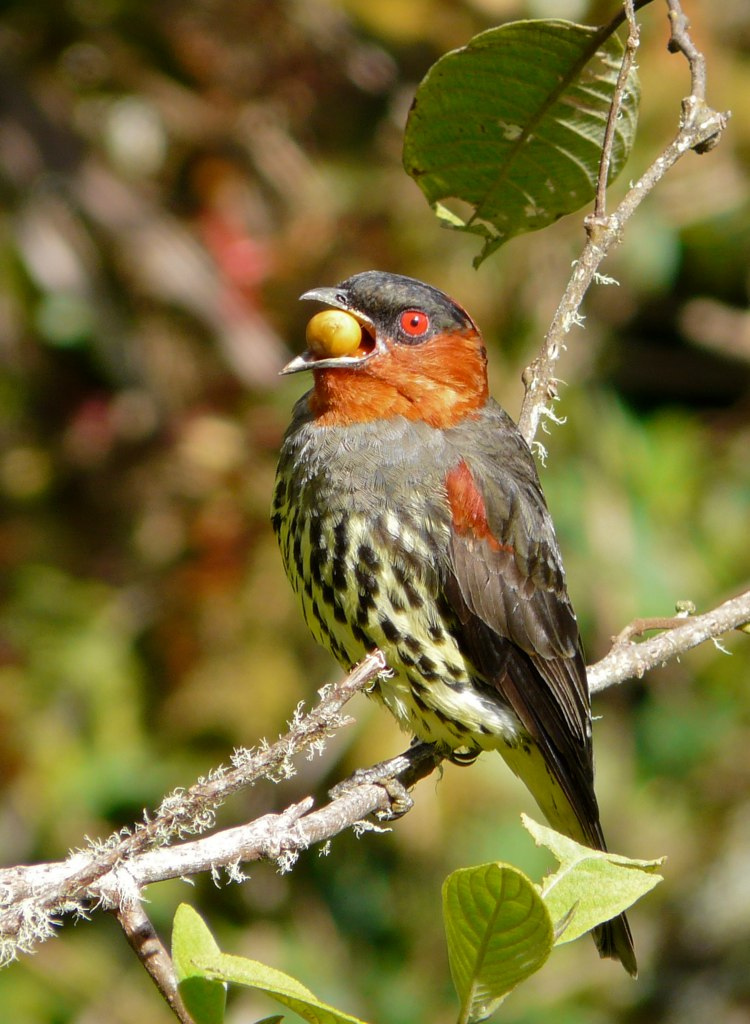
Masked Fruiteater
Pipreola pulchra
Order: Passeriformes / Family: Cotingidae

Wikimedia Commons
About the Masked Fruiteater
The Masked Fruiteater (Pipreola pulchra) is a vibrant member of the Cotingidae family, renowned for its vivid plumage and the unique ecological niche it occupies. Found predominantly in the cloud forests of the Andes, this species thrives at elevations ranging from 1,500 to 3,000 meters. Its presence is particularly notable in the humid montane regions of Peru, where it plays a vital role in seed dispersal, contributing to forest regeneration. The Masked Fruiteater is an integral part of the Andean avian community, often seen flitting through the canopy in search of fruit, which constitutes the majority of its diet. This frugivorous diet not only sustains the bird but also aids in the propagation of various plant species, as seeds pass through its digestive tract and are deposited in new locations. The species exhibits fascinating seasonal behaviors, with some altitudinal movements observed in response to fruiting cycles of different plant species. During peak fruiting seasons, the Masked Fruiteater can be seen in more abundant numbers, as individuals congregate in areas with plentiful resources. This cyclical abundance underscores the bird's role in maintaining the ecological balance of its habitat. Its presence is a key indicator of healthy, biodiverse forest ecosystems, as it relies on intact forest cover for both sustenance and breeding. The Masked Fruiteater's vibrant appearance and ecological significance make it a prized sighting for birders and a critical species for conservationists aiming to preserve Andean biodiversity.
The Masked Fruiteater belongs to the family Cotingidae, within the order Passeriformes. These birds typically live estimated to be around 9 years, with some individuals living up to 11 years.
How to Identify a Masked Fruiteater
The Masked Fruiteater is easily recognizable by its striking coloration. Adult males sport a vivid green plumage with a distinctive black mask that gives the bird its common name. This mask extends from the lores to the nape, providing a stark contrast to the bright green of the rest of the bird's body. The underparts are generally paler, with a gradient towards yellow on the belly. Females, while similar, display a slightly duller green and lack the prominent black mask, making them less conspicuous. Juveniles resemble females but often show more muted colors overall. In flight, the Masked Fruiteater exhibits a smooth, undulating pattern, with wings that appear rounded and a slightly elongated tail. When perched, it maintains an upright posture, often remaining motionless for extended periods while scanning for ripe fruit. Its unique coloration and size, medium compared to other Cotingidae members, help distinguish it from similar species like the Green-and-black Fruiteater, which lacks the distinct mask and has a more uniform color pattern.
Having trouble telling birds apart? Upload a photo to our bird identification tool for an instant species match.
Masked Fruiteater Habitat and Range
Preferred Habitat
The Masked Fruiteater inhabits the montane cloud forests of the Andes, a habitat characterized by high humidity and dense vegetation. These forests, found at elevations between 1,500 and 3,000 meters, provide a rich tapestry of mosses, ferns, and epiphytes that support a diverse avian population. The bird favors areas where fruiting trees and shrubs are abundant, as these are crucial for its diet. Seasonal habitat shifts occur as the fruiteater follows the availability of fruit, sometimes moving to lower elevations during periods of scarcity. Unlike many bird species, the Masked Fruiteater is rarely found in urban settings, as it requires the complex structure of natural forests for both feeding and nesting.
Geographic Range
The Masked Fruiteater's range is confined to the Andean regions of South America, with its stronghold in the montane forests of Peru. This species is non-migratory, although it exhibits some altitudinal movements in response to seasonal food availability. Populations are densest in areas with high fruit diversity, particularly where mature cloud forests remain intact. The bird's range overlaps with several protected areas, providing some buffer against habitat loss. However, its presence outside these reserves is patchy due to deforestation and habitat fragmentation.
Want to know which birds visit your area? Browse our backyard birds by location guides for region-specific species lists.
What Does the Masked Fruiteater Eat?
The diet of the Masked Fruiteater consists predominantly of fruit, a preference reflected in its foraging behavior. It specializes in consuming small to medium-sized fruits, which it deftly plucks from branches with its short, robust bill. Seasonal changes in fruit availability influence its diet, with a preference for ripe fruits high in sugars and nutrients during breeding seasons. Occasionally, the fruiteater may consume insects, particularly during periods when fruit is scarce. Foraging often occurs in small groups, and the bird employs a methodical approach, moving systematically through the canopy to assess fruiting potential.
Masked Fruiteater Behavior and Social Structure
The Masked Fruiteater exhibits a mix of solitary and social behaviors. While it often forages alone or in pairs, during periods of fruit abundance, it may join loose flocks with other frugivorous species. This gregarious behavior aids in locating fruiting trees and provides some protection from predators. Courtship displays are subtle, involving soft vocalizations and postures that highlight its colorful plumage. The species is generally non-territorial, although males may defend areas with high fruit density during the breeding season. The fruiteater's daily activity peaks in the early morning and late afternoon, coinciding with cooler temperatures and increased fruit availability.
Masked Fruiteater Nesting and Reproduction
The Masked Fruiteater constructs its nest in the canopy of dense forests, using a combination of twigs, moss, and leaves to create a shallow cup. These nests are typically placed on horizontal branches, well-concealed by foliage. The species usually lays two to three eggs per clutch, with both parents sharing incubation duties, which last approximately 18 to 20 days. Nestlings fledge about three weeks after hatching, with parental care continuing for several weeks thereafter. The fruiteater generally raises one brood per year, although in fruit-rich environments, a second brood may occur.
Masked Fruiteater Sounds and Vocalizations
The vocalizations of the Masked Fruiteater are soft yet distinctive, consisting mainly of a series of melodious whistles interspersed with short, choppy notes. Its primary song features a rhythmic pattern, often delivered from a concealed perch high in the canopy. Calls are used more sparingly, typically as contact notes between foraging individuals. Alarm calls, although rare, are sharper and more abrupt, serving as effective warnings to nearby birds. During the dawn chorus, the fruiteater's song contributes to the rich tapestry of forest sounds, although it is not the predominant voice.
Interesting Facts About the Masked Fruiteater
- 1The Masked Fruiteater's vivid green and black plumage provides excellent camouflage within the lush canopy of cloud forests.
- 2This frugivorous bird plays a crucial role in seed dispersal, helping to maintain the biodiversity of its Andean habitat.
- 3Despite its striking appearance, the Masked Fruiteater often goes unnoticed due to its quiet nature and preference for dense foliage.
- 4It belongs to the Cotingidae family, which includes some of the most visually spectacular birds in the New World tropics.
- 5The fruiteater's presence in a forest is a good indicator of ecological health, as it relies on a diverse array of fruiting plants.
Masked Fruiteater Conservation Status
The Masked Fruiteater currently holds a status of Least Concern on the IUCN Red List, although it faces threats from habitat destruction and fragmentation due to logging and agricultural expansion. While populations appear stable within protected areas, ongoing deforestation in unprotected regions poses significant risks. Conservation efforts focus on preserving remaining cloud forests and promoting sustainable land-use practices. Historical population trends have shown resilience, but continued habitat protection is crucial for long-term stability.