
Masked Tityra
Tityra semifasciata
Order: Passeriformes / Family: Cotingidae

Wikimedia Commons
About the Masked Tityra
The Masked Tityra (Tityra semifasciata) is a notable member of the Cotingidae family, primarily inhabiting the lush, tropical forests of Central and South America. This medium-sized bird is easily recognized by its distinctive appearance: a pale body contrasted with a striking black mask and tail. The Masked Tityra plays a significant role in the ecosystem as both a predator and seed disperser, contributing to the maintenance of its forest habitats.
Found from southern Mexico through Central America to northwestern South America, the Masked Tityra thrives in lowland tropical and subtropical forests. Its presence is crucial in these ecosystems, as it controls insect populations and aids in the dispersal of seeds from the fruits it consumes. The bird's feeding activities help maintain forest health, promoting plant diversity and regeneration.
Throughout the year, the Masked Tityra can be observed engaging in a variety of behaviors indicative of its adaptability to different environmental conditions. During the breeding season, which typically occurs in the dry months, the species exhibits increased territoriality and vocal activity. The bird's adaptability extends to its feeding habits, shifting from primarily insectivorous diets during the breeding season to frugivorous diets as different fruiting plants become available. This flexibility in diet and behavior underscores the bird's importance in both its ecological role and its ability to thrive across a range of tropical habitats.
The Masked Tityra belongs to the family Cotingidae, within the order Passeriformes. These birds typically live average 6-8 years, with some individuals living up to 12 years..
How to Identify a Masked Tityra
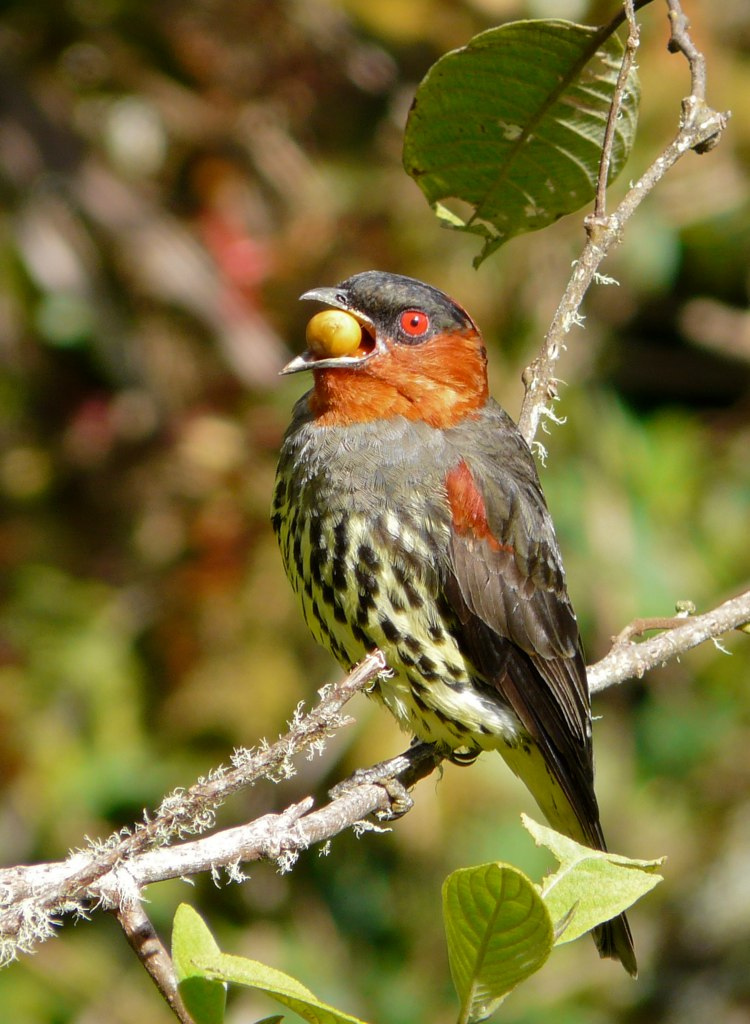
The Masked Tityra is readily identifiable by its unique plumage and distinctive markings. Adult males and females share a similar appearance, with a predominantly pale gray to white body contrasted by a striking black mask that extends from the base of the bill across the eyes, giving the species its name. The tail and wings are also dark, adding to the contrast against the bird's lighter body.
Juvenile Masked Tityras can be differentiated from adults by their slightly duller plumage, often showing a browner tone and less defined black markings. Males and females are similar, but males generally exhibit slightly more vibrant coloration and a more pronounced mask.
In flight, the Masked Tityra displays a robust and direct flight pattern, characterized by steady wingbeats. When perched, it adopts an upright posture, often seen scanning its surroundings for insects or fruits. Despite its unique appearance, this species can sometimes be confused with similar tityras or other medium-sized tropical birds, but the distinctive black mask remains a key feature for accurate identification.
Having trouble telling birds apart? Upload a photo to our bird identification tool for an instant species match.
Masked Tityra Habitat and Range
Preferred Habitat
The Masked Tityra predominantly inhabits tropical and subtropical forests, with a preference for lowland primary and secondary woodlands. It is commonly found at elevations from sea level to about 1,200 meters, although it may ascend higher in some regions. Dense forest canopies and forest edges provide ideal habitats, where the species can forage among the foliage and branches.
While the bird primarily resides in forested areas, it occasionally ventures into more open woodlands and is adaptable enough to inhabit disturbed habitats such as plantations and gardens in rural areas. The Masked Tityra's presence in urban environments is rare, but it may occasionally be spotted near human settlements if suitable trees and food sources are available.
Geographic Range
The Masked Tityra's range spans across a significant portion of the Neotropics, with its breeding and resident range extending from southern Mexico through Central America, including Belize, Guatemala, and Panama, into parts of South America such as Colombia, Ecuador, and Venezuela. It is a year-round resident in most of its range, though some local movements may occur in response to food availability and breeding conditions.
Although not a migratory species, the Masked Tityra may exhibit altitudinal movements, descending to lower elevations during colder months or in response to seasonal changes in food resources. Within its range, population densities vary, with higher concentrations often found in undisturbed forest habitats where food resources abound.
Want to know which birds visit your area? Browse our backyard birds by location guides for region-specific species lists.
What Does the Masked Tityra Eat?
The diet of the Masked Tityra is diverse, primarily consisting of insects and fruits. During the breeding season, it predominantly feeds on insects, which provide the necessary protein for raising young. Beetles, grasshoppers, and caterpillars are among its most common prey, captured through agile sallying flights from perches.
As seasons change and fruit becomes more abundant, the Masked Tityra shifts to a more frugivorous diet, consuming a wide variety of fruits and berries. This adaptability in diet helps the bird exploit different food resources throughout the year, maintaining its energy needs and contributing to seed dispersal within its habitat.
The Masked Tityra typically forages in the upper and mid-levels of the forest canopy, using its keen eyesight to locate food. Feeding often occurs during the cooler hours of the day, with peaks in activity in the early morning and late afternoon.
Masked Tityra Behavior and Social Structure
The Masked Tityra exhibits a range of behaviors that reflect its adaptability and ecological role in tropical forests. It is generally found in pairs or small family groups, though it may join mixed-species flocks outside the breeding season to enhance foraging efficiency and predator avoidance.
Territorial during the breeding season, the Masked Tityra engages in vocal displays to establish and defend its territory. Courtship involves both visual and vocal displays, with males often performing aerial displays to attract females. Once paired, the birds show strong pair bonds and cooperate in nest building and care of the young.
The Masked Tityra is diurnal, being most active during daylight hours. Its daily routine involves periods of foraging interspersed with rest and preening. When faced with potential predators, the bird may emit sharp alarm calls and engage in mobbing behavior to deter threats.
Masked Tityra Nesting and Reproduction
Masked Tityras nest in tree cavities, often utilizing abandoned woodpecker holes or natural hollows. The selection of nest sites typically occurs in high trees within the forest, providing safety and proximity to food sources. Nest construction involves minimal material, primarily using leaves and twigs to line the cavity.
The typical clutch size ranges from 2 to 4 eggs, with both parents sharing incubation duties over a period of approximately 17 to 20 days. After hatching, the young are altricial and require significant parental care. Both male and female Masked Tityras participate in feeding and protecting the chicks until they fledge, usually within 25 to 30 days after hatching.
The species generally raises one brood per year, although in regions with abundant resources, a second brood may occasionally occur.
Masked Tityra Sounds and Vocalizations
The Masked Tityra is not known for an elaborate song but emits a series of simple, harsh notes. Its calls include a variety of grating and nasal sounds, often described as 'wheezy' or 'buzzy'. These vocalizations serve to communicate with mates and signal alarm in the presence of predators.
During the dawn chorus, the Masked Tityra's calls can be heard interspersed with those of other forest birds, contributing to the acoustic tapestry of its environment. Its vocalizations are less melodious than those of many songbirds, but they play a critical role in maintaining social bonds and territory defense.
Interesting Facts About the Masked Tityra
- 1Masked Tityras have a distinctive appearance due to their black mask, which resembles a bandit's mask, earning them their common name.
- 2This species often takes advantage of abandoned woodpecker nests, saving energy by not excavating its own cavities.
- 3Masked Tityras are known to form loose associations with other bird species, enhancing their foraging success.
- 4They play a critical role in seed dispersal, especially for large-seeded plants in tropical forests.
- 5The Masked Tityra's call is unique among its relatives, characterized by its wheezy, nasal quality.
- 6Their diet shifts seasonally, with a marked increase in fruit consumption during times of abundance.
- 7Masked Tityras exhibit sexual dimorphism, with males generally showing slightly brighter plumage compared to females.
Masked Tityra Conservation Status
The Masked Tityra, currently listed as Least Concern by the IUCN, enjoys a stable population across much of its range. However, habitat loss due to deforestation poses a potential threat, particularly in areas where tropical forests are being cleared for agriculture and development. Conservation efforts focused on preserving forest habitats are vital for the continued stability of Masked Tityra populations. Protected areas and sustainable land-use practices help ensure suitable habitats remain available. Historical data suggest that populations have remained relatively stable, though ongoing monitoring is necessary to detect and address any emerging threats.
Other Cotingidae Species



Birds Similar to the Masked Tityra
These species are often confused with the Masked Tityra due to similar appearance or overlapping range.

