Myrmeciza longipes
Myrmeciza longipes
Order: Passeriformes / Family: Thamnophilidae

Wikimedia Commons
About the Myrmeciza longipes
The Myrmeciza longipes, commonly known as the White-bellied Antbird, is a captivating species within the family Thamnophilidae. This bird inhabits the rich undergrowth of humid tropical forests across South America, particularly in countries such as Brazil, Colombia, and Venezuela. Its ecological significance stems from its role as a specialized insectivore, primarily feeding on ants and other small arthropods, which it expertly forages from the leaf litter. The White-bellied Antbird typically resides in lowland forests, often near riverbanks or swampy areas where the dense underbrush provides ample cover.
This bird plays a crucial role in maintaining the balance of the forest ecosystem by controlling insect populations. Interestingly, the Myrmeciza longipes does not follow army ant swarms as some other antbird species do. Instead, it forages independently or in pairs, using its keen sense of hearing to detect prey. During the breeding season, which coincides with the rainy season in many parts of its range, this antbird becomes notably vocal, with males singing to establish territories and attract mates.
The White-bellied Antbird's presence is a good indicator of healthy forest ecosystems. It thrives in undisturbed environments, though it can sometimes be found in secondary growth forests. This adaptability, however, does not negate the threats posed by deforestation and habitat fragmentation, which continue to loom over many South American bird species. As a species of least concern according to IUCN, the Myrmeciza longipes is a testament to the resilience of some forest birds, yet it also serves as a reminder of the delicate balance that exists within these biodiverse habitats.
The Myrmeciza longipes belongs to the family Thamnophilidae, within the order Passeriformes. These birds typically live average 6-8 years with a maximum recorded of 12 years..
How to Identify a Myrmeciza longipes
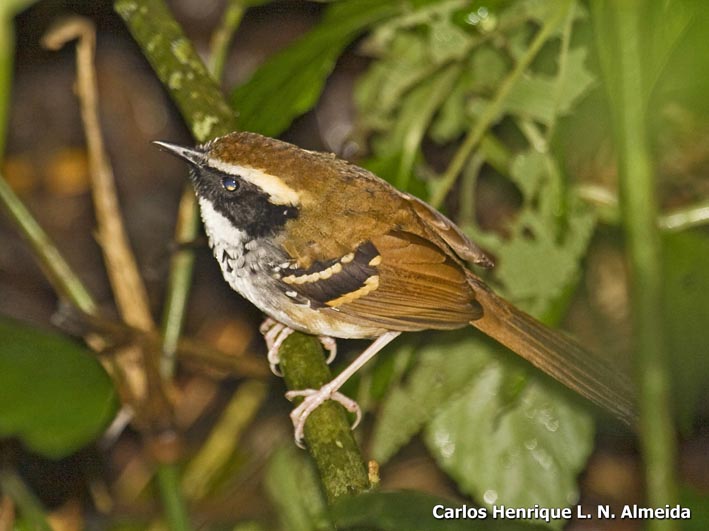
The White-bellied Antbird presents a distinct appearance that aids in its identification. Adult males display a striking contrast between the blackish or dark brown upperparts and the clean white underparts, which give the bird its common name. Females, while similar, often exhibit a more subdued coloration with lighter browns replacing the male's darker tones. Juveniles resemble females but possess even softer and more washed-out hues.
One of the key identification features of Myrmeciza longipes is its robust bill, which it uses skillfully to probe for insects in the forest floor litter. The bird's eyes are dark, set against its plain face, and its legs are a muted grayish color. In flight, the White-bellied Antbird shows a short, rounded wing shape typical of many understory foragers, allowing for quick maneuvering through dense foliage. When perching, it often adopts a horizontal posture, which helps it blend seamlessly into the underbrush.
Though sometimes confused with similar antbird species, the White-bellied Antbird's unique coloration and preference for specific habitats usually aid in correct identification. Its preference for dense, low-lying vegetation further distinguishes it from other superficially similar birds that may inhabit higher strata of the forest.
Having trouble telling birds apart? Upload a photo to our bird identification tool for an instant species match.
Myrmeciza longipes Habitat and Range
Preferred Habitat
The Myrmeciza longipes primarily inhabits lowland tropical forests, particularly favoring areas with dense undergrowth and abundant leaf litter. These environments provide not only food but also the cover necessary for evading predators and constructing nests. The bird is frequently found near water sources such as riverbanks and swamps. Elevation-wise, it generally resides in areas below 1,000 meters, with a preference for undisturbed primary forests or well-established secondary growth.
In terms of urban versus rural presence, the White-bellied Antbird is largely absent from urban environments, as it requires the unblemished forest floor conditions found in wilderness areas. However, it may occasionally be encountered in forest fragments within agricultural landscapes, provided the habitat retains sufficient underbrush and is not heavily degraded. Seasonal habitat shifts are minimal, as this bird is non-migratory and tends to remain within its established territory year-round.
Geographic Range
The White-bellied Antbird's range extends across northern South America, with confirmed populations in Venezuela, Colombia, and Brazil. It is also present in Guyana, Suriname, and French Guiana. Within these countries, the bird is predominantly found in the Amazon Basin, where the vast tracts of lowland rainforest provide an ideal habitat. The bird's presence is less common in areas of heavy deforestation or agricultural development.
Myrmeciza longipes does not undergo long-distance migrations, instead maintaining a relatively stable presence within its breeding range throughout the year. This sedentary nature means that its range is tightly linked to the availability of suitable forest habitats. While population densities can be difficult to ascertain in these dense environments, hotspots of abundance are typically associated with regions where forest integrity is maintained.
Want to know which birds visit your area? Browse our backyard birds by location guides for region-specific species lists.
What Does the Myrmeciza longipes Eat?
The diet of the Myrmeciza longipes primarily consists of ants, which it sources from the forest floor. This bird's feeding strategy involves slow, deliberate movements through the underbrush, where it uses its acute hearing to locate prey beneath the leaf litter. It occasionally consumes other small arthropods, such as beetles and spiders, diversifying its diet to some extent depending on availability.
Seasonal changes in diet are minimal, as the forest's insect populations remain relatively stable throughout the year. The White-bellied Antbird is most active in its foraging during the early morning and late afternoon, taking advantage of the cooler temperatures and heightened insect activity during these periods. Its probing feeding technique involves using its robust bill to flip leaves and peck at any uncovered prey, a method well-suited to its forest floor habitat.
Myrmeciza longipes Behavior and Social Structure
The social structure of the White-bellied Antbird is primarily monogamous, with pairs often seen foraging together. Territorial behavior is pronounced, particularly during the breeding season, when males become vocally active to ward off rivals and secure their mating territory. Males engage in a variety of courtship displays, including song and visual displays, to attract females.
This antbird is not known to form large flocks, preferring the company of its immediate mate. However, it may occasionally join mixed-species foraging flocks, particularly when insect activity is high. In response to predators, the Myrmeciza longipes relies on its cryptic plumage and the dense cover of its habitat, often freezing or moving stealthily to avoid detection. Daily activity patterns are largely diurnal, with most foraging and vocalization occurring in the morning and late afternoon.
Myrmeciza longipes Nesting and Reproduction
The nesting habits of the Myrmeciza longipes are closely tied to its forest habitat. It constructs cup-shaped nests using materials such as leaves, twigs, and fibers, usually located low to the ground within dense shrubbery or vines. This positioning provides concealment from predators and protection from the elements.
Clutch sizes typically range from two to three eggs, with both parents involved in incubation duties. The incubation period lasts approximately two weeks, followed by a fledging period of another two to three weeks. Parental roles are shared, with both male and female participating in feeding and caring for the young. The Myrmeciza longipes may produce one to two broods per year, depending on environmental conditions and food availability.
Myrmeciza longipes Sounds and Vocalizations
The primary song of the Myrmeciza longipes is a series of clear, sharp whistles, often described as 'chee-chee-chee,' repeated rapidly. This song serves both as a territorial marker and a mating call, most frequently heard during the early morning hours. The call notes can vary slightly, with some individuals incorporating softer trills or variations in pitch.
Alarm calls are harsher and more abrupt, designed to alert mates or signal distress. During the dawn chorus, the White-bellied Antbird's song blends into the symphony of forest sounds, yet its distinct clarity often pierces through the cacophony. Its vocalizations are reminiscent of the sharp, clear whistles of a referee's signal, providing a distinct audial marker for identifying the species.
Interesting Facts About the Myrmeciza longipes
- 1The White-bellied Antbird is not truly ant-following, unlike many of its antbird relatives, preferring to forage independently.
- 2Despite its name, the Myrmeciza longipes is adaptable to various insect diets, allowing it to thrive in a range of forest conditions.
- 3This antbird's song is one of the clearest in the forest, often cutting through the morning air with its sharp, repetitive notes.
- 4The species name 'longipes' refers to its relatively long legs, an adaptation for maneuvering through dense underbrush.
- 5Myrmeciza longipes plays a crucial role in controlling insect populations, maintaining ecological balance in its habitat.
- 6The White-bellied Antbird is a monogamous species, with pairs often remaining together across multiple breeding seasons.
- 7Its ability to remain concealed within its environment is a testament to its evolutionary adaptation to dense forest undergrowth.
Myrmeciza longipes Conservation Status
The Myrmeciza longipes is currently classified as a species of least concern by the IUCN, thanks to its relatively stable population numbers and wide distribution across suitable habitats. However, the primary threat to this species remains habitat destruction, mainly due to deforestation for agriculture and logging. Conservation efforts are crucial to maintaining the integrity of its forested environments, with various initiatives focusing on the preservation of the Amazon Basin's diverse ecosystems. Historical population changes have been minimal, but continuous monitoring is essential, particularly as human activities encroach further into its natural habitat. Supporting protected areas and sustainable forestry practices are key strategies in ensuring the long-term survival of the White-bellied Antbird.
Other Thamnophilidae Species



Birds Similar to the Myrmeciza longipes
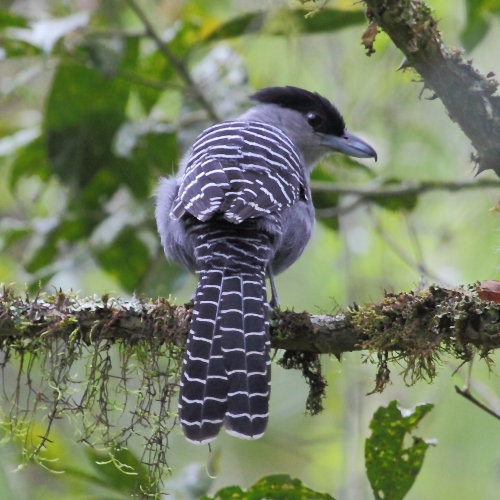
These species are often confused with the Myrmeciza longipes due to similar appearance or overlapping range.