Nilgiri Laughingthrush
Trochalopteron cachinnans
Order: Passeriformes / Family: Leiothrichidae

Wikimedia Commons
About the Nilgiri Laughingthrush
The Nilgiri Laughingthrush, Trochalopteron cachinnans, is a striking member of the leiothrichidae family, endemic to the Western Ghats in southern India. These birds predominantly inhabit high-altitude montane forests, favoring dense underbrush and thickets where they can forage and nest with relative safety. Their presence is most pronounced in the Nilgiri Hills, which lend part of their name to this species. Known for their loud, laughter-like vocalizations, these birds play a crucial role in their ecosystem by aiding in seed dispersal and controlling insect populations.
This species is emblematic of the rich biodiversity found in the Western Ghats, a UNESCO World Heritage site recognized for its unique flora and fauna. The Nilgiri Laughingthrush is a significant indicator of the health of its habitat, as it prefers undisturbed environments with abundant foliage. Conservation efforts in these regions directly benefit from a focus on this species, as protecting their habitat supports a wide array of other organisms.
Ecologically, the Nilgiri Laughingthrush contributes to the maintenance of forest dynamics. During the breeding season, which typically extends from March to June, these birds are more conspicuous as they engage in more vocal and territorial behaviors. Outside the breeding season, they form loose flocks, often mingling with other species. Their adaptability to slightly altered habitats, such as tea estates when interspersed with native vegetation, demonstrates their resilience, though they remain vulnerable to significant habitat destruction.
The Nilgiri Laughingthrush belongs to the family Leiothrichidae, within the order Passeriformes. These birds typically live typically 6-8 years, with some individuals living up to 11 years..
How to Identify a Nilgiri Laughingthrush
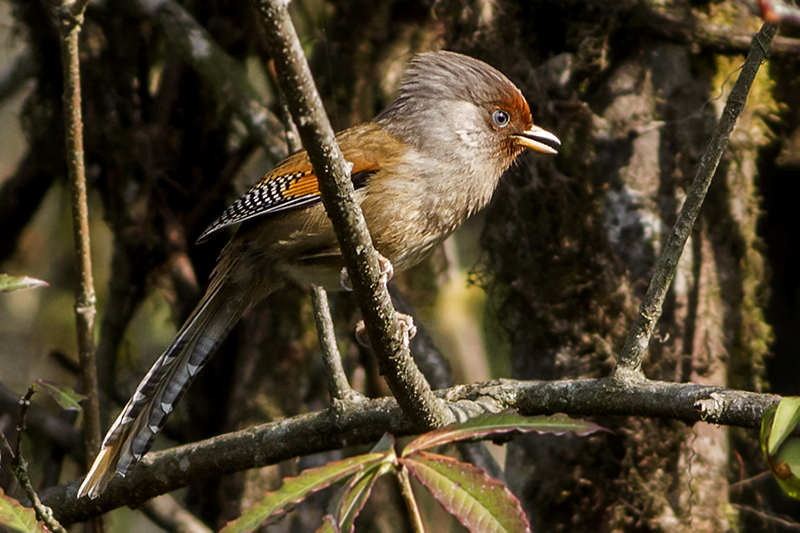
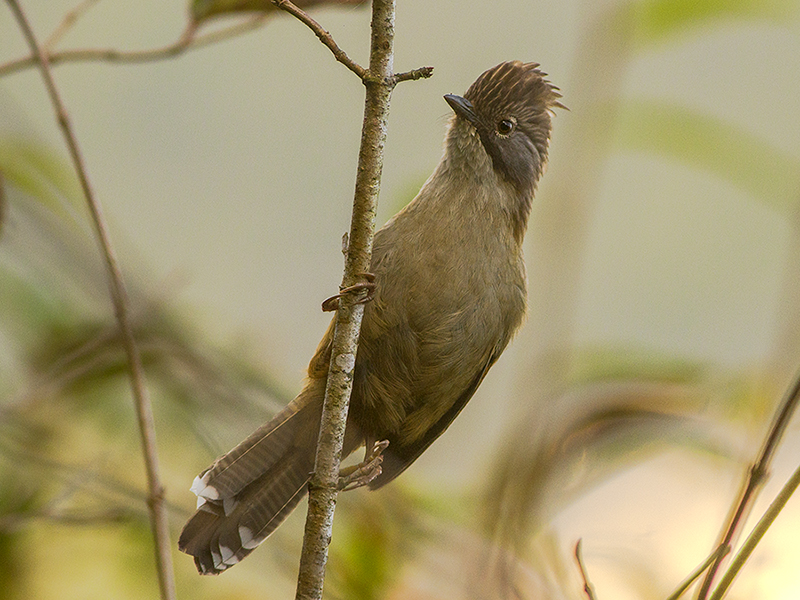
Distinguished by a combination of striking plumage and vocalizations, the Nilgiri Laughingthrush is a medium-sized bird with an overall length of about 23-25 cm. It features a predominantly grayish-brown body, with a notable rufous wash on the wings and tail. The head is marked by a white supercilium that contrasts with its black eye-stripe, giving it a distinctive facial pattern. The throat and breast are a soft gray, merging into a paler belly. Juveniles tend to have duller plumage compared to adults but retain the characteristic facial markings.
Males and females are similar in appearance, though females may be slightly smaller and less vibrant in coloration. When compared to other laughingthrush species within its range, the Nilgiri Laughingthrush's combination of gray and rufous tones helps to distinguish it. In flight, its silhouette is typical of a passerine, with broad wings and a slightly rounded tail.
On perches, the Nilgiri Laughingthrush exhibits an upright posture, often flicking its tail up and down. This behavior, coupled with its distinctive calls, makes it easier to identify within its dense, wooded habitat. Its movements are agile and deliberate, often seen hopping through underbrush or low branches in search of food.
Having trouble telling birds apart? Upload a photo to our bird identification tool for an instant species match.
Nilgiri Laughingthrush Habitat and Range
Preferred Habitat
The Nilgiri Laughingthrush primarily inhabits montane evergreen forests within the Western Ghats, preferring elevations ranging from 1,200 to 2,500 meters. These forests provide the dense undergrowth and canopy cover that the species requires for foraging and nesting. The Nilgiri Hills, Palani Hills, and the higher reaches of the Anamalai Hills are particularly significant locales for this species.
While the Nilgiri Laughingthrush shows some adaptability, it generally avoids heavily altered landscapes, such as urban areas. However, it can sometimes be found in tea plantations or cardamom forests that maintain native shrubs and trees. Seasonal movements are minimal, with the species showing strong site fidelity, rarely venturing far from established territories even outside the breeding season.
The loss of primary forest cover due to agricultural expansion and urbanization poses a threat to its habitat, emphasizing the importance of conservation efforts focused on preserving the unique montane ecosystems of the Western Ghats.
Geographic Range
The Nilgiri Laughingthrush has a restricted range, endemic to the Western Ghats of southern India. It primarily occurs in the states of Tamil Nadu, Kerala, and Karnataka, with its presence most notable in the Nilgiri Hills. This region's unique geography and climate provide the specific conditions necessary for the species' survival.
Unlike migratory species, the Nilgiri Laughingthrush remains within its breeding range year-round. Populations are densest in protected areas like the Mudumalai National Park and Silent Valley National Park, where habitats are preserved. The species' restricted range makes it particularly susceptible to habitat disturbances, which can lead to population declines.
Efforts to map and monitor the range of the Nilgiri Laughingthrush are crucial, as it helps in understanding the impacts of habitat fragmentation and identifying areas for potential conservation actions. While it does not undertake long migrations, the connectivity between different forest patches is vital for maintaining genetic diversity and population stability.
Want to know which birds visit your area? Browse our backyard birds by location guides for region-specific species lists.
What Does the Nilgiri Laughingthrush Eat?
The Nilgiri Laughingthrush primarily feeds on insects and small invertebrates, playing a crucial role in controlling pest populations within its habitat. Its diet includes a variety of beetles, ants, and caterpillars, which it gleans from leaves, branches, and the forest floor. This insectivorous diet is supplemented by berries and seeds, particularly during the non-breeding season when insect availability may decline.
Feeding mostly occurs in the early morning and late afternoon, with the birds often forming small foraging parties. These groups provide safety in numbers and increase foraging efficiency. The Nilgiri Laughingthrush employs a methodical approach, probing into bark crevices and leaf litter to uncover hidden prey. This behavior highlights its adaptability and resourcefulness in exploiting available food sources.
During the breeding season, the demand for protein-rich food increases, with adults actively seeking out larger insects to feed their young. This dietary flexibility helps the species thrive in its montane environment, where food availability can vary with season and weather.
Nilgiri Laughingthrush Behavior and Social Structure
The Nilgiri Laughingthrush exhibits social and territorial behaviors that are integral to its survival and reproduction. Typically, these birds live in small family groups or loose flocks, especially outside the breeding season. This social structure aids in predator detection and resource location, providing a communal advantage in the dense forest habitat.
During the breeding season, pairs become more territorial, often engaging in vocal displays to assert dominance over their chosen area. Males are particularly vocal, using their distinctive calls to attract mates and ward off rivals. Courtship involves mutual preening and food sharing, strengthening pair bonds.
The Nilgiri Laughingthrush is generally active during the day, with peaks in activity during the early morning and late afternoon. This diurnal pattern aligns with the availability of food resources and favorable environmental conditions. When threatened by predators, these birds employ alarm calls to warn others in the vicinity, often taking cover in the dense underbrush where they are more challenging to spot.
Their response to human presence is generally one of cautious curiosity, with individuals often retreating to higher branches or denser cover when disturbed. Understanding these behavioral patterns is essential for effective conservation management and ensuring the species' long-term survival.
Nilgiri Laughingthrush Nesting and Reproduction
Nilgiri Laughingthrushes construct cup-shaped nests using a variety of materials, including twigs, leaves, and moss. These nests are typically positioned in dense shrubs or low trees, providing both camouflage and protection from predators. The choice of nesting location is crucial, as it needs to offer security while being close to reliable food sources.
The breeding season runs from March to June, during which time the female lays a clutch of 2-3 eggs. Both parents share responsibilities, with the female primarily incubating the eggs for about 14-16 days. Once hatched, both parents are involved in feeding and caring for the chicks, which fledge approximately 12-14 days after hatching.
Parental care extends beyond fledging, as adults continue to feed and teach their young essential survival skills. Typically, the Nilgiri Laughingthrush raises one brood per year, although in favorable conditions, a second brood may occur. Nest predation and environmental factors like heavy rain can affect breeding success, emphasizing the importance of stable, undisturbed habitats.
Nilgiri Laughingthrush Sounds and Vocalizations
The Nilgiri Laughingthrush is renowned for its rich vocal repertoire, characterized by a series of melodious, laughter-like calls that carry through the forest. These calls consist of varied notes with a rhythmic, cascading quality, often described as a series of 'chee-wit' sounds followed by a rapid, descending trill.
These vocalizations serve multiple functions: territory establishment, mate attraction, and group cohesion. The birds also produce softer, more subdued calls for communication within flocks. Alarm calls, sharper and more urgent in tone, alert others to potential danger, contributing to the group's overall vigilance.
During the dawn chorus, the Nilgiri Laughingthrush’s calls are particularly prominent, adding to the rich tapestry of sounds in their montane forest habitat. Their song is a vital component of their identity and social interaction, with slight variations noted between individuals and populations.
Interesting Facts About the Nilgiri Laughingthrush
- 1The Nilgiri Laughingthrush is endemic to the Western Ghats, a biodiversity hotspot and UNESCO World Heritage site.
- 2Despite its name, the Nilgiri Laughingthrush's calls are not true laughter but are characterized by melodious, laughter-like notes.
- 3This species is a vital part of the forest ecosystem, helping control insect populations and assisting in seed dispersal.
- 4Unlike migratory birds, the Nilgiri Laughingthrush remains within its montane range year-round, showing strong site fidelity.
- 5The Nilgiri Laughingthrush's nests are well-camouflaged, constructed in dense foliage to protect against predators.
- 6The bird's social structure involves small family groups, enhancing foraging efficiency and predator awareness.
- 7Climate change poses a significant threat, potentially altering its montane forest habitat and impacting food availability.
Nilgiri Laughingthrush Conservation Status
The Nilgiri Laughingthrush is currently classified as Near Threatened on the IUCN Red List, with populations experiencing pressures from habitat loss and fragmentation. Deforestation due to agricultural expansion, particularly for tea and coffee plantations, poses significant threats to their montane forest habitats. Climate change also presents emerging challenges, potentially altering the delicate ecosystem balance. Conservation efforts focus on habitat protection and restoration, with several key areas such as the Nilgiri Biosphere Reserve providing critical refuge. Community engagement and sustainable land-use practices are encouraged to mitigate habitat degradation. Historically, population declines were more pronounced with rapid industrialization, but recent efforts have stabilized some local populations. Ongoing research and monitoring are essential to understanding population dynamics and the effectiveness of conservation strategies. By prioritizing the preservation of the Western Ghats' unique biodiversity, the future of the Nilgiri Laughingthrush can be more secure.