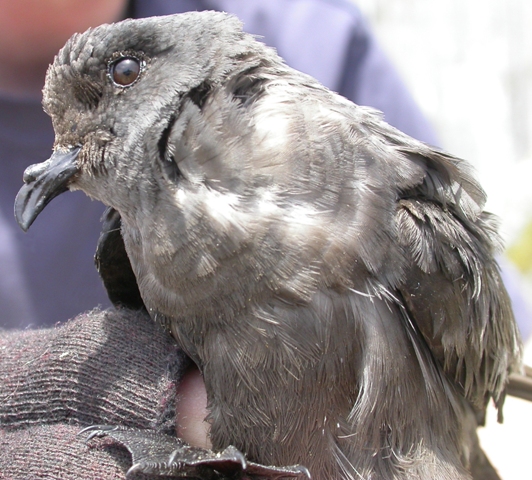
Oceanodroma hubbsi
Oceanodroma hubbsi
Order: Procellariiformes / Family: Hydrobatidae
About the Oceanodroma hubbsi
Oceanodroma hubbsi, commonly known as Hubbs's Storm-Petrel, is a member of the family Hydrobatidae within the order Procellariiformes. This storm-petrel is an often elusive seabird, predominantly found in the open waters of the southeastern Pacific Ocean. Unlike many bird species, Hubbs's Storm-Petrel spends the majority of its life far from land, relying on the vast oceanic environment for both sustenance and navigation. Its significance lies in its role as an indicator of ocean health. By studying the population dynamics of this species, scientists can gain insights into the broader ecological conditions of marine environments. Hubbs's Storm-Petrel plays a crucial ecological role as part of the marine food web. It primarily feeds on small fish and plankton, thus contributing to the regulation of these populations. In turn, it serves as a prey item for larger pelagic predators, including certain species of large fish and sharks. This seabird is also a vital subject for research due to its unique adaptation to life on the open sea. During the breeding season, Hubbs's Storm-Petrel returns to coastal islands to nest, such as those off the coast of Chile. These islands provide the necessary habitat for nesting away from the dangers of mainland predators. The bird's presence during this period highlights the importance of preserving these breeding grounds. Seasonally, Oceanodroma hubbsi exhibits a range of behaviors. During the non-breeding months, it can be observed in extensive feeding flocks over the ocean, often in association with other seabirds. This behavior contrasts with its solitary or paired nature during the breeding season. The species is known for its remarkable long-distance flights, which are essential for its survival and reproductive success.
The Oceanodroma hubbsi belongs to the family Hydrobatidae, within the order Procellariiformes. These birds typically live average 12 years with a max recorded of 18 years..
How to Identify a Oceanodroma hubbsi
Hubbs's Storm-Petrel is a medium-sized seabird characterized by its predominantly dark plumage with subtle differences between individuals. Adults display a sooty black coloration with a slightly paler rump, which can be a key field mark for identification. The wings are long and narrow, aiding their dynamic flight style over the ocean. Juveniles resemble adults but may exhibit slightly fresher plumage with less wear on the feathers. Males and females generally appear similar, making sex differentiation in the field challenging without close observation. In flight, Hubbs's Storm-Petrel can be distinguished by its quick wingbeats and gliding maneuvers, often skimmming close to the water's surface. Its flight silhouette is distinctive, with long wings and a forked tail, which sets it apart from other seabirds. When perching, which it does infrequently due to its pelagic lifestyle, this storm-petrel maintains a compact posture. Confusion with similar species such as the Black Storm-Petrel can occur, but closer examination reveals subtle differences in size and plumage shading.
Having trouble telling birds apart? Upload a photo to our bird identification tool for an instant species match.
Oceanodroma hubbsi Habitat and Range
Preferred Habitat
Oceanodroma hubbsi is primarily associated with pelagic habitats, where it thrives in the open ocean environment. This bird shows a preference for areas with abundant upwelling, regions where cold, nutrient-rich water rises to the surface, supporting a rich food web. It is typically found at low elevations, as its life cycle is closely tied to sea level. During the breeding season, it requires remote, predator-free coastal islands for nesting, such as those found in southern South America, particularly near Chile. These islands must offer suitable crevices and burrows for nesting. While Hubbs's Storm-Petrel is rarely found in urban or rural areas, its presence is solely linked to the ocean and specific island habitats. There is little evidence of significant habitat shifts outside of the breeding season, as its life remains closely tied to the pelagic zone.
Geographic Range
Hubbs's Storm-Petrel has a breeding range concentrated in the southeastern Pacific, particularly around the coastal islands off Chile. During the non-breeding season, its range extends across vast oceanic waters, where it remains highly pelagic. This species may venture northward along the South American coast during migration, although detailed migratory patterns are not well-documented. The bird's population density is highest near breeding colonies, but individuals disperse widely across the ocean post-breeding, making them less predictable in terms of location. Oceanodroma hubbsi's range does not extend to inland regions, as its life is inherently linked to marine environments.
Want to know which birds visit your area? Browse our backyard birds by location guides for region-specific species lists.
What Does the Oceanodroma hubbsi Eat?
The diet of Oceanodroma hubbsi primarily consists of small fish and planktonic organisms, including krill and other crustaceans. These food sources are abundant in the nutrient-rich waters of the southeastern Pacific. Foraging behavior involves picking prey off the water's surface, a technique facilitated by their agile flight. Hubbs's Storm-Petrel typically feeds during the day, although it may also take advantage of bioluminescent prey at night. Prey size is generally small, allowing the bird to swallow food whole. Seasonal changes in diet are less pronounced, as the bird follows the availability of its primary food sources, which remain relatively stable in its pelagic environment.
Oceanodroma hubbsi Behavior and Social Structure
Hubbs's Storm-Petrel exhibits a social structure that varies seasonally. During the breeding season, it is generally solitary or found in pairs, focused on nesting activities. Outside this period, it joins mixed-species feeding flocks over the ocean, indicating a more communal behavior. Courtship displays are subtle, involving aerial maneuvers and vocalizations near breeding sites. The bird's response to predators involves evasive flight and vocal alarms, although its pelagic lifestyle reduces encounters with many typical predators. Daily activity patterns are largely dictated by foraging needs, with peak activity occurring during daylight hours when prey is most accessible. Hubbs's Storm-Petrel's life at sea necessitates constant adaptation to changing weather and oceanic conditions.
Oceanodroma hubbsi Nesting and Reproduction
Nesting for Oceanodroma hubbsi occurs on remote coastal islands, where it utilizes natural crevices or burrows for protection. The nest is composed of minimal materials, often just a shallow depression lined with grasses or feathers. Clutch size typically consists of a single egg, which both parents take turns incubating. The incubation period lasts approximately 40 to 50 days. After hatching, the chick remains in the nest under parental care until fledging, which occurs around 60 to 70 days post-hatching. Parental roles are shared, with both the male and female involved in feeding and protecting the chick. Hubbs's Storm-Petrel generally produces one brood per season, given the extended care required for their offspring.
Oceanodroma hubbsi Sounds and Vocalizations
Hubbs's Storm-Petrel is known for its distinctive vocalizations, which play a crucial role in communication, especially during the breeding season. The primary song consists of a series of high-pitched, twittering notes delivered in rapid succession. These calls serve to establish territory and strengthen pair bonds. Alarm calls are sharper and more abrupt, designed to alert others of potential threats. During the dawn chorus, a cacophony of calls can be heard around breeding colonies, creating a vibrant soundscape. Compared to familiar sounds, their calls resemble a mix of chirps and whistles, conveying urgency and interaction.
Interesting Facts About the Oceanodroma hubbsi
- 1Hubbs's Storm-Petrel can spend months at sea without returning to land, relying on its remarkable adaptation to the pelagic lifestyle.
- 2This species of storm-petrel is named after Carl L. Hubbs, a notable American ichthyologist and marine biologist.
- 3Oceanodroma hubbsi's flight patterns allow it to navigate thousands of kilometers over open oceans, a testament to its endurance.
- 4The bird's dark plumage helps it blend into the sea surface, providing camouflage from aerial predators.
- 5Hubbs's Storm-Petrel may use olfactory cues to locate food, which is a rare adaptation among birds.
- 6Despite its small size, this storm-petrel plays a vital role in the marine ecosystem as both predator and prey.
- 7The breeding locations of Oceanodroma hubbsi are so remote that scientists only recently identified and described the species.
Oceanodroma hubbsi Conservation Status
Currently, Hubbs's Storm-Petrel holds a status of Least Concern according to the IUCN, although its population trend remains uncertain due to the challenges of studying pelagic species. Primary threats include habitat degradation on breeding islands and potential changes in food availability due to oceanic shifts. Conservation efforts focus on protecting critical breeding habitats and monitoring population trends. Historically, the species has been stable, but ongoing environmental changes necessitate continued attention to ensure its survival.