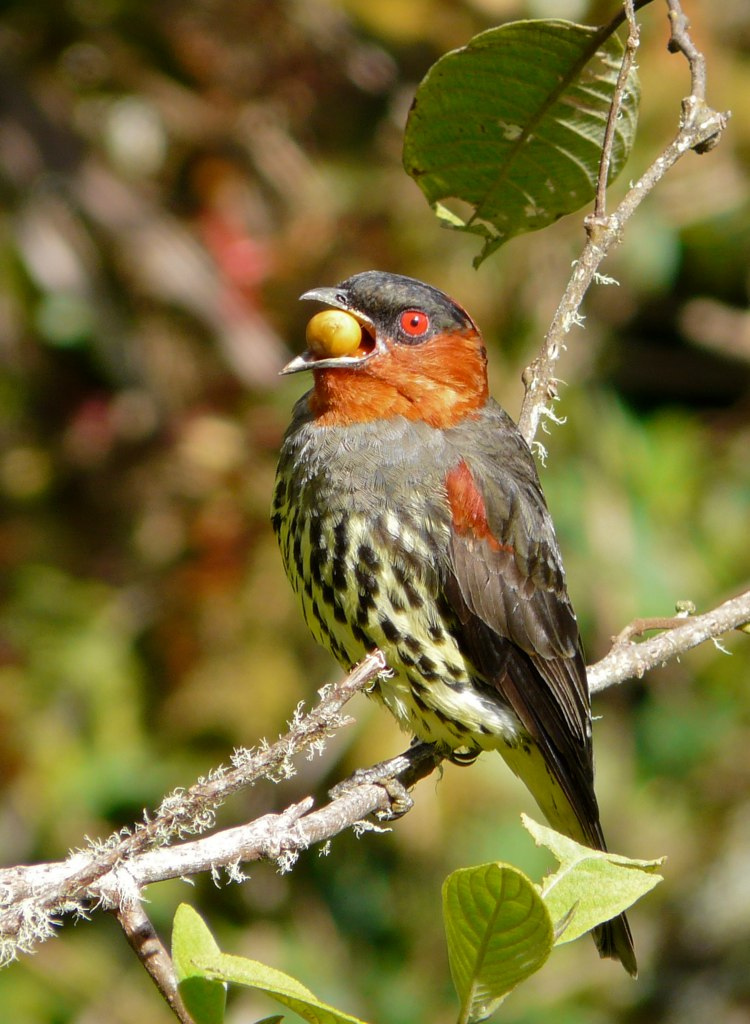
Orange-breasted Fruiteater
Pipreola jucunda
Order: Passeriformes / Family: Cotingidae

Wikimedia Commons
About the Orange-breasted Fruiteater
The Orange-breasted Fruiteater (Pipreola jucunda) is a captivating member of the Cotingidae family, often celebrated for its vivid plumage and distinct ecological niche. This bird inhabits the cloud forests of the Andes, primarily found in Colombia and Ecuador. These montane forests, rich in biodiversity, offer a complex ecosystem where the Orange-breasted Fruiteater plays a significant role as a frugivore, contributing to seed dispersal across its habitat. The bird's presence is a testament to the health of these forests, as it relies on the availability of diverse fruiting plants.
The significance of the Orange-breasted Fruiteater extends beyond its ecological role. Its striking appearance and elusive nature make it a species of interest for birdwatchers and researchers alike. The bird is typically found at elevations ranging from 800 to 2,300 meters, where it participates in the dynamic seasonal shifts of the Andean cloud forests. During the breeding season, it becomes more vocal and visible as it engages in courtship displays and territory establishment. The Orange-breasted Fruiteater's activity patterns and movements are closely tied to the fruiting cycles of the forest, making it a key indicator species for changes in forest health and climate.
Ecologically, the Orange-breasted Fruiteater plays a vital role in maintaining the balance of its environment. As a frugivore, it aids in the dispersal of seeds from a variety of fruiting plants, thereby promoting forest regeneration. This seed dispersal is crucial for the survival of both the bird and the plant species it relies on. The bird's interactions with its habitat highlight the intricate web of relationships that sustain the Andean cloud forests. The Orange-breasted Fruiteater's ability to thrive in these complex ecosystems underscores the importance of preserving its habitat and understanding the impacts of environmental changes on its population.
The Orange-breasted Fruiteater belongs to the family Cotingidae, within the order Passeriformes. These birds typically live up to 10 years, with a maximum recorded of 12 years.
How to Identify a Orange-breasted Fruiteater
Identifying the Orange-breasted Fruiteater in the field can be a rewarding experience. The adult male is unmistakable with its vivid orange breast, contrasting sharply with its green upperparts and black head. The female, while less vibrant, shares the green upperparts but features a more subdued yellowish-orange breast. Juveniles resemble females but have a duller overall appearance.
One of the key identification features is the bird's small size, measuring approximately 18 cm in length. The rounded body and short tail contribute to its robust appearance. In terms of behavior, the Orange-breasted Fruiteater often perches quietly in the mid-canopy, making it challenging to spot despite its bright colors.
When comparing similar species, the Orange-breasted Fruiteater might be confused with other members of the Pipreola genus. However, its unique combination of an orange breast and black head sets it apart. In flight, the bird's silhouette is characterized by rapid wing beats and a slightly undulating pattern, typical of small forest-dwelling birds.
Having trouble telling birds apart? Upload a photo to our bird identification tool for an instant species match.
Orange-breasted Fruiteater Habitat and Range
Preferred Habitat
The Orange-breasted Fruiteater thrives in montane cloud forests, predominantly in Colombia and Ecuador. These forests, rich in mosses and epiphytes, provide a lush and humid environment essential for the bird's survival. The preferred elevation for this species ranges from 800 to 2,300 meters, where the dense canopy offers ample food sources and protection from predators.
Seasonal habitat shifts are minimal, as the bird tends to remain within its preferred altitude range year-round. The species is more frequently found in primary forests, though it can occasionally be spotted in well-preserved secondary growth. Urban presence is rare, as the bird requires the complex structure and microclimate of pristine forest environments to thrive.
Geographic Range
The range of the Orange-breasted Fruiteater is restricted to the humid montane forests of northwestern South America, specifically in Colombia and Ecuador. Within these countries, the bird is found along the western slopes of the Andes. It does not undergo long-distance migration, instead exhibiting altitudinal movements in response to food availability.
Population densities are generally higher in regions with extensive, undisturbed forest cover, such as the Chocó biogeographic region. This area is known for its exceptional biodiversity and is considered a hotspot for avian diversity. The bird's relatively restricted range makes it susceptible to habitat loss, emphasizing the need for targeted conservation efforts.
Want to know which birds visit your area? Browse our backyard birds by location guides for region-specific species lists.
What Does the Orange-breasted Fruiteater Eat?
The diet of the Orange-breasted Fruiteater is primarily frugivorous, consisting mainly of small fruits and berries. It forages by carefully selecting ripe fruits from the mid to upper canopy, using its strong beak to pluck and swallow them whole. During certain seasons, the bird may also consume small insects and other invertebrates, supplementing its diet when fruit availability is low.
The bird's foraging technique involves short flights between fruiting trees, often in the company of mixed-species flocks. This behavior not only aids in locating food but also provides some protection from predators. The Orange-breasted Fruiteater typically feeds during the early morning and late afternoon, avoiding the intense midday heat.
Orange-breasted Fruiteater Behavior and Social Structure
The Orange-breasted Fruiteater exhibits a range of fascinating behaviors that reflect its adaptation to the cloud forest environment. Socially, the bird is known to be relatively solitary or found in pairs, especially during the breeding season. However, it often joins mixed-species flocks to forage, benefiting from collective vigilance against predators.
Territorially, the Orange-breasted Fruiteater is quite vocal during the breeding season, using a series of whistles and trills to establish its presence and ward off potential competitors. The courtship display involves the male showcasing its bright plumage through short flights and perch displays aimed at attracting a mate.
Daily activities are largely dictated by light levels and food availability. The bird is most active during the dawn and late afternoon hours, spending midday resting or preening in the shade of the forest canopy. Its response to predators includes remaining motionless or retreating deeper into the foliage to avoid detection.
Orange-breasted Fruiteater Nesting and Reproduction
Nesting for the Orange-breasted Fruiteater is a carefully orchestrated process, with both sexes participating. The nest is typically a shallow cup constructed from twigs, moss, and leaves, strategically placed in the fork of a tree branch, usually in the mid-canopy.
Clutch size generally consists of two eggs, with an incubation period of around 18-20 days. Both parents share incubation duties, ensuring the eggs are consistently warmed and protected. After hatching, the chicks remain in the nest for approximately 20-25 days before fledging. Throughout this period, both parents are involved in feeding and caring for the young.
The Orange-breasted Fruiteater typically raises one brood per year, although favorable conditions may lead to a second brood. The reliance on specific nesting sites emphasizes the importance of intact forest habitats for successful reproduction.
Orange-breasted Fruiteater Sounds and Vocalizations
The Orange-breasted Fruiteater's primary song is a series of clear, musical whistles, delivered in rapid succession. These notes are high-pitched and can be heard echoing through the forest. In addition to its song, the bird produces a variety of call notes, including short, sharp 'chip' sounds that serve as contact calls between mates or flock members.
Alarm calls are harsher and more urgent, alerting others to the presence of predators. During the dawn chorus, the Orange-breasted Fruiteater is an active participant, its melodious notes contributing to the rich tapestry of sounds that characterize the Andean cloud forests.
Interesting Facts About the Orange-breasted Fruiteater
- 1The Orange-breasted Fruiteater belongs to the Cotingidae family, which includes some of the most strikingly colored birds in the Neotropics.
- 2Despite its vivid colors, the Orange-breasted Fruiteater is often difficult to spot due to its preference for dense mid-canopy perches.
- 3The bird's diet is almost entirely frugivorous, making it an important seed disperser in the ecosystems it inhabits.
- 4The Orange-breasted Fruiteater's range is restricted to the humid montane forests of the Andes, primarily in Colombia and Ecuador.
- 5This species is known for joining mixed-species flocks, which enhances its foraging efficiency and predator avoidance.
- 6The Orange-breasted Fruiteater typically measures about 18 cm in length, with males being slightly more colorful than females.
- 7During courtship, the male performs a display that highlights its bright orange breast to attract a female.
Orange-breasted Fruiteater Conservation Status
The Orange-breasted Fruiteater is currently listed as Least Concern by the IUCN, although its population trend is decreasing. The primary threats to its survival include habitat loss due to deforestation and agriculture expansion in its limited range. Conservation efforts focus on protecting the cloud forests of Colombia and Ecuador, emphasizing the need for sustainable land-use practices and the establishment of protected areas. Historical population changes have been influenced by the ongoing fragmentation of forest habitats, highlighting the urgent need for conservation action to ensure the continued existence of this vibrant species.