
Painted Manakin
Machaeropterus eckelberryi
Order: Passeriformes / Family: Pipridae

Wikimedia Commons
About the Painted Manakin
The Painted Manakin (Machaeropterus eckelberryi) is a small, vividly colored passerine bird belonging to the family Pipridae. This species is predominantly found in the lowland tropical forests of southeastern Peru, where its presence adds a splash of color to the dense, verdant canopy. Its significance extends beyond mere visual appeal; the Painted Manakin plays a crucial role in seed dispersal for various forest plant species. The bright plumage of the male, which serves as an attention-grabbing feature during mating displays, is a subject of interest for both ornithologists and bird enthusiasts alike. The dense forests of the upper Amazon Basin provide the perfect backdrop for the Painted Manakin's life cycle. It thrives in the humid, shaded understory of primary forests, where it can be seen flitting between branches in search of food or a mate. The ecological role of the Painted Manakin is underscored by its fruit-heavy diet, which supports seed dispersion and promotes forest regeneration. Seasonal changes in the Amazon influence the availability of food, which in turn affects the behavior and distribution of this colorful species. During the wet season, when fruiting trees are abundant, the Painted Manakin's activity intensifies. It becomes more vocal and visible in its quest to establish territories and court mates. Conversely, the dry season sees a decrease in fruit abundance, leading the Manakin to expand its foraging range. The Painted Manakin's existence in these biodiverse regions highlights the interconnectedness of ecosystems, where even the smallest creatures have a significant impact on their environment. In the context of ecological balance, the Painted Manakin is a valuable player, contributing to the maintenance of the intricate web of life in Amazonian forests.
The Painted Manakin belongs to the family Pipridae, within the order Passeriformes. These birds typically live 4-6 years in the wild..
How to Identify a Painted Manakin
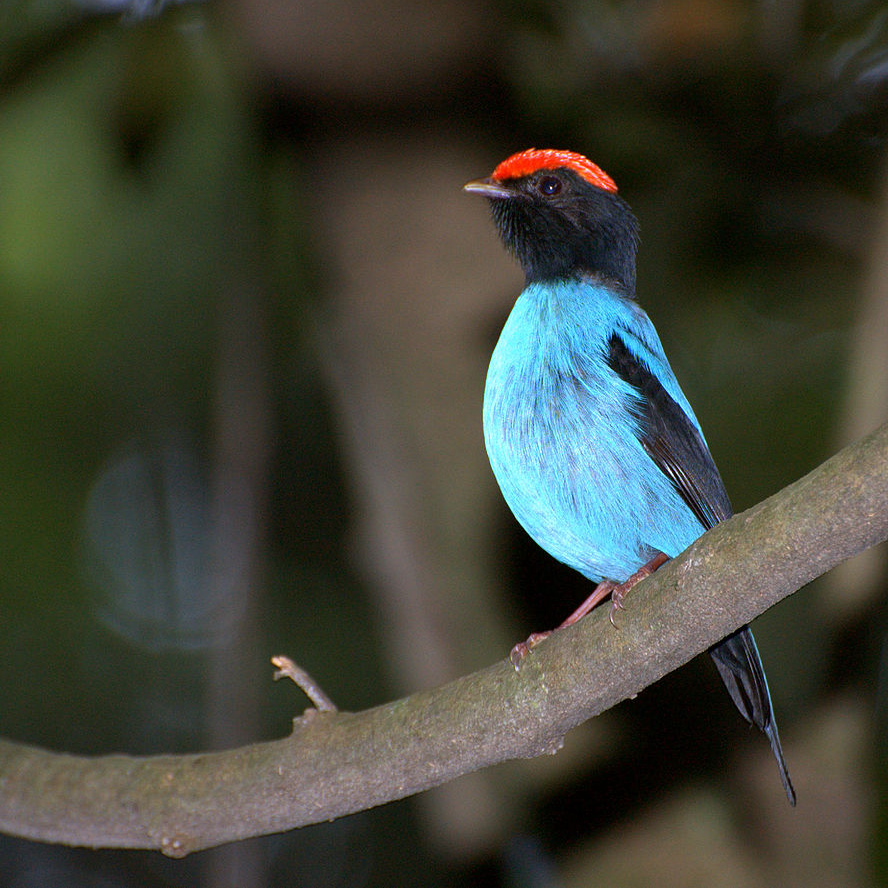
Identifying the Painted Manakin involves observing several distinct field marks. Adult males stand out with their vibrant plumage: a striking combination of bright red upperparts and contrasting black wings and tail. The head features a vivid red crown, while the face and throat are black, creating a bold, eye-catching appearance. Females and juveniles, however, exhibit more subdued coloration. They possess olive-green upperparts that blend seamlessly with the forest foliage, providing effective camouflage. Their underparts are a lighter shade of green, and they lack the males' signature red crown. One might confuse the Painted Manakin with other manakin species, such as the Scarlet-horned Manakin or the Fiery-capped Manakin. However, the Painted Manakin's distinct color pattern, particularly the red crown and contrasting black wings, helps to differentiate it from these similar species. In flight, the Painted Manakin displays a rapid, agile flight pattern, characterized by quick wing beats. When perched, it often adopts an upright stance on thin branches within the canopy, where it can maintain a clear view of its surroundings. Such posture facilitates quick takeoffs, an essential trait for evading predators and pursuing potential mates.
Having trouble telling birds apart? Upload a photo to our bird identification tool for an instant species match.
Painted Manakin Habitat and Range
Preferred Habitat
The Painted Manakin thrives in the lush, tropical lowland forests of the upper Amazon Basin. It favors dense, primary forests with a rich understory that provides ample cover and foraging opportunities. This species is commonly found at elevations ranging from 200 to 800 meters. Within these forests, the Painted Manakin particularly favors areas with abundant fruiting trees, which supply its primary food source. Seasonal shifts in habitat use are minimal, as the Painted Manakin remains closely tied to the forest interior year-round. Unlike some other bird species, it shows little inclination to venture into more open or urbanized areas. Its presence is largely restricted to undisturbed forest habitats where its dietary and nesting needs can be met. The species' reliance on intact forest environments highlights the importance of preserving these ecosystems, not only for the Painted Manakin's survival but also for the overall health of the Amazonian biodiversity.
Geographic Range
The Painted Manakin's range is relatively restricted, with its primary habitat found in southeastern Peru. It inhabits areas within the regions of Madre de Dios and Puno, where the forest conditions are ideal for its survival. While primarily a resident species, the Painted Manakin may exhibit local movements in response to seasonal changes in fruit availability. Its range does not extend significantly beyond these regions, and it does not participate in long-distance migrations. Population densities are highest in areas where fruiting trees are abundant, providing ample food resources. The Painted Manakin's limited range makes it vulnerable to habitat loss and underscores the need for targeted conservation efforts to preserve the pristine forest areas it calls home.
Want to know which birds visit your area? Browse our backyard birds by location guides for region-specific species lists.
What Does the Painted Manakin Eat?
The Painted Manakin's diet predominantly consists of fruits, which play a crucial role in its daily nutritional intake. Its preference for small, fleshy fruits makes it an effective seed disperser, contributing to forest regeneration. During the wet season, when fruit is plentiful, the Painted Manakin's diet is almost exclusively frugivorous. It forages in the understory and mid-levels of the forest, skillfully plucking fruits while hovering or perching. In the dry season, when fruits become scarcer, the Painted Manakin may supplement its diet with small insects and arthropods to meet its protein needs. This dietary flexibility allows it to adapt to seasonal fluctuations in food availability. Foraging typically occurs during the cooler parts of the day, such as early morning and late afternoon, to avoid the midday heat. The Painted Manakin's feeding technique involves short, agile flights between fruiting trees, ensuring a varied diet and aiding in the spread of seeds across its habitat.
Painted Manakin Behavior and Social Structure
The Painted Manakin exhibits a fascinating array of behaviors, particularly in its social interactions and courtship displays. This species is generally solitary, except during the breeding season when males gather in small leks to perform elaborate displays. These displays involve intricate dances, rapid wing flicks, and vocalizations designed to attract females. Males compete for the attention of visiting females, showcasing their vibrant plumage and athletic prowess. Territorial behavior is prominent, with males fiercely defending their display sites against rivals. Outside of the breeding season, the Painted Manakin maintains a more solitary lifestyle, although it may occasionally join mixed-species foraging flocks. Its response to predators involves quick, agile flights into dense foliage, where it can evade capture. Daily activity patterns revolve around foraging during the cooler hours and resting during the peak heat of the day. Such behaviors are essential for the Painted Manakin's survival in the dynamic environment of the Amazon rainforest.
Painted Manakin Nesting and Reproduction
The nesting habits of the Painted Manakin are as intriguing as its courtship displays. Nest construction occurs in the dense understory of the forest, where the female selects a suitable location on a horizontal branch or in a small fork. The nest itself is a cup-shaped structure, intricately woven from plant fibers, leaves, and twigs, providing a secure environment for the eggs. Typically, the female lays a clutch of two to three eggs, which exhibit a cream-colored shell with brown speckles. Incubation duties fall solely on the female, lasting approximately 18 to 20 days until hatching. After the chicks emerge, the female continues to care for them, feeding and protecting them until they fledge, usually around 14 to 16 days post-hatching. The male's role during this period is minimal, with his primary contribution being the courtship efforts that precede nesting. The Painted Manakin generally raises one to two broods per year, depending on food availability and environmental conditions.
Painted Manakin Sounds and Vocalizations
The Painted Manakin's vocalizations are a key component of its courtship and territorial behaviors. Its primary song consists of a series of high-pitched, rapid whistles, often described as a 'tsee-tsee-tsee' sequence. This song serves to establish territory and attract females during the breeding season. Additionally, the Painted Manakin emits various call notes, including sharp 'chip' sounds used for communication between individuals. Alarm calls are harsher and more abrupt, signaling potential threats in the vicinity. During the early morning hours, the Painted Manakin participates in the dawn chorus, adding its distinctive voice to the symphony of forest sounds. Its calls and songs are higher in pitch compared to many other forest birds, making them a unique identifier for those familiar with its repertoire.
Interesting Facts About the Painted Manakin
- 1The Painted Manakin's courtship dance involves a series of rapid, side-to-side hops and wing flicks, a spectacle that lasts several minutes.
- 2Despite its vibrant colors, the Painted Manakin's small size, at just 10 cm long, makes it challenging to spot in dense foliage.
- 3The male's vivid red plumage results from carotenoid pigments, which are derived from its fruit-heavy diet.
- 4Painted Manakins are known to participate in leks, where multiple males display collectively, a behavior seen in only about 200 bird species worldwide.
- 5The species is named in honor of artist Don Eckelberry, who was renowned for his avian illustrations.
- 6Painted Manakins are one of the few bird species that exhibit reversed sexual dimorphism, with males being more colorful than females.
- 7Their lekking behavior has made the Painted Manakin a subject of numerous studies on sexual selection and mating strategies.
Painted Manakin Conservation Status
The IUCN currently lists the Painted Manakin as a species of Least Concern, although its restricted range and specific habitat requirements make it vulnerable to deforestation and habitat degradation. Population trends appear stable, but ongoing threats from logging and land conversion for agriculture remain significant concerns. Conservation efforts focus on preserving the intact forest areas within its range, particularly in southeastern Peru. Historical population data suggest that the Painted Manakin has maintained relatively consistent numbers, thanks in part to the remote nature of its habitats. To ensure its continued survival, conservationists advocate for the protection of large, contiguous forest areas, which serve as critical refuges for the Painted Manakin and numerous other Amazonian species.
Other Pipridae Species


Birds Similar to the Painted Manakin
These species are often confused with the Painted Manakin due to similar appearance or overlapping range.

