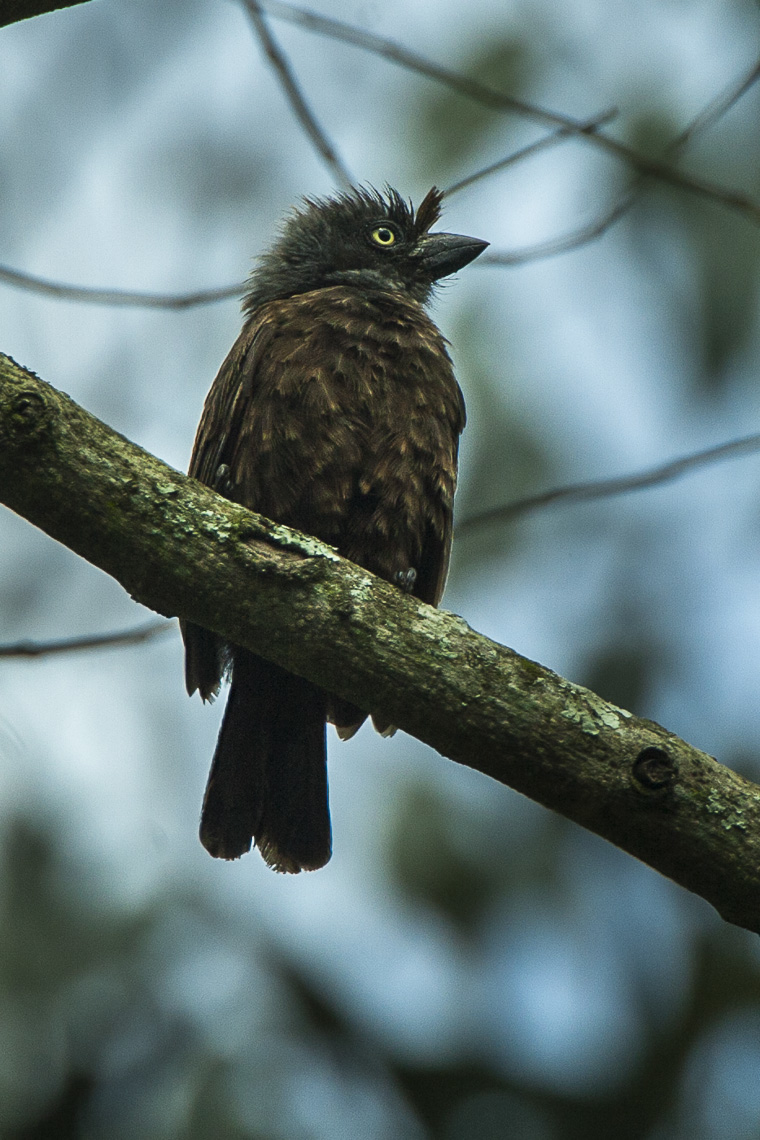
Pale-throated Barbet
Gymnobucco vernayi
Order: Piciformes / Family: Lybiidae
About the Pale-throated Barbet
The Pale-throated Barbet (Gymnobucco vernayi) is a fascinating avian species belonging to the family Lybiidae, widely distributed across the tropical rainforests of Central Africa. Known for its distinctive pale throat, this barbet is an endearing sight among birdwatchers and naturalists. The species plays a significant ecological role as both a seed disperser and a consumer of various insects, contributing to the health and diversity of its forest habitat. The Pale-throated Barbet is commonly found in countries such as the Democratic Republic of the Congo, Cameroon, and Gabon, where it resides in lowland and montane forests. Its presence is notable in protected areas like the Virunga National Park, where it finds refuge among the dense canopy and abundant fruiting trees. This bird's significance extends beyond its ecological role; it serves as an indicator of forest health due to its reliance on intact ecosystems. The Pale-throated Barbet also participates in seasonal behaviors, particularly during the breeding season, when both males and females engage in vocal displays to defend territories and attract mates. As a non-migratory species, it remains largely sedentary, although it may move short distances in response to changes in food availability. Its ecological role is further highlighted by its interactions with other species, including the mutualistic relationship it shares with fruiting plants. By consuming fruits and subsequently dispersing seeds, the Pale-throated Barbet aids in forest regeneration, ensuring the survival of plant species that rely on avian dispersal mechanisms. As a frugivore, its diet consists predominantly of fruits, but it also consumes insects, providing a form of pest control within its habitat. This dual diet allows the Pale-throated Barbet to adapt to seasonal variations in food supply, showcasing its resilience in the face of environmental changes. The Pale-throated Barbet's continued presence in Central Africa's forests underlines its importance not only as a species but also as a component of the region's rich biodiversity.
The Pale-throated Barbet belongs to the family Lybiidae, within the order Piciformes. These birds typically live average 9 years with a maximum recorded of 13 years..
How to Identify a Pale-throated Barbet
The Pale-throated Barbet is a medium-sized bird, measuring about 18 cm in length. Its most distinguishing feature is its pale throat, contrasting with the darker gray-brown plumage on its head and back. Adults exhibit a mottled appearance, with fine streaks of white on their chest and underparts, which help in camouflaging them within the forest canopy. Juvenile birds, however, possess a less pronounced pale throat and a more uniform brown plumage, making them slightly harder to identify. Males and females are similar in appearance, with no significant differences in plumage, which can make sexing them challenging in the field. The bird's stout bill is another key identification feature, adapted for its frugivorous diet. When it comes to similar species, the Pale-throated Barbet can be confused with the Bristle-nosed Barbet, but the latter lacks the distinctive pale throat and has a more pronounced bristled appearance around the nostrils. Observing the bird in flight, one notes its rapid wingbeats and short, direct flight pattern, typical of barbets. Perched, the Pale-throated Barbet maintains a horizontal posture, often seen clinging to branches or hanging upside down while foraging for fruit.
Having trouble telling birds apart? Upload a photo to our bird identification tool for an instant species match.
Pale-throated Barbet Habitat and Range
Preferred Habitat
The Pale-throated Barbet resides primarily in lowland and montane tropical forests, thriving in regions with dense canopy cover and abundant fruiting trees. It favors areas with a mix of primary and secondary growth, where it can exploit a variety of food resources. This bird is commonly found at elevations ranging from sea level to about 2,000 meters, though it prefers lower elevations where fruit availability is higher. Unlike some species, it does not typically venture into urban areas, preferring the undisturbed forest environments of Central Africa. Seasonal habitat shifts are minimal, as the Pale-throated Barbet is non-migratory, but it may alter its foraging areas within the forest based on fruiting patterns of trees. Although primarily a forest dweller, the bird occasionally visits forest edges, especially when abundant fruiting trees are present.
Geographic Range
The Pale-throated Barbet's range is restricted to the tropical forests of Central Africa, with populations concentrated in nations such as the Democratic Republic of the Congo, Cameroon, and Gabon. It does not exhibit long-distance migration, maintaining a relatively stable presence within its range year-round. However, local movements in search of food are common, particularly during periods when fruit is scarce in a given area. Population density hotspots include protected areas like Korup National Park in Cameroon and the Congo Basin's extensive forest ecosystem. These regions offer the necessary habitat and food resources that sustain healthy populations of the Pale-throated Barbet. While the bird's range does not extend into seasonal migration corridors, it remains a consistent presence in its preferred forest habitat throughout the year.
Want to know which birds visit your area? Browse our backyard birds by location guides for region-specific species lists.
What Does the Pale-throated Barbet Eat?
The Pale-throated Barbet primarily feeds on a diet of fruits, which constitutes the bulk of its nutritional intake. It favors figs and berries, which are abundant in its forest habitat, but it also consumes other fruits depending on seasonal availability. Insects make up a secondary component of its diet, providing essential protein, especially during the breeding season when energy demands are higher. The bird employs a variety of foraging techniques, such as gleaning fruit directly from branches or capturing insects mid-flight. Typically, the Pale-throated Barbet forages in the canopy or sub-canopy, rarely descending to the forest floor. Its feeding schedule is diurnal, with peak activity occurring in the early morning and late afternoon when temperatures are cooler and fruiting trees are most accessible. The bird's foraging behavior involves both solitary and social feeding, often joining mixed-species flocks to exploit concentrated food resources.
Pale-throated Barbet Behavior and Social Structure
The Pale-throated Barbet exhibits fascinating social behavior, often found in small groups or family units. These birds maintain a structured social hierarchy, with dominant individuals asserting control over preferred foraging areas and nesting sites. Territorial behavior is pronounced during the breeding season, with both males and females engaging in vocal displays to deter intruders and establish territory boundaries. Courtship displays involve mutual preening and the presentation of food items, strengthening pair bonds. The Pale-throated Barbet rarely forms large flocks, preferring the company of a few conspecifics or joining mixed-species foraging parties. In response to predators, it employs alarm calls to alert fellow group members, often seeking refuge within dense foliage. Daily activity patterns are diurnal, with periods of rest during the hottest part of the day. The bird's adaptability is evident in its ability to adjust its foraging strategies based on food availability and competition from other frugivores.
Pale-throated Barbet Nesting and Reproduction
The Pale-throated Barbet nests in tree cavities, often utilizing abandoned woodpecker holes or natural cavities in old trees. It may also excavate its own nesting site if suitable cavities are unavailable. Nesting materials include soft plant fibers and leaves, which line the cavity to provide a comfortable environment for the eggs. Clutch sizes typically range from 2 to 4 eggs, with both parents participating in incubation, which lasts about 14 days. After hatching, the chicks remain in the nest for approximately three weeks before fledging. Parental roles are shared, with both males and females involved in feeding and protecting the young. The Pale-throated Barbet generally raises one brood per year, although in favorable conditions with abundant food, a second brood may be attempted. Nest site fidelity is common, with birds returning to the same location in successive years if conditions remain suitable.
Pale-throated Barbet Sounds and Vocalizations
The Pale-throated Barbet's vocalizations include a series of rapid, repetitive notes that create a rhythmic, chattering song. This primary song serves both territorial and mate attraction purposes, often described as a 'purr' or 'churr.' Call notes are shorter and less complex, used for communication between individuals within a group. Alarm calls are sharper and more urgent, signaling the presence of predators. The bird participates in a dawn chorus, where its calls contribute to the symphony of forest sounds at sunrise. Comparatively, its song is less melodic than that of some other barbet species, characterized more by its rhythm and persistence than tonal quality.
Interesting Facts About the Pale-throated Barbet
- 1The Pale-throated Barbet can consume up to 20 different fruit species in a single day, showcasing its dietary adaptability.
- 2This barbet's stout bill is not only useful for eating fruit but also for excavating nesting cavities in trees.
- 3Despite its sedentary nature, the Pale-throated Barbet can travel several kilometers in search of food.
- 4The bird's vocalizations can be heard up to 100 meters away, helping to maintain territory boundaries.
- 5Pale-throated Barbets often join mixed-species flocks, increasing their foraging efficiency and reducing predation risk.
- 6Their nesting success rate improves with abundant fruit availability, emphasizing the importance of healthy ecosystems.
- 7The Pale-throated Barbet's role as a seed disperser aids in maintaining forest biodiversity and resilience.
Pale-throated Barbet Conservation Status
According to the IUCN Red List, the Pale-throated Barbet is currently listed as Least Concern, indicating a stable global population. However, habitat loss due to deforestation poses a significant threat to its long-term survival. Conservation efforts focus on preserving large tracts of intact forest and establishing protected areas such as national parks. Historical fluctuations in population sizes have been linked to changes in forest cover, with declines observed in regions experiencing heavy logging or agricultural expansion. Collaborative efforts between governments and conservation organizations aim to mitigate these threats through sustainable land-use practices and habitat restoration initiatives.