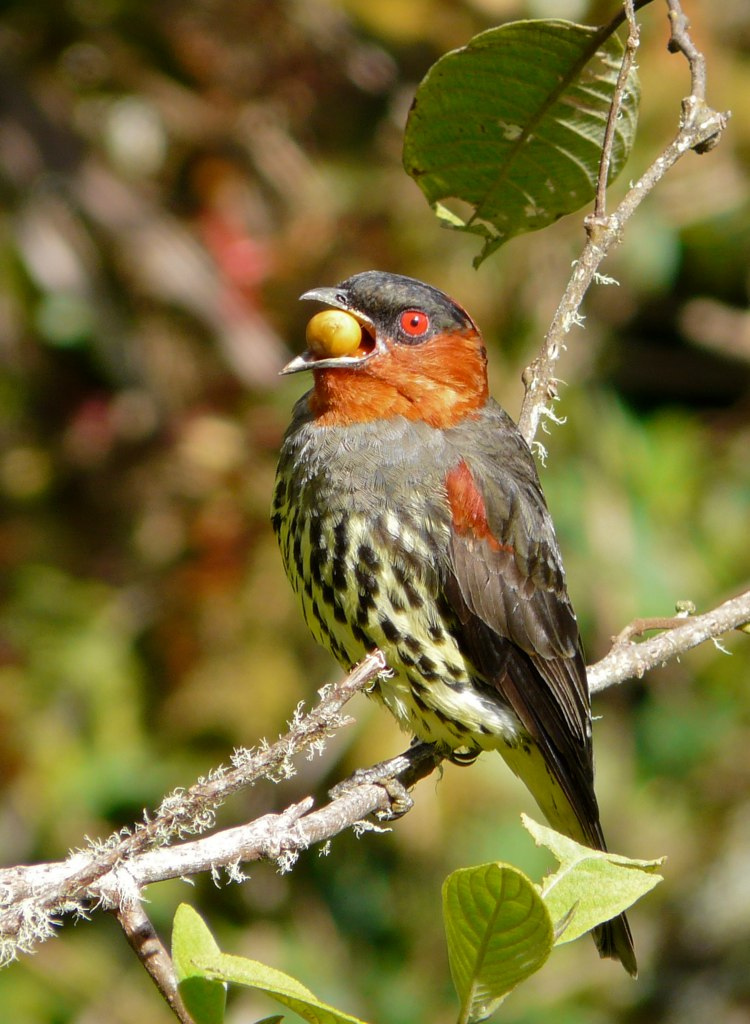
Peruvian Plantcutter
Phytotoma raimondii
Order: Passeriformes / Family: Cotingidae

Wikimedia Commons
About the Peruvian Plantcutter
The Peruvian Plantcutter is a captivating species endemic to the dry coastal regions of northern Peru. This bird, belonging to the family Cotingidae, is notable for its strict vegetarian diet, which is unusual among passerines. It primarily inhabits the dry forest and scrubland habitats found in the Sechura Desert and the adjacent areas. Here, it plays a crucial ecological role as both a seed disperser and a consumer of leaves. Historically, the Peruvian Plantcutter has been observed along the northern coastal regions from Piura to Lambayeque, thriving in habitats dominated by Prosopis pallida, commonly known as the mesquite tree. This tree serves as a critical resource for the plantcutter, providing both food and nesting sites. The bird's presence in these ecosystems highlights its importance in maintaining the ecological balance, particularly in seed dispersion and vegetation control. The Peruvian Plantcutter is a year-round resident in its restricted range, showing little to no migratory behavior. Its activities are closely tied to the seasonal availability of food, specifically leaves and shoots, which it skillfully clips with its specialized bill. During the wet season, the plantcutter takes advantage of the lush growth of foliage, while in the dry months, it relies on the more drought-resistant plant species that remain green. This adaptation to seasonal changes in food availability underscores the plantcutter’s resilience and its niche specialization. The Peruvian Plantcutter's habitat is under pressure from human activities, particularly urban expansion, agriculture, and deforestation. These threats have led to a decline in suitable habitats, which in turn affects the bird's population. Conservation efforts are paramount to ensure the survival of this unique species, focusing on habitat preservation and restoration. The plantcutter’s significance extends beyond its immediate ecological role, serving as an indicator of the health of its dry forest ecosystems. Protecting the Peruvian Plantcutter will contribute to the overall conservation of these biodiverse but vulnerable habitats.
The Peruvian Plantcutter belongs to the family Cotingidae, within the order Passeriformes. These birds typically live average 5-7 years in the wild..
How to Identify a Peruvian Plantcutter
The Peruvian Plantcutter exhibits a distinctive appearance, making it relatively easy to identify in the field. Adult males display a striking combination of reddish-brown and gray plumage. The head, nape, and back are primarily gray, while the breast and belly show a rich reddish-brown hue. This color contrast is a key field mark that distinguishes males from other similar species. Females, on the other hand, are more subdued in coloration, with a predominantly olive-brown body and less pronounced red on the underparts. Juveniles resemble females but have even duller tones and lack the full intensity of adult coloration. One of the plantcutter's most distinctive features is its bill, which is short, stout, and adapted for cutting vegetation, a trait not commonly seen in passerines. This bill shape is essential for its folivorous diet. In flight, the Peruvian Plantcutter shows a characteristic silhouette with broad, rounded wings and a somewhat short tail, which aids in maneuverability among dense foliage. When perched, the plantcutter often sits upright with a slight forward tilt, a posture that, along with its unique coloration, helps birdwatchers and researchers identify it in its natural environment. The bird's size, typically around 18-19 cm in length, falls within the small to medium range for passerines, making it an unobtrusive yet fascinating subject for observation.
Having trouble telling birds apart? Upload a photo to our bird identification tool for an instant species match.
Peruvian Plantcutter Habitat and Range
Preferred Habitat
The Peruvian Plantcutter inhabits the dry forest and scrublands typical of northern Peru's coastal Sechura Desert. These areas are characterized by sparse, thorny vegetation, including Prosopis pallida and Acacia species, which provide essential food and nesting resources. The bird favors regions where such vegetation remains dense enough to offer cover and sustenance, but it avoids areas heavily altered by agriculture or urbanization. The plantcutter is primarily found at elevations ranging from sea level to about 500 meters. While it may occasionally venture into more disturbed habitats, such as agricultural fields or urban fringes, it predominantly remains within native dry forest environments. Seasonal habitat shifts are minimal, as the plantcutter relies on the consistent presence of foliage provided by drought-resistant plant species. Urban development poses a significant threat to its preferred habitats, emphasizing the need for targeted conservation efforts to preserve these critical areas.
Geographic Range
The Peruvian Plantcutter's range is confined to the northern coastal region of Peru, specifically within the departments of Piura and Lambayeque. It does not exhibit any migratory behavior, remaining a year-round resident within this limited geographical area. The plantcutter's population is most concentrated in the dry forest and scrubland habitats of the Sechura Desert. Within this range, specific hotspots of population density correspond to areas where Prosopis pallida is abundant, as these trees form a cornerstone of the bird's diet and nesting preferences. While the bird does not migrate, it may exhibit short-range movements in response to local food availability, particularly during periods of drought or after heavy rains that influence vegetation growth. The Peruvian Plantcutter’s restricted range and specialized habitat requirements make it vulnerable to environmental changes and habitat destruction, necessitating active conservation measures to ensure its continued survival.
Want to know which birds visit your area? Browse our backyard birds by location guides for region-specific species lists.
What Does the Peruvian Plantcutter Eat?
The Peruvian Plantcutter's diet is unique among passerines due to its strict vegetarian nature. Its primary food sources include leaves, shoots, and young stems from a variety of native plant species, with a strong preference for Prosopis pallida. This diet is facilitated by its specialized bill, which allows the bird to skillfully clip foliage. During the wet season, the plantcutter’s diet expands as a greater diversity of plant growth becomes available. In contrast, the dry season diet relies heavily on the more drought-resistant species that retain their foliage. The plantcutter forages in small groups, often moving through the mid to upper levels of vegetation in search of fresh leaves. Its feeding schedule is largely diurnal, with peak activity occurring during the cooler morning and late afternoon hours, aligning with the availability of tender leaves. The plantcutter’s feeding habits play a crucial role in seed dispersion within its habitat, indirectly supporting the regeneration of native plant species.
Peruvian Plantcutter Behavior and Social Structure
The Peruvian Plantcutter exhibits a variety of behaviors that reflect its adaptation to a specialized niche. Socially, it may be found alone or in small family groups, often consisting of a mating pair and their offspring. The plantcutter is generally non-territorial, although it will defend a chosen feeding area or nesting site from intruders if necessary. During the breeding season, males engage in simple courtship displays, which include vocalizations and posturing to attract females. While not known for grand displays, the subtlety of their courtship rituals reflects the bird's understated elegance. The plantcutter’s daily activity pattern is largely diurnal, with foraging and social interactions peaking in the early morning and late afternoon. In the face of predators, the bird relies on its cryptic plumage to blend into the surrounding vegetation, often remaining motionless until the threat passes. The plantcutter’s response to potential threats underscores its reliance on camouflage and habitat for survival. Unlike many bird species, the Peruvian Plantcutter does not form large flocks, preferring the company of a few individuals, which may assist in reducing competition for limited food resources.
Peruvian Plantcutter Nesting and Reproduction
The Peruvian Plantcutter constructs simple yet effective nests, typically located in the dense foliage of mesquite trees such as Prosopis pallida. These nests are cup-shaped and composed of twigs, leaves, and other plant materials, providing a secure environment for raising young. The preferred nesting sites are usually between 1 to 3 meters above ground, offering protection from ground predators and access to nearby food sources. The typical clutch size for this species ranges from two to three eggs, which are incubated primarily by the female. The incubation period lasts approximately 14-16 days, during which the male may assist by providing food to the female. Once hatched, the chicks remain in the nest for about 18-20 days, during which both parents partake in feeding and caring for the young. The fledging timeline ensures that the chicks develop sufficient strength and skills before leaving the nest. The Peruvian Plantcutter generally produces one to two broods per year, depending on environmental conditions and food availability.
Peruvian Plantcutter Sounds and Vocalizations
The Peruvian Plantcutter's vocalizations are a key aspect of its behavior, characterized by a series of soft, musical notes that carry through its arid habitat. The primary song consists of a rhythmic sequence of short whistles and chirps, delivered with a melodic quality that stands out against the harsh desert backdrop. In addition to its song, the plantcutter emits a variety of call notes, including sharp 'chit' sounds used in communication between mates or family members. Alarm calls are more abrupt and harsh, serving to warn others of potential danger. During the dawn chorus, the plantcutter contributes its song alongside other desert-dwelling birds, creating a symphony that marks the start of the day. The bird's vocal repertoire, while not as varied as some songbirds, plays an essential role in maintaining social bonds and defending territory.
Interesting Facts About the Peruvian Plantcutter
- 1The Peruvian Plantcutter is one of the few passerines with a vegetarian diet, primarily consuming leaves.
- 2This bird's range is restricted to the coastal regions of northern Peru, making it an endemic species.
- 3The specialized bill of the Peruvian Plantcutter allows it to efficiently clip foliage, a unique adaptation.
- 4The plantcutter plays a significant role in seed dispersal, aiding in the regeneration of native plant species.
- 5Despite its limited range, the Peruvian Plantcutter contributes to the biodiversity of the Sechura Desert.
- 6The bird's conservation status has spurred efforts to protect its habitat from further degradation.
- 7The plantcutter's vocalizations, though simple, are a vital part of its communication and social interaction.
Peruvian Plantcutter Conservation Status
The IUCN currently lists the Peruvian Plantcutter as Endangered, with its population trend showing a concerning decline. Habitat loss due to agriculture, urban expansion, and deforestation poses the greatest threat to this species. Conservation efforts focus on habitat preservation, including the protection of key areas within its range and restoration of degraded habitats. Organizations are also working to increase public awareness and engage local communities in conservation initiatives. Historically, the plantcutter's population was more widespread, but human activities have fragmented its habitat, leading to isolated populations. Continuous monitoring and research are essential to inform conservation strategies and ensure the survival of this unique bird.