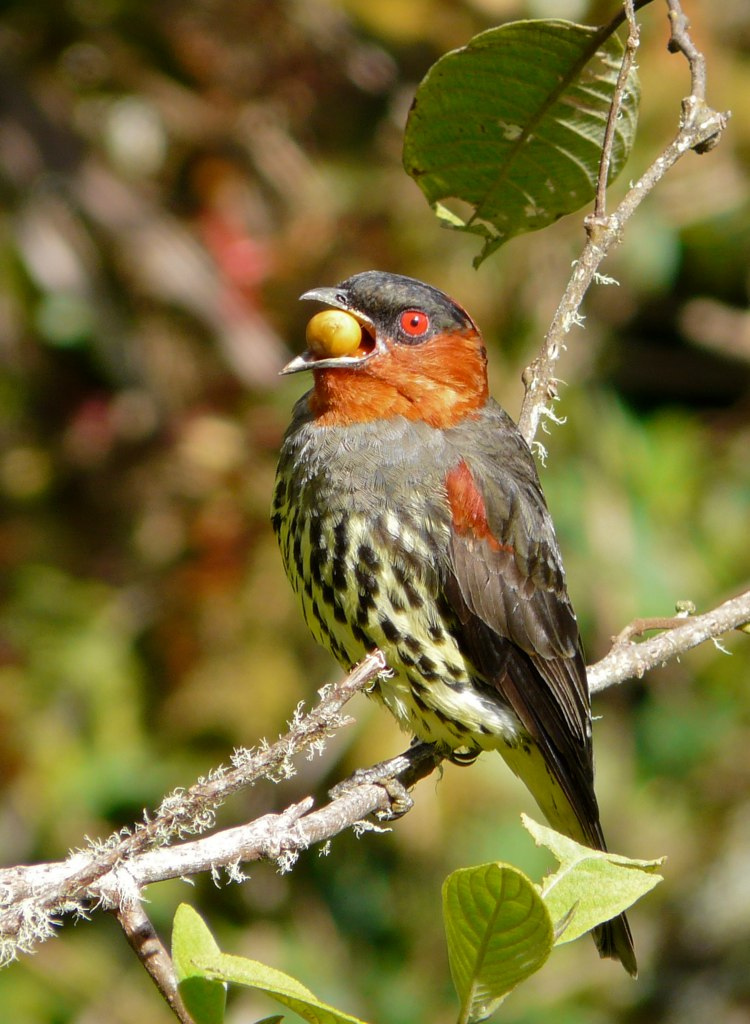
Purple-breasted Cotinga
Cotinga cotinga
Order: Passeriformes / Family: Cotingidae

Wikimedia Commons
About the Purple-breasted Cotinga
The Purple-breasted Cotinga (Cotinga cotinga) is a visually arresting bird residing in the lush tropical forests of South America. Its vibrant plumage, particularly the male's, sets it apart as one of the most colorful members of the Cotingidae family. This species is predominantly found in the Amazon Basin, spanning countries like Brazil, Colombia, and Peru, where it thrives in the dense canopy of lowland rainforests. These birds play a critical role in the ecosystem as seed dispersers, aiding in the maintenance of their forest habitats by feeding on a variety of fruits. The Purple-breasted Cotinga's presence underscores the rich biodiversity of its environment, often serving as an indicator of forest health. While they are non-migratory, these birds exhibit some seasonal movements within their habitat, typically in search of food resources. The males' striking purple and blue hues contrast beautifully with the females' more subdued greenish-brown tones, a common sexual dimorphism in bird species that engage in such visually driven courtship displays. Throughout the year, the Purple-breasted Cotinga is most active during the day, when it can be observed flitting through the canopy, its vibrant colors and melodious calls leaving a lasting impression on any fortunate observer. The cotinga's ecological role extends beyond seed dispersal, as it also contributes to the control of insect populations, balancing the forest ecosystem. Observing these birds in their natural habitat provides invaluable insights into the interconnectedness of tropical forest ecosystems and the species that inhabit them. In addition, their reliance on intact forest environments makes them particularly vulnerable to habitat destruction, underscoring the importance of conservation efforts to protect these vital regions. Through their ecological contributions and the aesthetic pleasure they provide, Purple-breasted Cotingas are both a symbol of tropical biodiversity and a reminder of the need for sustainable environmental stewardship.
The Purple-breasted Cotinga belongs to the family Cotingidae, within the order Passeriformes. These birds typically live typically 8-9 years, with some individuals reaching 11 years..
How to Identify a Purple-breasted Cotinga
The Purple-breasted Cotinga is a medium-sized bird, typically measuring around 18 centimeters in length. Adult males are particularly striking, with an iridescent purple breast and a bright blue back, making them easily distinguishable from other species. Females, on the other hand, exhibit a more camouflaged appearance with greenish-brown plumage that helps them blend into the forest environment. Juveniles resemble females but with less distinct markings and a more muted coloration. In flight, the cotinga's silhouette is compact, with rounded wings and a short tail. Despite their vibrant colors, their flight is often silent, allowing them to move through the canopy with little detection. Perched high in the trees, their upright posture and vivid plumage make males particularly conspicuous during courtship displays. While there are other bright-colored birds in the region, such as tanagers and manakins, the Purple-breasted Cotinga's unique color combination and size help prevent confusion. Their distinct calls, alongside their plumage, further aid in identification, especially in dense forest habitats where visual sightings may be challenging.
Having trouble telling birds apart? Upload a photo to our bird identification tool for an instant species match.
Purple-breasted Cotinga Habitat and Range
Preferred Habitat
The Purple-breasted Cotinga primarily inhabits tropical lowland rainforests, favoring dense canopy environments where it can forage for fruit. These birds are most commonly found at elevations below 1,000 meters, though they may venture slightly higher in search of food. They are largely absent from urban areas, preferring the undisturbed expanses of forest that provide both sustenance and shelter. During the breeding season, they may be observed in more open forest edges, where males perform courtship displays. Seasonal habitat shifts are minimal, as these birds do not migrate long distances, relying instead on the diverse fruit availability within their forest range. Because they are highly dependent on forest cover, they are rarely found in deforested or heavily disturbed areas, highlighting the importance of conserving their natural habitats.
Geographic Range
The range of the Purple-breasted Cotinga extends across the Amazon Basin, primarily within countries such as Brazil, Colombia, Venezuela, and Peru. Although they are non-migratory, their presence is more concentrated in regions with abundant fruiting trees. This distribution pattern makes them particularly common in the central Amazon, where dense forests offer ample foraging opportunities. In terms of population density, hotspots occur in areas of undisturbed forest, though precise numbers can fluctuate with fruit availability and habitat conditions. The absence of migratory behavior means that their range remains relatively constant throughout the year, with only minor local movements influenced by food resources. Despite their relatively stable range, habitat fragmentation poses a significant threat, potentially limiting their distribution in the future.
Want to know which birds visit your area? Browse our backyard birds by location guides for region-specific species lists.
What Does the Purple-breasted Cotinga Eat?
The diet of the Purple-breasted Cotinga primarily consists of fruits, making them important seed dispersers in their ecosystem. They favor berries and other small fruits, which they consume during the day while perched high in the canopy. Their foraging technique involves short flights between fruiting trees and brief periods of hovering to access hard-to-reach fruits. Although fruits form the bulk of their diet, they also occasionally consume insects, supplementing their nutritional intake. Seasonal variations in fruit availability can lead to shifts in dietary focus, with some periods seeing an increased consumption of insects. The cotinga's feeding schedule is primarily diurnal, with peak foraging activity occurring in the early morning and late afternoon, times when fruiting trees are most accessible and competition with other frugivores is minimal.
Purple-breasted Cotinga Behavior and Social Structure
The Purple-breasted Cotinga exhibits a fascinating array of behaviors, particularly in social and courtship contexts. Males are known for their elaborate courtship displays, which involve showcasing their vibrant plumage and performing aerial maneuvers to attract females. These displays often occur in small clearings or at the edges of the forest, where visibility is greatest. While generally solitary, these birds may form loose associations during foraging, particularly in areas of abundant fruit. Territorial behavior is not especially pronounced, as their primary resources, fruits, are widely distributed. However, males do defend display territories during the breeding season to ensure access to potential mates. In the face of predators, the cotinga relies on its coloration for concealment, remaining still amidst foliage to avoid detection. Daily activity patterns are largely influenced by feeding, with periods of rest interspersed between active foraging sessions.
Purple-breasted Cotinga Nesting and Reproduction
The nesting habits of the Purple-breasted Cotinga reflect their adaptation to life in the forest canopy. They construct shallow cup nests using twigs, leaves, and moss, often placed on horizontal branches high above the ground. Nest location preference leans towards areas with dense foliage, providing concealment from predators. A typical clutch consists of two to three eggs, with the female primarily responsible for incubation over a period of about two weeks. Once hatched, the young remain in the nest for approximately three weeks before fledging. Both parents participate in feeding the chicks, bringing back a diet primarily composed of regurgitated fruit. The species generally raises one brood per year, though under favorable conditions, a second brood may be attempted.
Purple-breasted Cotinga Sounds and Vocalizations
The vocalizations of the Purple-breasted Cotinga are both distinctive and melodic. Their primary song consists of a series of clear, flute-like notes, often repeated in a rising and falling sequence. These calls play a crucial role in mate attraction and territory establishment, resonating through the forest canopy. In addition to their song, they produce a variety of call notes, including soft whistles and harsh chattering sounds used for communication with mates or to signal alarm. During the dawn chorus, the cotinga's song can be one of the most prominent, contributing to the rich tapestry of sounds that characterize the tropical forest at daybreak.
Interesting Facts About the Purple-breasted Cotinga
- 1The Purple-breasted Cotinga's vibrant plumage is not due to pigments but rather the microscopic structure of its feathers reflecting light.
- 2Unlike many birds, the Purple-breasted Cotinga does not have a complex vocal organ, yet it produces a surprisingly melodious song.
- 3This species can consume fruits that are toxic to other animals, contributing to its role as a unique seed disperser in its ecosystem.
- 4During courtship, males may perform up to 12 different aerial displays to attract a mate, showcasing their agility and endurance.
- 5The cotinga's diet can vary widely based on seasonal fruit availability, demonstrating their adaptability to changing environmental conditions.
- 6Despite its brilliant colors, the Purple-breasted Cotinga can be surprisingly difficult to spot in the dense forest canopy.
- 7The species' preference for high canopy nesting sites reduces predation risk, a crucial factor for reproductive success.
Purple-breasted Cotinga Conservation Status
The Purple-breasted Cotinga is currently listed as least concern by the IUCN, reflecting a relatively stable population trend. However, its dependence on intact forest environments makes it susceptible to threats from deforestation and habitat fragmentation, particularly in the Amazon Basin. Conservation efforts focus on preserving large tracts of rainforest and reducing illegal logging activities. Historically, population numbers have remained stable due to the vastness of their habitat, but ongoing environmental pressures necessitate continued vigilance. Protected areas and sustainable land management practices are essential to ensuring the long-term survival of this visually and ecologically significant species.