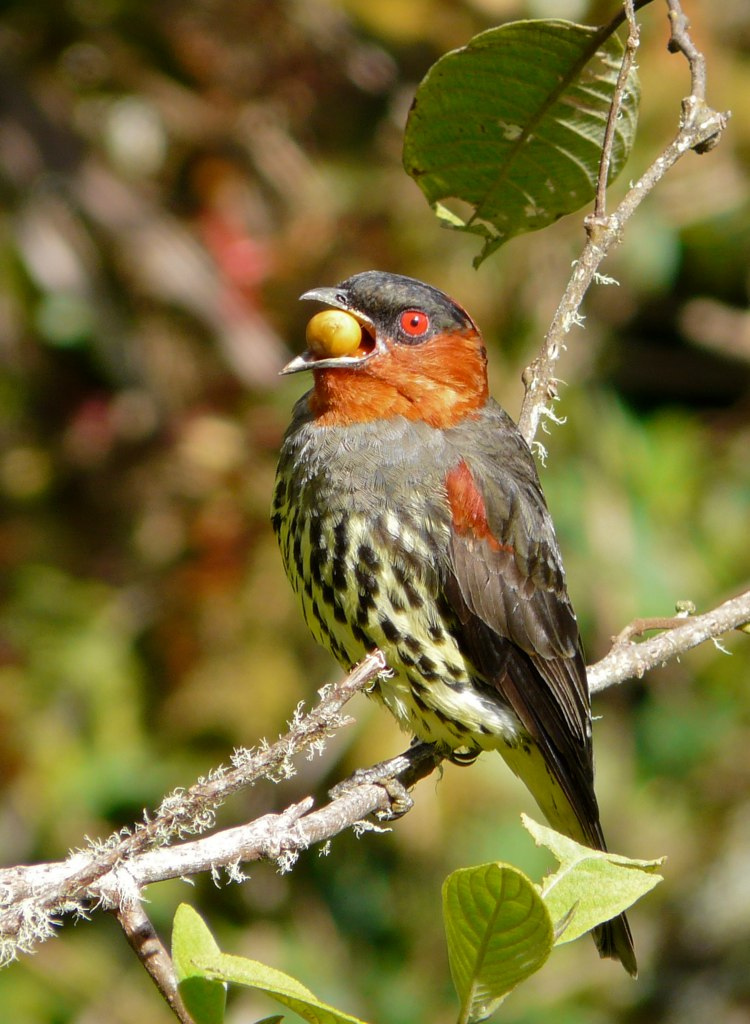
Purple-throated Cotinga
Porphyrolaema porphyrolaema
Order: Passeriformes / Family: Cotingidae

Wikimedia Commons
About the Purple-throated Cotinga
The Purple-throated Cotinga (Porphyrolaema porphyrolaema) is a striking member of the Cotingidae family, known for its vibrant plumage and elusive nature. Found predominantly in the lowland rainforests of the Amazon Basin, this bird's range spans across several countries including Brazil, Peru, and Colombia. Its significance in the ecosystem is not just visual; it plays a crucial role in seed dispersal due to its fruit-heavy diet, aiding in the regeneration of tropical flora. This cotinga's preferred habitat includes the dense canopy of primary forests, where it can often be seen perched high in the trees. Seasonal behaviors of the Purple-throated Cotinga include minor altitudinal movements in response to fruit availability, though it is not known for extensive migratory patterns. Often, these birds are seen alone or in pairs, as they do not form large flocks. The male Purple-throated Cotinga, with its metallic purple throat and deep blue body, is particularly eye-catching, while the female is more subdued in coloration, featuring a blend of browns and blues. Their presence in the rainforest canopy highlights the incredible biodiversity of the region, as they share their habitat with countless other species of birds, mammals, and insects. Their role as both predator and prey links them intricately to their ecosystem, making them vital to the health of their environment.
The Purple-throated Cotinga belongs to the family Cotingidae, within the order Passeriformes. These birds typically live average 8 years with a maximum recorded of 12 years..
How to Identify a Purple-throated Cotinga
The adult male Purple-throated Cotinga is unmistakable with its iridescent purple throat, contrasting against a vibrant blue body. The rest of its plumage, including the head and back, retains a rich cobalt hue that can appear almost black in certain lighting. Females, on the other hand, exhibit a more cryptic coloration with a combination of dull blues and browns, aiding in camouflage within the forest canopy. Juvenile birds resemble females but lack the full development of adult plumage. One might confuse the Purple-throated Cotinga with the Spangled Cotinga; however, the latter lacks the distinctive purple throat and is more uniformly blue with spangled white spots. In flight, the Purple-throated Cotinga's silhouette is relatively compact with broad, rounded wings and a short tail, a shape well-suited for maneuvering through dense foliage. When perched, these birds often sit upright on high branches, providing a clear view of their vivid plumage against the green backdrop of the forest.
Having trouble telling birds apart? Upload a photo to our bird identification tool for an instant species match.
Purple-throated Cotinga Habitat and Range
Preferred Habitat
The Purple-throated Cotinga thrives in the humid lowland rainforests of the Amazon Basin, predominantly found in countries like Brazil, Peru, and Colombia. These birds favor the dense canopy layer where fruit is abundant. Typically, they inhabit elevations from sea level up to approximately 900 meters. While they show some flexibility in habitat preference, they are mostly associated with primary forests rather than secondary growth or heavily disturbed areas. There is little evidence of the Purple-throated Cotinga venturing into urban environments, as their lifestyle and dietary needs are closely tied to undisturbed forest ecosystems.
Geographic Range
The Purple-throated Cotinga's range is primarily restricted to the Amazon Basin, with a presence in countries such as Brazil, Peru, Colombia, Ecuador, and Bolivia. They are considered non-migratory, residing year-round in these tropical regions. Within this range, population densities can vary, with higher concentrations in areas where fruit-bearing trees are prolific. However, due to habitat specificity, they are not uniformly distributed across their range and are more frequently observed in protected areas and national parks where primary forest conditions are maintained.
Want to know which birds visit your area? Browse our backyard birds by location guides for region-specific species lists.
What Does the Purple-throated Cotinga Eat?
The diet of the Purple-throated Cotinga is predominantly frugivorous, focusing heavily on a variety of fruits and berries available in the rainforest canopy. During fruiting seasons, these birds can be seen vigorously foraging, their technique involving swift, agile movements through the treetops as they pluck ripe fruit. Occasionally, they may supplement their diet with insects, especially during times of fruit scarcity. This opportunistic feeding behavior ensures they meet their nutritional needs year-round. They primarily feed during the early morning and late afternoon, taking advantage of cooler temperatures and peak fruit availability.
Purple-throated Cotinga Behavior and Social Structure
Socially, the Purple-throated Cotinga is generally solitary or found in pairs, displaying limited interaction with other bird species. During the breeding season, males perform elaborate courtship displays, utilizing their vibrant plumage to attract females. These displays often involve fluttering flights and vocalizations. While not overtly territorial, males may defend prime perching spots that offer abundant fruit. Predators, such as raptors, pose a threat, but the cotinga relies on its striking appearance and canopy-dwelling habits to avoid detection. Daily activity peaks during the early morning and late afternoon, with midday often spent resting or preening.
Purple-throated Cotinga Nesting and Reproduction
Nesting for the Purple-throated Cotinga occurs in the high canopy. The female typically constructs a simple, shallow cup nest from twigs and leaves, positioned securely on a horizontal branch. Clutch size usually consists of two eggs, with an incubation period of approximately 18-20 days. Both parents participate in feeding the chicks, though the female primarily incubates the eggs. Fledging occurs around 25-28 days post-hatching, with juveniles remaining close to the nest site for several weeks as they learn to forage. Typically, there is only one brood per year, aligning with the peak fruiting season to ensure ample food supply for the growing chicks.
Purple-throated Cotinga Sounds and Vocalizations
The vocalizations of the Purple-throated Cotinga are subtle yet distinct, featuring a series of soft, melodious whistles that rise and fall in pitch. These calls, often heard at dawn, serve both as contact calls between mates and as territorial signals. The primary song is composed of a repetitive series of notes that can carry surprisingly well through dense foliage. Alarm calls are sharper and more abrupt, intended to alert nearby birds to potential threats. The cotinga's sounds contribute to the complex acoustic landscape of the Amazon rainforest, aiding in the establishment of territories and social interactions.
Interesting Facts About the Purple-throated Cotinga
- 1The Purple-throated Cotinga can consume up to 50% of its body weight in fruit daily, showcasing its critical role in seed dispersal.
- 2Despite its vivid colors, the Purple-throated Cotinga is surprisingly elusive and rarely seen from the ground.
- 3Male Purple-throated Cotingas use their iridescent plumage in courtship displays, a spectacle that rivals any tropical bird.
- 4The species' reliance on high canopy levels makes it an indicator of healthy rainforest ecosystems.
- 5Purple-throated Cotingas are often seen in the company of tanagers and other frugivorous birds, forming loose feeding associations.
- 6The unique calls of the Purple-throated Cotinga contribute to the dawn chorus of the Amazon, enhancing the auditory landscape.
- 7Female Purple-throated Cotingas build their nests high in the canopy, choosing secluded spots to protect their young from predators.
Purple-throated Cotinga Conservation Status
Currently, the Purple-throated Cotinga holds a status of Least Concern according to the IUCN, with populations appearing stable. However, habitat loss due to deforestation poses a significant threat, particularly in areas outside protected zones. Conservation efforts focus on preserving primary forest habitats and enforcing environmental regulations. Historically, these birds have adapted to shifting forest dynamics, but ongoing habitat destruction could alter their population trends. Continued research and monitoring are essential to ensure the long-term survival of this vibrant species.