
Purple-throated Fruitcrow
Querula purpurata
Order: Passeriformes / Family: Cotingidae

Wikimedia Commons
About the Purple-throated Fruitcrow
The Purple-throated Fruitcrow (Querula purpurata) is a striking member of the bird family Cotingidae, found predominantly in the tropical rainforests of Central and South America. This species is known for its vibrant purple throat, which distinguishes it from many other birds within its habitat. Primarily occupying lowland forests, the fruitcrow has adapted well to various humid environments, making it a common sight in countries like Costa Rica, Panama, and Brazil. The bird's presence in these regions underscores its role in the local ecosystem as a seed disperser, due to its fruit-based diet. As a frugivore, the Purple-throated Fruitcrow aids in forest regeneration, playing a pivotal role in maintaining the health and diversity of its habitat. The bird's seasonal behaviors are influenced by the availability of food sources, primarily fruit, which can lead to minor shifts in its range during different times of the year. During breeding season, typically aligned with the rainy season when food is most abundant, these birds become more vocal and active, participating in lively displays to attract mates. The fruitcrow's social structure is fascinating, often forming small groups that move through the forest canopies in search of food. This social behavior not only facilitates feeding but also provides protection against predators. Its ecological significance extends beyond just fruit consumption, as the bird also consumes insects, particularly during the breeding season. This dietary flexibility allows the Purple-throated Fruitcrow to maintain a stable presence in its environment, even when fruit availability might fluctuate. With a distinctive call that resonates through the forest, this species continues to captivate ornithologists and bird watchers alike, contributing to the rich biodiversity of the neotropical forests.
The Purple-throated Fruitcrow belongs to the family Cotingidae, within the order Passeriformes. These birds typically live average 10 years with a maximum recorded of 16 years..
How to Identify a Purple-throated Fruitcrow
The Purple-throated Fruitcrow is a medium-sized bird characterized by its vibrant plumage. Adult males boast a striking deep purple throat that contrasts with their otherwise black body. This vivid throat is most pronounced in sunlight, making it a key feature for identification. Females, while similar in overall coloration, tend to have a slightly duller throat and may exhibit some brownish hues on the wings. Juveniles resemble females but are generally less vibrant. Their plumage can appear more sooty than the glossy black of mature birds. In flight, the Purple-throated Fruitcrow's silhouette is recognizable by its broad wings and relatively short tail, which it uses adeptly to maneuver through dense forest canopies. When perched, it often adopts an upright posture, allowing easy viewing of its distinctive throat patch. Observers may occasionally confuse it with other black cotingas or similar-sized blackbirds, but the purple throat is unmatched in its range. The fruitcrow's size and unique coloration make it a standout among its peers, facilitating identification even from a distance.
Having trouble telling birds apart? Upload a photo to our bird identification tool for an instant species match.
Purple-throated Fruitcrow Habitat and Range
Preferred Habitat
The Purple-throated Fruitcrow predominantly inhabits tropical rainforests, favoring humid, lowland areas up to 1,200 meters in elevation. It thrives in dense, primary forests but can also be found in secondary forests and partially cleared areas, provided there is ample canopy cover. Seasonal shifts in habitat use are minimal, though slight movements might occur in response to fruit availability. While primarily a forest-dwelling species, it occasionally ventures into forest edges or even gardens adjacent to its primary habitat. Unlike some tropical species, the Purple-throated Fruitcrow shows little adaptation to urban environments, preferring the lush, uninterrupted expanses of its native forests.
Geographic Range
The Purple-throated Fruitcrow's range extends from southern Mexico through Central America, including Belize and Panama, and into the northern parts of South America. It is prevalent in Colombia, Venezuela, Ecuador, and northern Brazil. This range includes regions such as the Amazon Basin, where populations are particularly dense. Unlike migratory species, the fruitcrow is generally sedentary, maintaining a consistent presence within its range year-round. The bird's distribution is largely influenced by forest availability, and it is absent from open areas or regions heavily impacted by deforestation. Despite this, the fruitcrow's adaptability to secondary growth areas has allowed it to maintain stable populations in many parts of its range.
Want to know which birds visit your area? Browse our backyard birds by location guides for region-specific species lists.
What Does the Purple-throated Fruitcrow Eat?
The Purple-throated Fruitcrow primarily feeds on a variety of fruits, making it a key frugivore in its ecosystem. It prefers soft, fleshy fruits, which it plucks from trees while either perched or in flight. The diet may include berries and small drupes, with a preference for species that produce fruit year-round. In addition to fruits, the fruitcrow supplements its diet with insects, especially during the breeding season when protein demand increases. Foraging typically occurs in the early morning and late afternoon, when cooler temperatures prevail. Its foraging technique involves moving through the canopy in small groups, often following mixed-species flocks to maximize food finding opportunities.
Purple-throated Fruitcrow Behavior and Social Structure
The social structure of the Purple-throated Fruitcrow is characterized by small, loosely organized flocks, typically consisting of less than ten individuals. These social groups facilitate cooperative foraging and vigilance against predators. The fruitcrow's territorial behavior is relatively subdued, with individuals and groups often tolerating others nearby. During the breeding season, males engage in courtship displays, showcasing their vibrant throats and performing aerial acrobatics to attract females. Flocking patterns are influenced by food availability, with groups dispersing to exploit fruiting trees throughout the forest. The fruitcrow exhibits low aggression levels, even when competitors are present. Daily activity peaks during the cooler parts of the day, with mid-morning and mid-afternoon periods dedicated to rest and preening. In response to predators, the fruitcrow employs a combination of alarm calls and evasive flight maneuvers, relying on the dense canopy for protection.
Purple-throated Fruitcrow Nesting and Reproduction
Purple-throated Fruitcrows build simple, cup-shaped nests composed of twigs, leaves, and vines. These nests are typically placed high in the tree canopy, often over 10 meters above the ground, to deter ground-based predators. The clutch size ranges from two to three eggs, with both parents sharing incubation duties over approximately 20 days. Once hatched, the chicks remain in the nest for about three weeks before fledging. During this period, both parents are actively involved in feeding and protecting the young. The fruitcrow typically raises one brood per year, although favorable conditions may occasionally allow for a second. Nesting sites are chosen based on proximity to food sources and relative safety from predators.
Purple-throated Fruitcrow Sounds and Vocalizations
The call of the Purple-throated Fruitcrow is a distinctive series of clear, resonant whistles that carry well through the forest. Each call consists of a rhythmic sequence of rising and falling notes, often described as melodic and flute-like. Outside of the breeding season, the bird's vocalizations are less frequent, consisting mainly of short, sharp calls used for communication within groups. Alarm calls are harsher and more abrupt, alerting other birds to potential danger. During the dawn chorus, the fruitcrow's song is a prominent feature, rising above the cacophony of other forest sounds. Its melodic quality makes it one of the more easily recognizable calls in its habitat.
Interesting Facts About the Purple-throated Fruitcrow
- 1The Purple-throated Fruitcrow is one of the few fruitcrows with such a distinctively colored throat, a feature that aids in mate selection during the breeding season.
- 2Despite their name, Purple-throated Fruitcrows are not closely related to crows but are part of the diverse cotinga family.
- 3These birds play a significant ecological role by dispersing seeds across large distances, aiding in forest regeneration.
- 4The Purple-throated Fruitcrow's call can be heard over 500 meters away in dense forest due to its clear, resonant quality.
- 5While primarily a forest bird, the Purple-throated Fruitcrow can sometimes be spotted in mangrove forests, adapting to different humid environments.
Purple-throated Fruitcrow Conservation Status
The Purple-throated Fruitcrow is currently listed as Least Concern by the IUCN, with stable population trends. However, primary threats include habitat loss due to deforestation and land conversion for agriculture. Conservation efforts focus on preserving large tracts of the tropical rainforest, which are crucial for maintaining its habitat. The bird's adaptability to secondary forests offers some resilience against habitat degradation, though continued deforestation could pose a long-term threat. Historically, the fruitcrow has maintained stable populations, but ongoing habitat destruction in parts of its range necessitates vigilant conservation measures.
Other Cotingidae Species


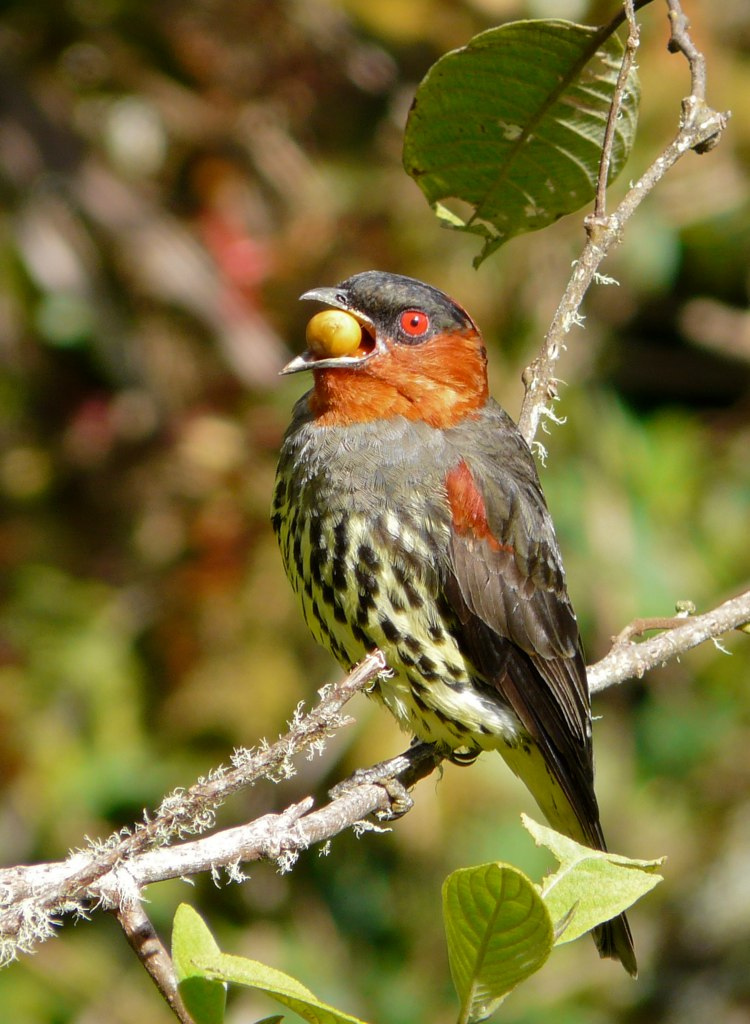

Birds Similar to the Purple-throated Fruitcrow
These species are often confused with the Purple-throated Fruitcrow due to similar appearance or overlapping range.

