
Red-capped Manakin
Pipra mentalis
Order: Passeriformes / Family: Pipridae

Wikimedia Commons
About the Red-capped Manakin
The Red-capped Manakin (Pipra mentalis) is an enchanting bird residing predominantly in the tropical forests of Central and South America. Its striking appearance and unique courtship rituals make it a subject of interest among ornithologists and bird watchers alike. The male Red-capped Manakin boasts a vivid red crown, contrasting sharply with its velvety black body, while the females and juveniles are primarily olive-green, providing excellent camouflage amidst the dense foliage. This bird species plays a significant ecological role as a seed disperser, consuming a variety of fruits and aiding in the propagation of numerous forest plant species. Found from southern Mexico through to Panama, this manakin favors humid, lowland rainforests, although it can also be spotted in secondary forests and plantations, indicating a degree of adaptability to altered landscapes. Seasonal behaviors of the Red-capped Manakin include intricate courtship displays performed primarily by the males during the breeding season. These displays occur primarily in lekking grounds, where males gather to compete for female attention. The manakin's presence in these regions underscores its importance to the ecological balance, serving as a key species in maintaining the health and diversity of its habitats.
The Red-capped Manakin belongs to the family Pipridae, within the order Passeriformes. These birds typically live average 8 years, with a maximum recorded of 12 years.
How to Identify a Red-capped Manakin
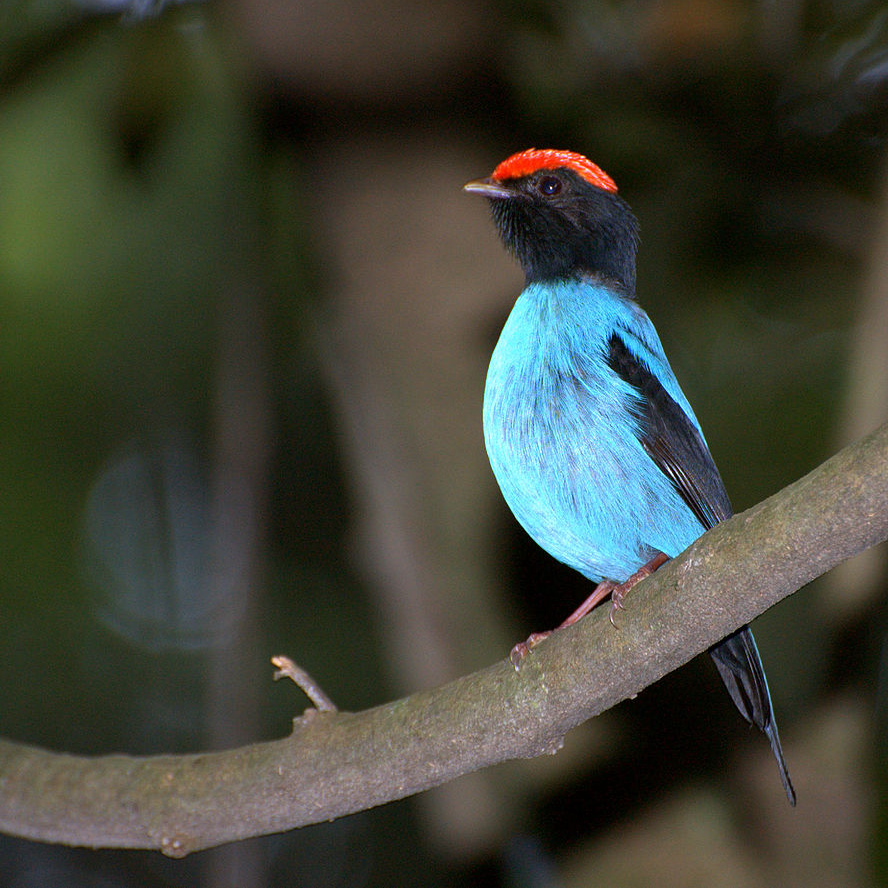
Identifying the Red-capped Manakin involves noting several key features. Adult males are particularly striking with their brilliant red caps and jet-black bodies, which make them relatively easy to distinguish from other birds in their range. The contrast in coloration is further enhanced by their bright yellow thighs, which can be seen during their distinctive courtship dances. Females and juveniles, however, are more subtly colored with olive-green plumage that allows them to blend in with the forest canopy. This sexual dimorphism is common among manakins, aiding in both mate attraction and predator avoidance. When observing the bird in flight, look for a compact silhouette with rounded wings and a short tail. The male's courtship dance is a notable behavioral marker, characterized by quick, backwards shuffling movements along branches that are reminiscent of a 'moonwalk'. Similar species, such as the Golden-collared Manakin, can be differentiated by the absence of a red cap and different vocalizations. The Red-capped Manakin's perching posture is often upright, and the bird frequently flicks its wings and tail.
Having trouble telling birds apart? Upload a photo to our bird identification tool for an instant species match.
Red-capped Manakin Habitat and Range
Preferred Habitat
The Red-capped Manakin primarily inhabits the humid lowland rainforests and secondary forests of Central America, thriving in regions from southern Mexico to Panama. It prefers dense, tropical environments rich in fruit-bearing plants, which are crucial for its diet. In addition to primary forests, this manakin can inhabit secondary growth and plantations, indicating some level of adaptability. Typically found at elevations ranging from sea level to about 1200 meters, the Red-capped Manakin does not usually migrate but may exhibit some local movements dictated by food availability. Unlike some other forest species, it is less commonly found in urban areas, maintaining a preference for dense, rural forest habitats.
Geographic Range
The Red-capped Manakin's range extends from southern Mexico through Central America to western Panama. It is a resident bird, meaning it does not engage in long-distance migrations, although it may make localized movements in search of food or suitable breeding territories. This species is primarily concentrated in the tropical rainforests of these regions, with higher densities often found in areas where fruiting trees are abundant. The bird's range does not extend into South America, largely confined to the lush, humid landscapes that characterize its Central American distribution. The population density is typically highest in regions where the forest remains relatively undisturbed, but it can also adapt to secondary growth forests.
Want to know which birds visit your area? Browse our backyard birds by location guides for region-specific species lists.
What Does the Red-capped Manakin Eat?
The Red-capped Manakin primarily consumes a diet of fruits, making it an important frugivore within its ecosystem. Its diet includes a variety of small, fleshy fruits from several plant species, which it plucks with remarkable agility. This bird occasionally supplements its diet with insects, particularly during the breeding season when the demand for protein increases. Manakins forage by perching quietly and plucking fruits from nearby branches, often using their wings and tail to maintain balance. The size of the prey, whether fruit or insect, tends to be small to medium. Feeding predominantly occurs during the daylight hours, with peak activity often observed in the early morning and late afternoon.
Red-capped Manakin Behavior and Social Structure
The social behavior of the Red-capped Manakin is most prominently observed during its breeding season, characterized by the formation of leks. In these gatherings, males perform elaborate courtship displays to attract females. The display involves a series of energetic dances, including a distinctive 'moonwalk' style movement, intended to showcase the male's physical fitness and vibrant plumage. Outside of the breeding season, the Red-capped Manakin tends to be more solitary or found in small groups. Territorial behavior is primarily displayed by males during the breeding period. In response to predators, the manakin often relies on its cryptic coloration and rapid flight to evade capture. Daily activity patterns show early morning and late afternoon peaks in feeding and social interactions, with quieter periods during the midday heat.
Red-capped Manakin Nesting and Reproduction
Red-capped Manakins construct small, cup-shaped nests using materials such as fine twigs, roots, and leaves. These nests are typically situated in the fork of a branch, often several meters above ground level, providing protection from ground-based predators. The female primarily undertakes the construction of the nest and the care of the young. A typical clutch consists of two eggs, with an incubation period lasting approximately 18-20 days. The female incubates the eggs alone, while the male's role is largely limited to courtship and territory defense. Once hatched, the chicks are altricial and require significant parental care, fledging after about 15-20 days. Typically, the Red-capped Manakin raises one brood per year, although in favorable conditions, a second brood may be attempted.
Red-capped Manakin Sounds and Vocalizations
The vocalizations of the Red-capped Manakin are understated compared to its visual displays. The primary song consists of a series of high-pitched, buzzing notes that are often described as insect-like in quality. These calls can be heard during the dawn chorus and are used primarily for communication between males and females during the breeding season. Alarm calls are sharper, serving as a deterrent against potential threats. The manakin's vocal repertoire is relatively limited, focusing more on visual displays than vocal communication, which is typical of many manakin species.
Interesting Facts About the Red-capped Manakin
- 1The Red-capped Manakin's 'moonwalk' dance was popularized after appearing in a viral video, showcasing its unique courtship behavior.
- 2Despite their vibrant appearance, males spend a large part of the day perched quietly, conserving energy for elaborate displays.
- 3The Red-capped Manakin's diet primarily consists of small fruits, but during breeding season, it increases its intake of protein-rich insects.
- 4This species' lekking behavior involves multiple males gathering to perform and compete for the attention of visiting females.
- 5The Red-capped Manakin is vital for seed dispersal, aiding the regeneration of rainforest plants by spreading seeds through its droppings.
- 6Females and juveniles are significantly less colorful, helping them avoid predation by blending into the green canopy.
- 7Though primarily found in tropical forests, the Red-capped Manakin can adapt to secondary growth, showing resilience to some habitat changes.
Red-capped Manakin Conservation Status
The Red-capped Manakin is currently listed as Least Concern by the IUCN, with its population considered stable. However, habitat destruction, particularly due to deforestation, poses a significant threat to its long-term survival. Conservation efforts focus on preserving large tracts of tropical rainforest, which are essential for maintaining the ecological balance and biodiversity of the regions where this bird thrives. Despite historical fluctuations in population due to habitat loss, current efforts to manage and protect remaining forest areas have been effective in stabilizing numbers.
Other Pipridae Species


Birds Similar to the Red-capped Manakin
These species are often confused with the Red-capped Manakin due to similar appearance or overlapping range.

