Rufous-chinned Laughingthrush
Garrulax rufogularis
Order: Passeriformes / Family: Leiothrichidae

Wikimedia Commons
About the Rufous-chinned Laughingthrush
The Rufous-chinned Laughingthrush (Garrulax rufogularis) is a captivating member of the Leiothrichidae family, renowned for its charismatic presence in the dense, subtropical, and temperate forests of the Himalayas. This medium-sized songbird, measuring approximately 26 centimeters in length, is primarily found in countries like India, Nepal, Bhutan, and parts of China. Its striking rufous chin and throat, coupled with its melodious and complex vocalizations, make it a favorite among bird enthusiasts and ornithologists alike.
Occupying a significant ecological niche, the Rufous-chinned Laughingthrush plays a vital role in the forest ecosystems where it resides. It contributes to seed dispersal and pest control, aiding in the maintenance of a balanced environment. These birds favor understory vegetation, which provides them with ample food resources and protection from predators.
Throughout the year, the Rufous-chinned Laughingthrush exhibits intriguing behavioral adaptations. During the breeding season, which typically spans from March to July, these birds become more territorial and vocal, using their calls to establish dominance and attract mates. In the non-breeding season, they often form small, loose flocks, allowing them to forage more effectively and protect themselves from predators. Their adaptability to varying elevations, often ranging from 600 to 3000 meters, allows them to exploit a wide range of forest habitats, making them resilient to some degree of habitat disturbance.
The Rufous-chinned Laughingthrush's presence in diverse regions such as the Eastern Himalayas and the Yunnan province underscores its adaptability to different climatic conditions. Despite facing threats from habitat loss due to deforestation and agricultural expansion, this species' population remains relatively stable. Conservation efforts, particularly those focused on forest preservation, are crucial for maintaining the ecological balance and ensuring the long-term survival of this enchanting bird.
The Rufous-chinned Laughingthrush belongs to the family Leiothrichidae, within the order Passeriformes. These birds typically live typically 5-7 years with a maximum recorded of 9 years..
How to Identify a Rufous-chinned Laughingthrush
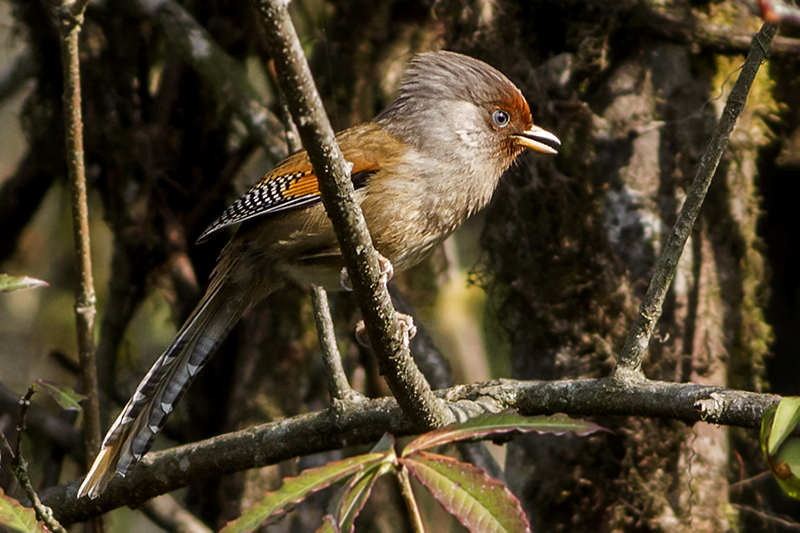
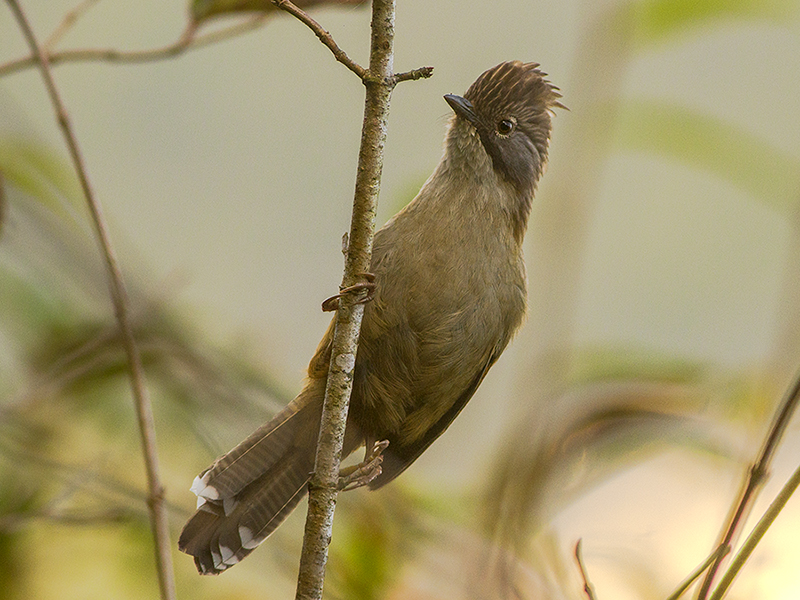
The Rufous-chinned Laughingthrush is easily identified by its rich rufous-colored chin and throat, a feature that sets it apart from other laughingthrushes. The rest of its plumage is primarily brown, with subtle grayish tones on the wings and back, and a paler, buffy belly. Its eyes are ringed with white, providing a striking contrast to its darker head and drawing attention to its inquisitive gaze.
Both male and female Rufous-chinned Laughingthrushes share similar plumage, making it challenging to distinguish between the sexes in the field. Juveniles, however, can be told apart by their slightly duller coloration and less pronounced rufous chin. In flight, this species exhibits a rounded silhouette with short, broad wings and a relatively long tail, which they fan out when gliding through the forest canopy.
When compared to similar species, such as the White-throated Laughingthrush, the Rufous-chinned Laughingthrush's distinct throat coloring and smaller size help avoid confusion. Observers can also note their perching posture, which is typically upright with the tail cocked slightly upwards, a characteristic stance that aids in their identification.
Having trouble telling birds apart? Upload a photo to our bird identification tool for an instant species match.
Rufous-chinned Laughingthrush Habitat and Range
Preferred Habitat
The Rufous-chinned Laughingthrush thrives in dense forest undergrowth, preferring subtropical and temperate forests. These birds are commonly found in the Eastern Himalayas, where they inhabit areas with thick vegetation that provides food and shelter. They are also present in the montane forests of northeast India, Nepal, and Bhutan, often at elevations ranging from 600 to 3000 meters.
This species demonstrates some flexibility in habitat preference, occasionally venturing into secondary growth and scrub areas, particularly during the non-breeding season. Although primarily a forest dweller, the Rufous-chinned Laughingthrush is not commonly observed in urban settings, as it avoids open areas lacking dense cover. Seasonal habitat shifts may occur in response to food availability, but they generally remain within forested regions year-round.
Geographic Range
The Rufous-chinned Laughingthrush is predominantly found across the Himalayan region, with its range extending through India, Nepal, Bhutan, and into southern China. Its preferred habitat encompasses the lush forests of the Eastern Himalayas, where it breeds and resides for much of the year.
During the breeding season, these birds can be found nesting in the dense forest undergrowth at elevations between 1500 and 3000 meters. In winter, they may descend to slightly lower elevations in search of food, though they do not undertake long migratory journeys. Population density is higher in regions with abundant forest cover, such as the Arunachal Pradesh in India and the hills of eastern Nepal.
Though generally considered a non-migratory species, some populations may exhibit altitudinal movements in response to seasonal changes in food availability. Despite the challenges posed by habitat fragmentation, the Rufous-chinned Laughingthrush maintains a stable presence across its range.
Want to know which birds visit your area? Browse our backyard birds by location guides for region-specific species lists.
What Does the Rufous-chinned Laughingthrush Eat?
The Rufous-chinned Laughingthrush primarily feeds on a diverse diet of insects and other invertebrates, making it an important player in controlling insect populations within its habitat. It forages on the forest floor and in the lower to mid-canopy, often seen flipping over leaves and probing crevices in search of prey such as beetles, caterpillars, and spiders.
In addition to insects, this bird's diet includes a variety of fruits and berries, which provide essential nutrients and energy. During the breeding season, when insect availability peaks, the Rufous-chinned Laughingthrush relies heavily on these protein-rich food sources. However, in the non-breeding season, it adjusts its diet to include more plant material as insect abundance decreases.
Foraging typically occurs in the early morning and late afternoon, with periods of rest and preening during the hotter midday hours. The Rufous-chinned Laughingthrush's opportunistic feeding behavior and ability to exploit different food sources contribute to its survival in the dynamic forest environment.
Rufous-chinned Laughingthrush Behavior and Social Structure
The Rufous-chinned Laughingthrush is a highly social bird, often observed in small groups or loose flocks, especially outside the breeding season. These flocks, typically comprising 5 to 10 individuals, enhance foraging efficiency and provide safety in numbers from predators such as hawks and snakes.
During the breeding season, pairs establish territories and become more solitary and vocal, using their distinctive calls to communicate and deter intruders. Courtship displays involve mutual preening and the exchange of food, strengthening pair bonds before nesting begins.
Daily activity patterns are largely diurnal, with the Rufous-chinned Laughingthrush being most active during the cooler hours of the morning and late afternoon. They spend much of this time foraging on the forest floor, exhibiting a characteristic hopping gait and occasionally fluttering to catch aerial insects.
In response to predators, these birds employ a range of vocalizations to alert flock members. They may also freeze in place or dive into dense undergrowth to evade capture. Their adaptable social structure and defensive behaviors play a crucial role in their survival amidst the challenges of their forest environment.
Rufous-chinned Laughingthrush Nesting and Reproduction
Rufous-chinned Laughingthrushes construct cup-shaped nests, using materials like twigs, grass, and leaves, which they skillfully weave together. These nests are usually positioned in dense shrubs or low trees, providing concealment from predators and shelter from the elements.
The typical clutch comprises 2 to 4 eggs, which are pale blue and speckled with brown. Both parents share incubation duties, which last for approximately 14 to 16 days, ensuring that the eggs are adequately protected and maintained at a constant temperature.
Once hatched, the chicks remain in the nest for about 11 to 14 days before fledging. During this period, both parents are actively involved in feeding the young, bringing them a steady supply of insects and other food items. Rufous-chinned Laughingthrushes may raise two broods per year, particularly in regions where conditions are favorable, allowing them to take advantage of abundant food resources and favorable weather conditions.
Rufous-chinned Laughingthrush Sounds and Vocalizations
The Rufous-chinned Laughingthrush is renowned for its melodious song, which consists of a series of rich, warbling notes delivered in a fluid, rhythmic sequence. These songs are often repeated several times in succession, serving both to attract mates and establish territory.
In addition to their primary song, these birds produce a variety of call notes, including sharp 'chek' sounds and softer, more conversational chatter when interacting with flock members. Alarm calls are harsher and more staccato, designed to alert others to the presence of potential threats.
During the dawn chorus, Rufous-chinned Laughingthrushes contribute to the symphony of forest sounds, their voices intertwining with those of other avian residents. Their vocalizations, while distinct, blend harmoniously into the natural soundscape, enriching the acoustic environment of their habitat.
Interesting Facts About the Rufous-chinned Laughingthrush
- 1The Rufous-chinned Laughingthrush can be found at elevations as high as 3000 meters, adapting to varying altitudes and climates.
- 2Their melodious songs often interweave with other bird calls, creating a rich tapestry of sound in their forest habitats.
- 3Rufous-chinned Laughingthrushes exhibit cooperative breeding, where younger birds may assist parents in raising subsequent broods.
- 4These birds are adept at foraging on the forest floor, using their strong legs to scratch through leaf litter in search of food.
- 5Despite their striking plumage, Rufous-chinned Laughingthrushes are masters of camouflage, blending seamlessly into the forest understory.
- 6They participate in mixed-species flocks, benefiting from the diverse foraging strategies of other bird species.
- 7Rufous-chinned Laughingthrushes have been observed using their calls to mimic other birds, demonstrating exceptional vocal versatility.
Rufous-chinned Laughingthrush Conservation Status
The Rufous-chinned Laughingthrush currently holds a status of Least Concern on the IUCN Red List, with populations considered stable across most of its range. Nevertheless, the species faces ongoing threats from habitat degradation due to deforestation, agricultural expansion, and human encroachment. Conservation efforts aimed at preserving forest habitats are crucial to ensuring the long-term survival of the Rufous-chinned Laughingthrush. Protected areas within its range, such as national parks and wildlife sanctuaries, play a vital role in safeguarding these birds and their ecosystems. Historical data indicates that while population densities have fluctuated with habitat changes, the Rufous-chinned Laughingthrush has demonstrated resilience, adapting to secondary growth forests and modified landscapes where necessary. Continued monitoring and habitat management will be essential to mitigate future risks and maintain stable populations.