Scaly Laughingthrush
Trochalopteron subunicolor
Order: Passeriformes / Family: Leiothrichidae
Wikimedia Commons
About the Scaly Laughingthrush
The Scaly Laughingthrush (Trochalopteron subunicolor) is a fascinating bird native to the subtropical and temperate regions of the Himalayas. This bird, belonging to the family Leiothrichidae, is notable for its intricate plumage that features a unique scaly pattern, a characteristic that sets it apart from other members of its genus. The Scaly Laughingthrush plays an essential ecological role as both a predator and a prey species within its habitat. Its primary habitats are the dense undergrowths of montane forests and bamboo thickets, where it often forages for insects, fruits, and seeds. These birds are particularly significant as bio-indicators for the health of forest ecosystems due to their sensitivity to habitat changes. They remain active throughout the year, displaying slight altitudinal shifts in response to seasonal temperature variations. During the breeding season, which occurs from March to August, the Scaly Laughingthrush becomes more vocal and territorial, often heard before seen due to its distinctive calls. This bird predominantly resides in the eastern Himalayas, with populations reported in Bhutan, northern India, especially in the states of Sikkim and Arunachal Pradesh, as well as in Nepal. Although not considered migratory, some local movements occur within their range, likely in response to food availability and climatic conditions. The presence of the Scaly Laughingthrush in these forests underscores the biodiversity and ecological richness of the region, making it a species of particular interest to ornithologists and conservationists alike. With its engaging behavior and distinct appearance, the Scaly Laughingthrush serves as both an ambassador for its environment and a subject of continued scientific study.
The Scaly Laughingthrush belongs to the family Leiothrichidae, within the order Passeriformes. These birds typically live average 5-7 years with a maximum recorded of 10 years..
How to Identify a Scaly Laughingthrush
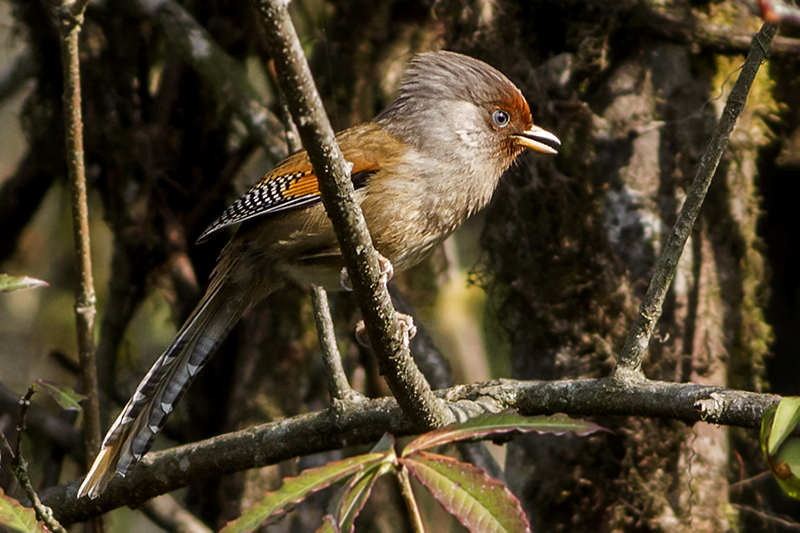
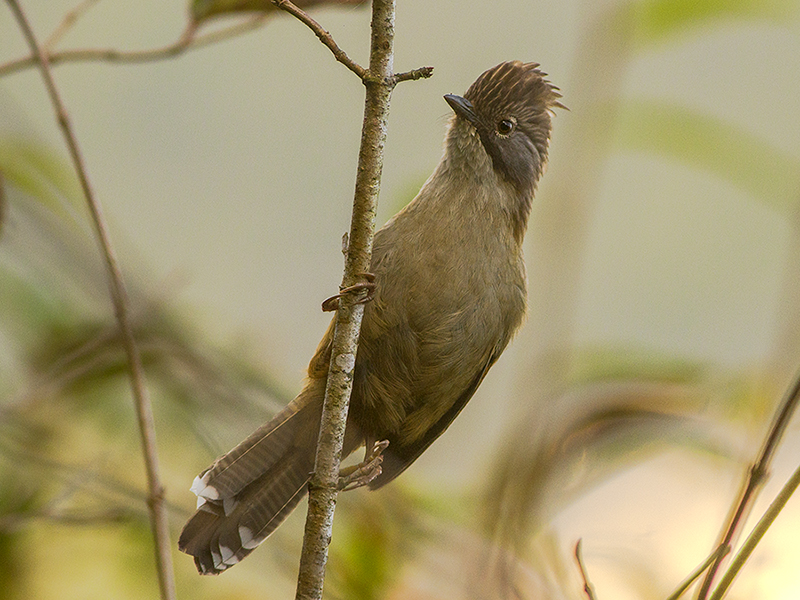
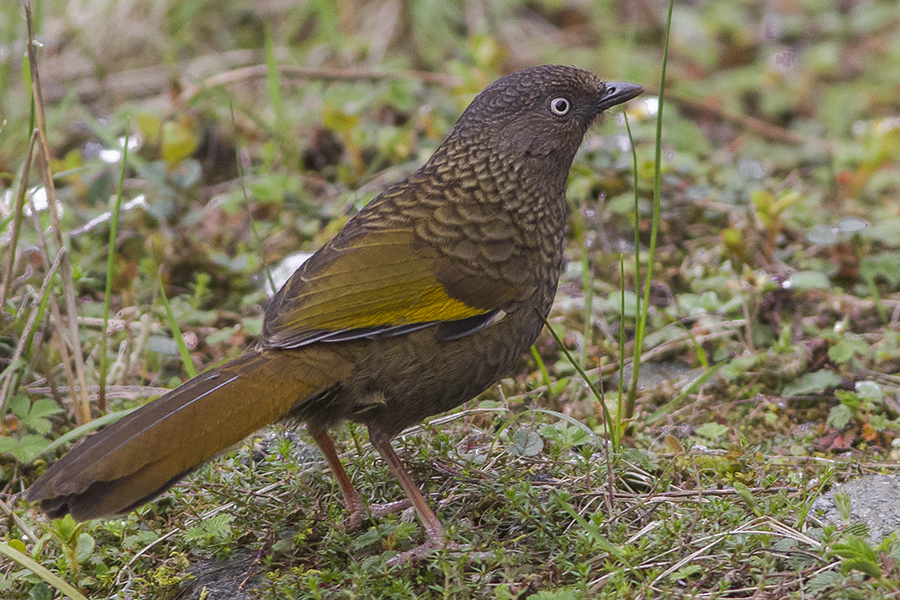
The Scaly Laughingthrush is a medium-sized bird, measuring approximately 25 to 28 centimeters in length. Its plumage is predominantly gray-brown, with each feather tipped in a paler gray, creating the striking scaly appearance for which it is named. Adults exhibit this scaly pattern more distinctly, while juveniles have a more subdued and less defined version of the same plumage. Unlike many bird species, there is little sexual dimorphism in the Scaly Laughingthrush, with males and females appearing similar. However, females might exhibit slightly duller plumage. In terms of similar species, the Spotted Laughingthrush (Garrulax ocellatus) could cause confusion due to overlapping ranges and shared habitats, but the latter displays spots rather than scales. When in flight, the Scaly Laughingthrush shows a rounded wing silhouette and short tail, which can be seen when it glides through the forest understory. Its perching posture is often horizontal, giving it a streamlined appearance as it moves through dense foliage.
Having trouble telling birds apart? Upload a photo to our bird identification tool for an instant species match.
Scaly Laughingthrush Habitat and Range
Preferred Habitat
The Scaly Laughingthrush primarily inhabits the montane forests of the eastern Himalayas, thriving in environments rich in dense undergrowth and bamboo thickets. These birds favor altitudes ranging from 1,500 to 3,000 meters, where the climate remains cool and moist. During winter, they may descend to lower elevations in search of food, though they remain within forested areas. They are rarely found in urban settings, preferring the secluded and complex habitats offered by mature forests. Seasonal habitat shifts are minimal, with the species displaying a preference for consistent environments that provide ample cover and foraging opportunities throughout the year. The presence of diverse plant species in these forests supports their dietary needs, ensuring the Scaly Laughingthrush remains a forest-dependent species.
Geographic Range
The Scaly Laughingthrush's range primarily encompasses the eastern Himalayas, including regions such as Bhutan, northern India, and Nepal. Within India, it is commonly found in the states of Sikkim and Arunachal Pradesh. While the bird does not undertake long-distance migrations, it exhibits altitudinal movements in response to seasonal changes, shifting to lower elevations during colder months. These movements allow the Scaly Laughingthrush to exploit different ecological niches and maintain access to food resources year-round. Population densities are generally highest in areas with extensive undisturbed forest cover, highlighting the species' reliance on healthy forest ecosystems. Despite its specialized habitat preferences, the Scaly Laughingthrush remains relatively widespread within its range, suggesting a stable population in suitable habitats.
Want to know which birds visit your area? Browse our backyard birds by location guides for region-specific species lists.
What Does the Scaly Laughingthrush Eat?
The diet of the Scaly Laughingthrush is diverse, primarily consisting of insects, fruits, and seeds. During the warmer months, when insects are abundant, they form the bulk of the diet, providing essential proteins and nutrients required for breeding. Insects such as beetles, caterpillars, and ants are common prey. As temperatures drop and insect availability diminishes, the Scaly Laughingthrush shifts its diet to include more fruits and seeds. Berries from shrubs and small trees become important food sources during this period, offering the sugars and carbohydrates necessary for energy. The bird employs a foraging technique that involves rummaging through leaf litter and probing into crevices in search of food. This behavior reflects its adaptability and resourcefulness in exploiting available food resources. The Scaly Laughingthrush typically forages in pairs or small groups, which may enhance its ability to locate food.
Scaly Laughingthrush Behavior and Social Structure
The Scaly Laughingthrush exhibits a complex social structure, often found in pairs or small family groups. Territorial behavior becomes prominent during the breeding season, with males engaging in vocal displays to deter intruders and attract mates. Courtship displays include a combination of vocalizations and physical posturing, with males showcasing their plumage to potential mates. Outside of the breeding season, these birds may form loose flocks, enhancing their ability to detect predators and locate food. The Scaly Laughingthrush is diurnal, with peak activity occurring in the early morning and late afternoon, coinciding with optimal foraging conditions. In response to predators, the bird employs an assortment of alarm calls to alert other members of its group. These calls serve as an effective early warning system, promoting collective vigilance. The species demonstrates a high level of adaptability in its daily routines, allowing it to thrive in the complex environments of the Himalayas.
Scaly Laughingthrush Nesting and Reproduction
The Scaly Laughingthrush constructs its nest in dense foliage, typically at a height of 1 to 3 meters above ground. Nests are cup-shaped and made from a variety of materials, including twigs, leaves, and grass. The preferred nesting sites are often in shrubs or low trees, providing concealment from predators. The typical clutch size ranges from 2 to 4 eggs, with both parents participating in incubation, which lasts approximately 14 to 16 days. Following hatching, both parents also contribute to feeding and caring for the chicks. The fledging period lasts an additional 14 to 18 days, after which the young birds leave the nest but remain dependent on their parents for some time. The Scaly Laughingthrush generally produces one brood per year, but in optimal conditions, a second brood may be attempted.
Scaly Laughingthrush Sounds and Vocalizations
The song of the Scaly Laughingthrush is a melodious series of whistles and trills, often described as cheerful and tuneful. Its primary song serves as both a territorial marker and a mate attraction tool. The call notes are shorter and more abrupt, used for communication between members of the group. Alarm calls are sharper and more urgent, designed to alert others of potential threats. During the dawn chorus, the Scaly Laughingthrush's vocalizations contribute to the vibrant soundscape of the forest, with males being particularly vocal at this time. The bird's song is sometimes compared to the chattering laughter of humans, a trait that has influenced its common name.
Interesting Facts About the Scaly Laughingthrush
- 1The Scaly Laughingthrush's song has been likened to human laughter, a unique trait among birds.
- 2Despite their name, Scaly Laughingthrushes are not known for laughing but for their melodious calls.
- 3These birds can be found at elevations ranging from 1,500 to 3,000 meters in the Himalayas.
- 4Scaly Laughingthrushes are non-migratory but may move to lower elevations in winter.
- 5The intricate plumage of the Scaly Laughingthrush serves as excellent camouflage in dense forests.
- 6Both male and female Scaly Laughingthrushes take part in building the nest and raising the young.
- 7Scaly Laughingthrushes play a crucial role in their ecosystem by controlling insect populations.
Scaly Laughingthrush Conservation Status
The Scaly Laughingthrush is currently classified as Least Concern by the IUCN, indicating a stable population trend. However, habitat degradation due to logging and agricultural expansion poses significant threats to its habitat. Conservation efforts focus on preserving forested areas and maintaining ecological corridors that support the species' needs. Historically, the Scaly Laughingthrush has maintained stable numbers, but continued habitat protection is crucial for its long-term survival. Initiatives aimed at sustainable land use and reforestation can mitigate potential declines.