
Scarlet-horned Manakin
Pipra cornuta
Order: Passeriformes / Family: Pipridae

Wikimedia Commons
About the Scarlet-horned Manakin
The Scarlet-horned Manakin (Pipra cornuta) is an enchanting bird that captivates both avid birders and casual observers with its vibrant appearance and fascinating behaviors. Its most distinctive feature is the bright scarlet crown, which contrasts sharply with its otherwise dark plumage. This bird is a member of the Pipridae family, known for the colorful and charismatic manakins, which inhabit the lush tropical forests of South America. Scarlet-horned Manakins primarily reside in the lowland and foothill forests of countries like Colombia, Venezuela, and Brazil. These regions provide the dense vegetation and diverse flora that support their varied diet and complex social structures. Manakins play a pivotal ecological role as seed dispersers, contributing to the maintenance and regeneration of their forest habitats. During the breeding season, which typically coincides with the rainy season to ensure food availability, males engage in elaborate courtship displays to attract females. These displays, often involving intricate dances and vocalizations, are a spectacle of avian behavior. Outside the breeding season, Scarlet-horned Manakins adjust their behaviors to match the seasonal changes in their environment, ensuring their survival in these dynamic ecosystems. The ecological significance of the Scarlet-horned Manakin extends beyond its visual appeal, as it helps maintain the health of the tropical ecosystems it inhabits. Its presence is an indicator of forest health, as these birds thrive in undisturbed environments where they can find ample food and nesting sites. In regions like the Amazon Basin, their populations are relatively stable, thanks to the vast expanses of untouched forest. However, in areas where deforestation and habitat fragmentation occur, their numbers can decline sharply. Conservation efforts aimed at preserving their habitats are crucial, as these birds are sensitive to environmental changes. By understanding and appreciating the role of the Scarlet-horned Manakin in its ecosystem, conservationists and ornithologists can better advocate for the protection of South America's rich biodiversity.
The Scarlet-horned Manakin belongs to the family Pipridae, within the order Passeriformes. These birds typically live average 8 years, with a maximum recorded of 12 years..
How to Identify a Scarlet-horned Manakin
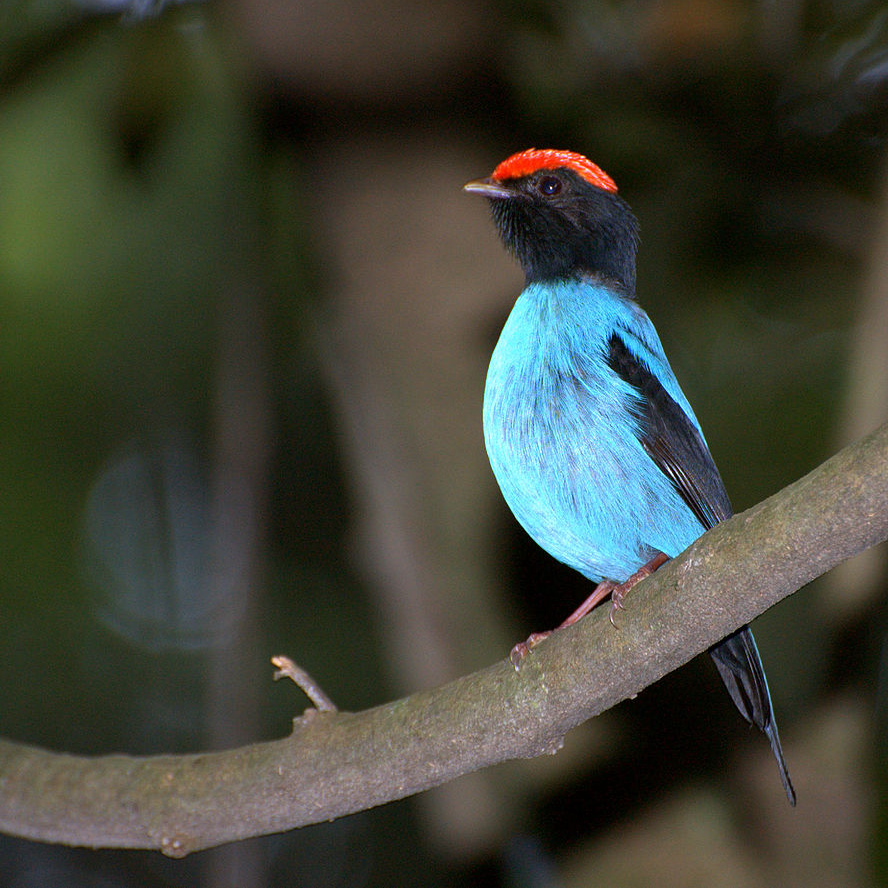
The Scarlet-horned Manakin is best identified by its striking scarlet crown, which is the adult male's most prominent feature. The rest of the male's plumage is predominantly black, providing a stark contrast that highlights the vividness of the crown. Females and juveniles, however, exhibit a more subdued coloration, with olive-green feathers that serve as effective camouflage in their forest habitats. This sexual dimorphism is typical of many manakin species, where males are more brightly colored to attract mates. While observing these birds, birders should note the smaller size of the Scarlet-horned Manakin, typically measuring around 11 cm in length. Its compact body and short tail are characteristic features that help differentiate it from similar species. In flight, the Scarlet-horned Manakin displays a rapid, fluttering wingbeat that is typical of the Pipridae family. When perched, it often adopts a solitary stance, with occasional bouts of high-energy movement as it flits between branches. Due to its preference for dense forest undergrowth, spotting this bird requires patience and a keen eye. Confusion with other manakin species is possible, particularly with those that share overlapping ranges. However, the combination of the Scarlet-horned Manakin's size, coloration, and behavior provides reliable field marks for accurate identification.
Having trouble telling birds apart? Upload a photo to our bird identification tool for an instant species match.
Scarlet-horned Manakin Habitat and Range
Preferred Habitat
The Scarlet-horned Manakin thrives in the humid, dense forests of South America, favoring lowland and foothill regions. These forests offer the rich biodiversity and complex structure necessary for the bird's survival. Within the Amazon Basin, the manakin prefers areas with abundant undergrowth, where it can forage for food and find shelter. This bird tends to avoid open areas, instead opting for the thick canopy and mid-story layers of the forest where it can move freely and remain protected from predators. The elevation range for the Scarlet-horned Manakin typically spans from sea level up to 1,000 meters, although it is more commonly found at lower elevations where the forest density is greatest. Seasonal habitat shifts are minimal for this species, as it generally remains within its tropical forest home year-round, adapting to changes in food availability and weather patterns. While urban environments encroach upon some of its native habitats, the Scarlet-horned Manakin is rarely found in such areas, preferring the serenity and stability of undisturbed forests.
Geographic Range
The Scarlet-horned Manakin's range is predominantly within the northern part of South America, with its presence most notable in Colombia, Venezuela, and Brazil. In these countries, it occupies extensive tracts of tropical rainforest, particularly within the Amazon Basin. During the breeding season, which aligns with the rainy season, these birds remain in their established territories, as the abundance of food resources supports their reproductive activities. The Scarlet-horned Manakin is generally a non-migratory species, maintaining a consistent presence in its preferred habitats throughout the year. Population density varies across its range, with hotspots often located in areas of high forest density and minimal human disturbance. Although its range is relatively broad, the Scarlet-horned Manakin's preference for specific habitat conditions means that its distribution can be patchy. Preservation of these habitats is essential to maintaining the species' population levels, as deforestation and habitat fragmentation pose significant threats to its continued survival.
Want to know which birds visit your area? Browse our backyard birds by location guides for region-specific species lists.
What Does the Scarlet-horned Manakin Eat?
The Scarlet-horned Manakin primarily feeds on a diet rich in fruits, which provides the necessary sugars and nutrients to sustain its active lifestyle. This frugivorous diet includes a variety of small fruits and berries found within the tropical forests it inhabits. The bird's role as a seed disperser is crucial, as it contributes to the propagation of plant species throughout its habitat. In addition to fruits, the Scarlet-horned Manakin occasionally consumes insects, particularly during the breeding season when protein intake is vital for energy and chick development. This opportunistic feeding behavior allows the bird to adapt to seasonal variations in food availability. Foraging typically occurs during daylight hours, with the manakin taking advantage of the forest's vertical structure to access food sources at various heights. By hopping between branches and making short flights, it efficiently exploits the abundance of its environment. The Scarlet-horned Manakin's diet reflects its adaptability and ecological importance within its tropical ecosystem.
Scarlet-horned Manakin Behavior and Social Structure
Socially, the Scarlet-horned Manakin displays a fascinating mix of solitary and communal behaviors. Males are known for their elaborate courtship displays, which take place on leks: communal display grounds where multiple males gather to perform for potential mates. These displays involve a combination of intricate dances, wing snaps, and vocalizations, showcasing the males' athleticism and vibrant plumage. Despite the competitive nature of these gatherings, they are generally non-aggressive, with males focusing on attracting females rather than engaging in physical confrontations. Outside the breeding season, the Scarlet-horned Manakin exhibits more solitary behaviors, often foraging alone or in small groups. Territoriality is less pronounced during these times, as the focus shifts to feeding and survival. The bird's daily activity patterns revolve around feeding in the morning and late afternoon, with periods of rest during the hottest parts of the day. In response to predators, which include birds of prey and snakes, the Scarlet-horned Manakin relies on its agility and the dense forest cover for protection. By quickly darting into thick foliage, it can evade many threats, showcasing its adaptability and survival instincts.
Scarlet-horned Manakin Nesting and Reproduction
Nesting for the Scarlet-horned Manakin involves the construction of a small, cup-shaped nest typically built by the female. These nests are often situated on thin branches in the undergrowth or mid-story of the forest, providing both concealment and proximity to food sources. The female uses a variety of plant materials, including leaves, twigs, and spider silk, to weave a sturdy and secure nest structure. The typical clutch size consists of two eggs, which the female incubates alone for approximately 18-20 days. During this period, the male's role is primarily to defend the territory and engage in courtship displays. Once the eggs hatch, the female assumes the primary responsibility for feeding and caring for the chicks. The fledging period lasts about 15-20 days, after which the young birds leave the nest but remain dependent on the female for several weeks. In favorable conditions, the Scarlet-horned Manakin may produce two broods per year, though this depends on food availability and environmental stability. The nesting habits of this species highlight the critical role of the female in ensuring reproductive success.
Scarlet-horned Manakin Sounds and Vocalizations
The Scarlet-horned Manakin's vocal repertoire is a charming aspect of its natural history. The primary song, often heard during courtship displays, consists of a series of high-pitched, melodious notes that vary in rhythm and pitch. The song is both a declaration of territory and an invitation to females, serving as an essential component of their mating ritual. In addition to its song, the Scarlet-horned Manakin produces a variety of call notes, including sharp, quick chirps used for communication with other birds, particularly during lekking. Alarm calls are less musical, characterized by a rapid, harsh series of notes that alert nearby birds to potential threats. During the dawn chorus, the Scarlet-horned Manakin's song contributes to the vibrant tapestry of sounds that define the tropical forest environment, each bird adding its unique voice to the symphony.
Interesting Facts About the Scarlet-horned Manakin
- 1The Scarlet-horned Manakin's courtship display is one of the most elaborate among manakins, involving intricate dances and vocalizations.
- 2Despite their small size, Scarlet-horned Manakins can consume large quantities of fruit, aiding in seed dispersal across vast forest areas.
- 3Scarlet-horned Manakins have a unique lekking behavior, where males gather in groups to perform for females, often using the same display sites year after year.
- 4The Scarlet-horned Manakin is one of the few Pipridae species where the female takes on the full responsibility of nest building and chick rearing.
- 5During the breeding season, male Scarlet-horned Manakins can perform hundreds of display dances each day to attract a mate.
- 6The bird's vibrant scarlet crown is not only for display but also serves as a status symbol among males in their social hierarchy.
- 7Scarlet-horned Manakins are known to live in multi-species flocks, often associating with other small, insectivorous birds to enhance foraging success.
Scarlet-horned Manakin Conservation Status
The Scarlet-horned Manakin currently holds a conservation status of Least Concern according to the IUCN, reflecting its relatively stable population across its range. However, localized threats such as deforestation and habitat fragmentation pose significant risks to its long-term survival. The primary conservation efforts focus on preserving large tracts of undisturbed forest, as these habitats are crucial for the species' survival. Historical population changes have been minimal in protected areas, but regions experiencing rapid deforestation could see declines in manakin numbers. Continued efforts to curb habitat destruction and promote sustainable land use practices are vital to ensuring the Scarlet-horned Manakin's presence in South America's forests.
Other Pipridae Species


Birds Similar to the Scarlet-horned Manakin
These species are often confused with the Scarlet-horned Manakin due to similar appearance or overlapping range.

