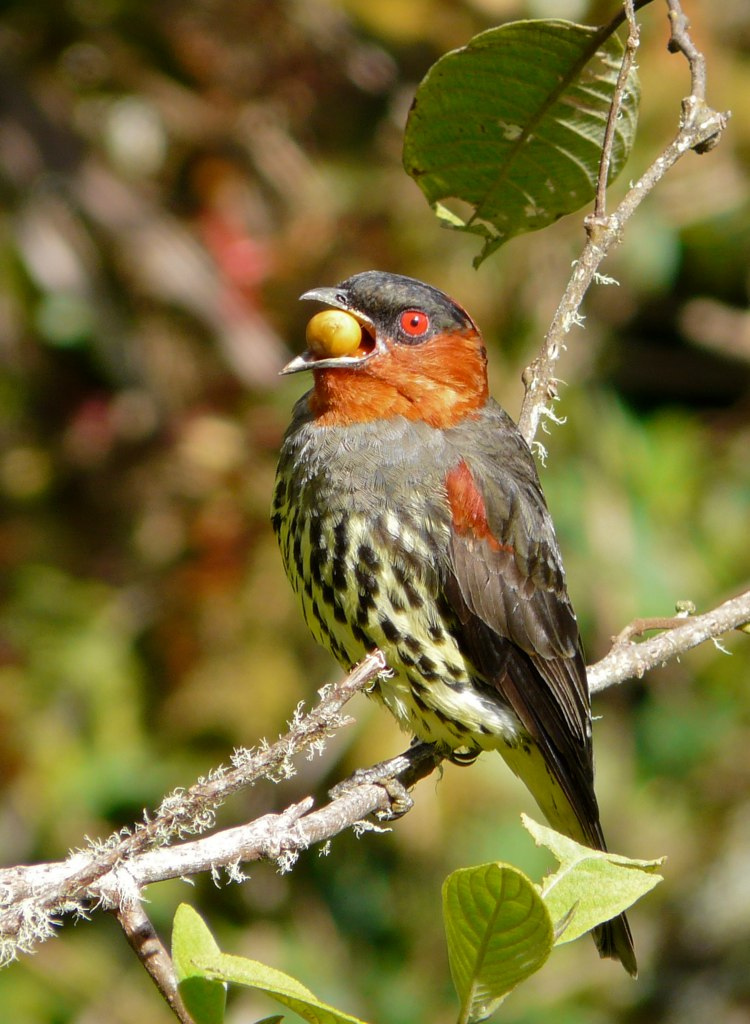
Scimitar-winged Piha
Lipaugus uropygialis
Order: Passeriformes / Family: Cotingidae

Wikimedia Commons
About the Scimitar-winged Piha
The Scimitar-winged Piha (Lipaugus uropygialis) is an intriguing bird endemic to the cloud forests of the Andes in South America, particularly Colombia, Ecuador, and Peru. A member of the Cotingidae family, this species is notable for its unique scimitar-like wing shape, which aids in its maneuverability among dense foliage. The bird's presence in these biodiverse habitats is critical, as it plays a significant role in seed dispersal, contributing to the health and regeneration of the forest ecosystem. Pihas are generally non-migratory; however, they may exhibit some altitudinal movements in response to seasonal changes in fruit availability. Their role as frugivores makes them integral to the ecological web, facilitating the spread of various tree and shrub species. The Scimitar-winged Piha's preference for the montane cloud forests, often at elevations ranging from 1,400 to 2,600 meters, positions it as an important indicator species for environmental health in these sensitive regions. Unfortunately, the piha's habitat is under threat from deforestation and agricultural expansion, highlighting the importance of conservation efforts. This bird's elusive nature and preference for dense, mist-shrouded forests make it a challenging yet rewarding subject for ornithologists and birdwatchers alike.
The Scimitar-winged Piha belongs to the family Cotingidae, within the order Passeriformes. These birds typically live average 6-9 years with a maximum recorded of 13 years..
How to Identify a Scimitar-winged Piha
The Scimitar-winged Piha is a medium-sized bird, approximately 25-28 cm in length, with a distinctively long tail. Its plumage is predominantly grayish-brown, with subtle variations in shade that can help in distinguishing it from similar species. The wings are uniquely shaped, reminiscent of a scimitar, which not only aids in identification but also hints at its name. Males and females exhibit similar plumage, making them difficult to differentiate in the field. Juveniles may appear slightly duller with somewhat less defined features. Its silhouette in flight is notable for its elongated wings and tail, setting it apart from other birds in its range. When perched, the piha holds a typically upright posture, often remaining motionless, which further aids its camouflage in its forested habitat. Despite its subtle coloration, the bird's unique shape and behavior make it distinguishable for experienced birders.
Having trouble telling birds apart? Upload a photo to our bird identification tool for an instant species match.
Scimitar-winged Piha Habitat and Range
Preferred Habitat
The Scimitar-winged Piha inhabits the montane cloud forests of the Andes, thriving in dense, humid environments rich in epiphytes and mosses. These forests, characterized by frequent mist and lush vegetation, provide the perfect backdrop for the piha's elusive lifestyle. The bird is typically found at elevations between 1,400 and 2,600 meters and prefers areas with a high density of fruit-bearing trees. Though predominantly associated with undisturbed forest areas, the piha may occasionally venture into secondary forests, particularly when primary forests face degradation. Seasonal shifts in food availability can prompt some movement within its range, although it remains largely stationary throughout the year.
Geographic Range
The Scimitar-winged Piha's range is restricted to the Andes of Colombia, Ecuador, and Peru. Within these countries, it occupies a narrow elevational band in the montane cloud forests. It does not engage in long-distance migrations, but some altitudinal movement may occur in response to seasonal fruiting patterns. While it can be locally common in suitable habitats, its range is fragmented due to the patchy distribution of cloud forests. Population density hotspots are often found in protected areas or national parks where habitat conditions remain optimal. Its limited range makes it sensitive to habitat destruction and highlights the importance of conserving these critical ecosystems.
Want to know which birds visit your area? Browse our backyard birds by location guides for region-specific species lists.
What Does the Scimitar-winged Piha Eat?
The diet of the Scimitar-winged Piha primarily consists of a variety of fruits, making it a key frugivore within its ecosystem. It favors small to medium-sized fruits, often foraging in the mid to upper canopy levels. The piha uses a sit-and-wait strategy, perching quietly before swiftly darting out to snatch fruit from branches or vines. During the wet season, when fruit abundance is high, the piha's diet is more diverse, including figs, berries, and drupes. In drier months or in periods of fruit scarcity, it may supplement its diet with insects, though this is less common. Foraging typically occurs during the early morning and late afternoon, aligning with peak fruit availability and cooler temperatures.
Scimitar-winged Piha Behavior and Social Structure
The Scimitar-winged Piha exhibits solitary behavior, often seen alone or in pairs. Unlike many cotingas, it does not form large flocks, preferring the company of its mate or remaining solitary. Territorial behavior is observed during the breeding season, with males establishing and defending small territories through vocal displays and occasional physical confrontations. The piha's courtship behavior is understated compared to other cotinga species, relying more on vocalizations than elaborate displays. Daily activity patterns include early morning and late afternoon foraging, with periods of inactivity during the hottest parts of the day. When faced with predators, the piha relies on its cryptic plumage and stillness to avoid detection, rather than engaging in defensive behaviors.
Scimitar-winged Piha Nesting and Reproduction
The Scimitar-winged Piha constructs a simple cup-shaped nest, often placed on a horizontal branch or within dense foliage, typically 3 to 8 meters above the ground. The nest is made from twigs, leaves, and moss, providing camouflage within the forest canopy. The female lays one to two eggs per clutch, with incubation lasting approximately 18 to 20 days. Both parents participate in feeding and caring for the chicks, which fledge around 20 to 25 days after hatching. The piha typically raises one brood per year, though favorable conditions may allow for a second. Nest predation is a significant risk, with snakes and larger birds posing threats to eggs and chicks.
Scimitar-winged Piha Sounds and Vocalizations
The Scimitar-winged Piha's primary song is a series of clear, whistled notes, often described as eerily haunting. The rhythm is slow, with each note delivered at regular intervals, creating a resonant effect that carries through the dense forest. Call notes are less frequent but include soft whistles and occasional harsh, chattering sounds. Alarm calls are rarely heard, as the piha relies more on stealth. During the dawn chorus, its song is a prominent feature, adding a mysterious ambiance to its montane forest home, reminiscent of a clear flute played from a distance.
Interesting Facts About the Scimitar-winged Piha
- 1The Scimitar-winged Piha's wings are not only unique in shape but also contribute to its agile flight through dense forest canopies.
- 2Despite its inconspicuous plumage, the piha's distinctive wing shape makes it easily recognizable among birders in the Andes.
- 3The name 'Scimitar-winged' refers to the bird's sickle-shaped wings, reminiscent of a traditional Middle Eastern sword.
- 4Scimitar-winged Pihas can be challenging to spot as they blend seamlessly into the cloud forest environment.
- 5This bird's haunting call is a signature sound of the cloud forests, often heard before the bird is seen.
Scimitar-winged Piha Conservation Status
The Scimitar-winged Piha is currently classified as Near Threatened on the IUCN Red List. Its population is decreasing due to ongoing habitat loss from deforestation and agricultural encroachment. Conservation efforts focus on protecting remaining cloud forests and establishing reserves to safeguard critical habitats. Historical population changes have been driven by habitat alterations, emphasizing the need for sustainable land-use practices. Efforts to raise awareness and implement forest management plans are crucial to reversing the declining trend and ensuring the species' survival.