Sharpbill
Oxyruncus cristatus
Order: Passeriformes / Family: Cotingidae

Wikimedia Commons
About the Sharpbill
The Sharpbill, Oxyruncus cristatus, is a fascinating bird found primarily in the humid forests of South America, notably from the lowlands to the montane regions. As a member of the family Cotingidae, it holds a special place in the avian ecosystem, playing a significant role as both predator and seed disperser. The Sharpbill is primarily distributed across countries such as Brazil, Colombia, and Ecuador, thriving in the dense canopy of tropical rainforests. Its ecological role extends beyond mere presence, as it supports forest regeneration through seed dispersal, a critical task for maintaining biodiversity in these lush habitats.
This bird shows a marked preference for high-canopy forests, making it a challenge to spot despite its vibrant plumage. The Sharpbill's seasonal behaviors are equally intriguing. During the breeding season, which varies with geography, it becomes more vocal, using its distinctive song to establish territories and attract mates. Outside the breeding season, the Sharpbill may join mixed-species foraging flocks, a behavior that enhances its foraging success and offers protection from predators. These flocks often include other canopy-dwellers such as tanagers and flycatchers, creating a dynamic and interactive ecosystem.
The Sharpbill's presence in the ecosystem is indispensable, particularly as forests face increasing threats from deforestation and habitat fragmentation. Its adaptability to different forest strata, from lowland to montane, allows it to occupy a niche that few other species can fill. In the broader ecological context, this bird serves as a vital indicator species, its population trends reflecting the health of its forest habitat. The Sharpbill's ability to thrive in diverse forest types underscores its importance as both a biological asset and a conservation priority.
The Sharpbill belongs to the family Cotingidae, within the order Passeriformes. These birds typically live average 5-7 years, with a max recorded of 10 years..
How to Identify a Sharpbill
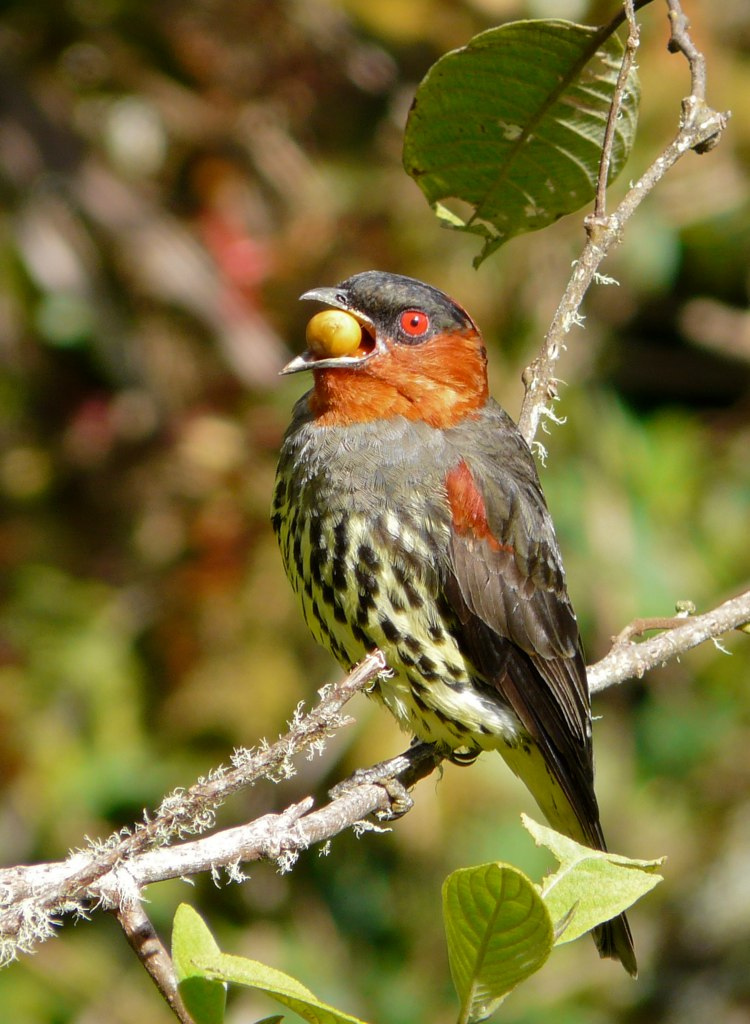
The Sharpbill is notable for its medium-sized, robust body and distinctive, sharply hooked bill, a feature that gives it its common name. Adult plumage is predominantly olive green with subtle yellowish underparts, a coloration that offers excellent camouflage among the dense foliage of its forest habitat. The head features a striking crest, often raised when the bird is alert or excited, which can appear reddish or orange, adding a splash of color to its otherwise muted plumage.
Juveniles tend to have duller coloration, lacking the vibrant crest of the adults, which helps them remain inconspicuous to predators. Males and females are similar in appearance, making it challenging to distinguish between the sexes in the field. However, during the breeding season, males may exhibit slightly brighter plumage and more pronounced vocalizations as part of their courtship displays.
In flight, the Sharpbill presents a compact silhouette with broad, rounded wings and a relatively short tail, a profile that aids in maneuvering through dense canopy layers. When perched, the bird maintains an upright posture, often remaining motionless for extended periods, further aiding its camouflage. This posture, combined with its unique bill shape, helps differentiate it from other species that share its habitat, such as certain flycatchers and tanagers, which lack the Sharpbill's distinctive hooked bill.
Having trouble telling birds apart? Upload a photo to our bird identification tool for an instant species match.
Sharpbill Habitat and Range
Preferred Habitat
The Sharpbill thrives in tropical and subtropical forests, particularly favoring the closed-canopy environments of lowland rainforests and montane cloud forests. It can be found at elevations ranging from sea level to around 2,500 meters, showing a remarkable adaptability to various forest types. In regions like the Andes and the Brazilian Atlantic Forest, it occupies mid to high elevation zones, where the dense canopy provides abundant food resources and nesting sites.
The bird shows little tolerance for open or fragmented habitats, rarely venturing into secondary growth or urban areas. Seasonal habitat shifts are minimal, as the Sharpbill generally remains within its forested range year-round, relying on the stable microclimate and consistent food availability. This preference for undisturbed forest environments highlights the importance of conservation efforts aimed at preserving primary forest ecosystems.
Geographic Range
The Sharpbill's range extends across much of northern and central South America, with its presence recorded in countries such as Brazil, Colombia, Venezuela, Ecuador, and Peru. In Brazil, it is found in the Atlantic Forest, one of the most biodiverse regions on the planet, though its range also covers parts of the Amazon Basin. The bird's distribution is discontinuous, with populations scattered across suitable forest habitats rather than forming continuous bands.
During the breeding season, the Sharpbill remains largely sedentary, occupying established territories. However, some altitudinal movements may occur, particularly in montane regions, where individuals might move to slightly lower elevations during inclement weather or in search of food during leaner periods. Despite being primarily resident, some birds undertake local movements in response to habitat changes or food availability, but these do not constitute long-distance migrations. Population density hotspots include the cloud forests of the Andes and the Atlantic Forest, where the bird finds ample food and nesting resources.
Want to know which birds visit your area? Browse our backyard birds by location guides for region-specific species lists.
What Does the Sharpbill Eat?
The Sharpbill's diet primarily consists of insects and fruit, making it an omnivorous forager. Insects provide a rich protein source, and the bird employs a variety of techniques to capture its prey, including gleaning from leaves and branches and sallying flights to catch flying insects mid-air. The sharply hooked bill is particularly effective for extracting insects from crevices or handling slippery prey.
Fruit forms a significant part of the diet, especially during the fruiting season when it becomes more readily available. The Sharpbill consumes a variety of berries and small fruits, aiding in seed dispersal as it moves through the forest. Its feeding schedule is largely diurnal, with peak activity in the early morning and late afternoon when insect activity is highest and fruit is ripest. Seasonal variations in diet reflect the availability of food resources, with a greater emphasis on fruit during the wet season when many trees and shrubs bear fruit.
Sharpbill Behavior and Social Structure
Sharpbills exhibit fascinating social and territorial behaviors. While they are often seen as solitary or in pairs, they participate in mixed-species foraging flocks. This behavior increases their foraging success and offers protection against predators by increasing vigilance within the group. Territorial behavior is most pronounced during the breeding season, with males using their distinctive songs to defend their space and attract mates.
Courtship displays involve both vocal and visual elements, with males showcasing their crest and engaging in aerial displays to impress potential partners. Once paired, Sharpbills are generally monogamous, maintaining strong pair bonds throughout the breeding season. Their response to predators includes remaining motionless, relying on their camouflaged plumage to avoid detection.
Daily activity patterns are largely diurnal, with birds emerging shortly after dawn to forage. They spend the majority of the day in the upper canopy, descending occasionally to the understory in pursuit of insects or fruit. As dusk approaches, activity diminishes, and Sharpbills retreat to roosting sites within the dense foliage, where they remain safe from nocturnal predators.
Sharpbill Nesting and Reproduction
The Sharpbill constructs a cup-shaped nest, typically placed high in the canopy to avoid ground-based predators. Nest materials include fine twigs, leaves, moss, and lichen, which help camouflage the nest among the branches. Nests are often located near the trunk of a tree or on a sturdy horizontal limb, providing stability and concealment.
Clutch size is usually two to three eggs, with the incubation period lasting around 14-16 days. Both parents share responsibilities, though the female typically takes on a greater role in incubation. After hatching, the nestlings remain in the nest for another 18-22 days, during which time they are fed a diet rich in insects and fruits by both parents.
The Sharpbill usually raises one brood per year, though in regions with extended favorable conditions, a second brood may occur. Parental roles continue even after fledging, with both parents contributing to feeding and protecting the young until they are independent.
Sharpbill Sounds and Vocalizations
The Sharpbill's primary song is a series of sharp, metallic notes delivered in quick succession. These notes are high-pitched and can pierce through the dense forest canopy, making the bird's presence known even when it is not visible. The song serves both to establish territory and to attract mates during the breeding season.
Call notes are less complex, consisting of short, clipped sounds used for communication between mates or within mixed-species flocks. Alarm calls are distinct, often a rapid series of sharp notes that serve to alert other birds to the presence of a predator. During the dawn chorus, the Sharpbill's song is a prominent feature, contributing to the symphony of sounds that define the early morning hours in tropical forests.
Interesting Facts About the Sharpbill
- 1The Sharpbill's hooked bill is unique among its family, allowing it to efficiently handle both insects and fruit.
- 2Despite its bright crest, the Sharpbill is often hard to spot due to its secretive nature and camouflaged plumage.
- 3Sharpbills participate in mixed-species foraging flocks, a behavior that enhances their foraging efficiency.
- 4The bird's song can be heard up to 200 meters away, cutting through the dense canopy of its forest habitat.
- 5Sharpbills are important seed dispersers, contributing to the regeneration and diversity of tropical forests.
- 6The Sharpbill's preference for high-canopy nests helps protect its eggs from many ground-based predators.
- 7Sharpbills can adapt to a range of elevations, from lowland rainforests to montane cloud forests.
Sharpbill Conservation Status
The Sharpbill is currently listed as Least Concern by the IUCN, with populations considered stable across much of its range. However, ongoing threats such as deforestation and habitat fragmentation pose significant risks to its habitat. Conservation efforts focus on preserving large tracts of primary forest, crucial for the Sharpbill's survival. Historically, the bird's population has fluctuated in response to habitat changes, but efforts to protect forested areas in countries like Brazil and Colombia have helped stabilize numbers. Continued vigilance and habitat protection are essential to ensure the long-term survival of this unique species.