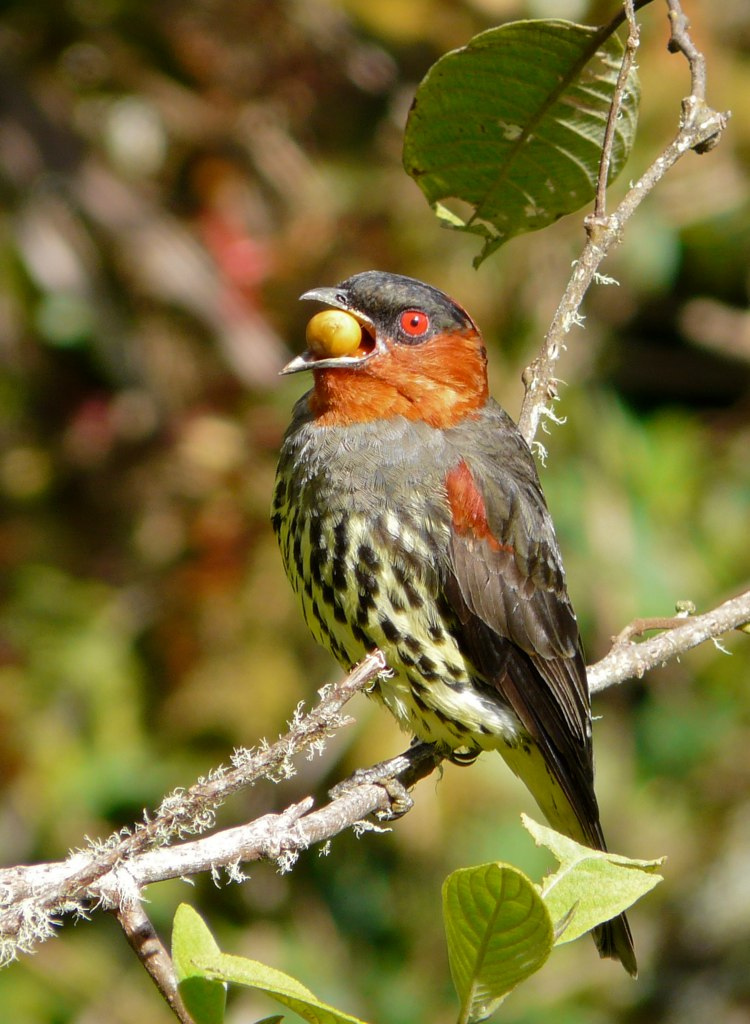
Shrike-like Cotinga (Andean)
Laniisoma elegans
Order: Passeriformes / Family: Cotingidae

Wikimedia Commons
About the Shrike-like Cotinga (Andean)
The Shrike-like Cotinga (Laniisoma elegans) presents a captivating study for ornithologists due to its distinctive appearance and specific habitat preferences. Found primarily in the subtropical and tropical moist montane forests of the Andes, this bird is a true emblem of these lush, biodiverse regions. The species holds particular significance as both an indicator of forest health and a contributor to the ecosystem's balance, playing a crucial role in the seed dispersal of various plant species. The Shrike-like Cotinga's habitat spans across countries like Colombia, Ecuador, Peru, and Bolivia, where it is typically observed at elevations ranging from 900 to 2,400 meters. These regions are characterized by dense vegetation, which provides the ideal environment for these birds to thrive.
Its ecological role extends beyond mere seed dispersal. As a member of the Cotingidae family, the Shrike-like Cotinga is part of a larger group of birds that contribute to the rich tapestry of avian life in the Andes. These birds often act as prey for larger raptors, thus maintaining the balance within the food web. Notably, the Andean subspecies of Laniisoma elegans exhibits unique behaviors adapted to the changing seasons. During the breeding season, which occurs from October to March, these birds become more vocally active, using their calls to establish territories and attract mates. Outside of the breeding season, the Shrike-like Cotinga may exhibit altitudinal migration within its range, moving to slightly lower elevations in search of food resources as temperatures drop and food becomes scarce in higher areas.
The Shrike-like Cotinga's presence in the Andean forests highlights the critical need for conservation efforts aimed at preserving these habitats. Deforestation and habitat fragmentation pose significant threats to this species, as does climate change, which impacts the delicate balance of these ecosystems. Protecting the habitats of the Shrike-like Cotinga not only secures the future of this particular bird but also aids in the conservation of countless other species that share its environment. The intricate connections between species like the Shrike-like Cotinga and their habitats underscore the importance of comprehensive conservation strategies that take into account the entire ecosystem.
The Shrike-like Cotinga (Andean) belongs to the family Cotingidae, within the order Passeriformes. These birds typically live average 7 years with a maximum recorded of 10 years.
How to Identify a Shrike-like Cotinga (Andean)
The Shrike-like Cotinga is notable for its striking appearance, which simplifies identification for birders despite its reclusive nature. Adult males display a predominantly gray plumage with a subtle blue tinge, particularly on the head and back. This is complemented by a pale yellow belly and a distinctive black mask around the eyes, which gives the bird its 'shrike-like' appearance. Females, while similar in size, generally exhibit a more muted coloration, with browns replacing the gray and less pronounced eye markings. Juveniles resemble females but display even duller plumage with more streaking and lack the characteristic mask.
In the field, distinguishing the Shrike-like Cotinga from similar species is essential. The bird's unique combination of the black mask and pale yellow underparts serves as key field marks. Unlike other Cotingas that may share its habitat, such as the Andean Cock-of-the-rock, the Shrike-like Cotinga does not possess the vivid reds or large crests, simplifying differentiation. Its silhouette in flight is rather unremarkable, with a medium-sized body and relatively short tail. However, when perched, its upright posture and alert demeanor distinguish it from many other birds in its range.
The Shrike-like Cotinga's vocalizations can also aid in identification. Its calls, though not as melodious as some other songbirds, have a distinct rhythmic quality that, once learned, can help locate this otherwise elusive bird. Observers often note the bird's preference for mid to upper canopy perches, where it can remain inconspicuous, yet vigilant, in the dense foliage.
Having trouble telling birds apart? Upload a photo to our bird identification tool for an instant species match.
Shrike-like Cotinga (Andean) Habitat and Range
Preferred Habitat
The Shrike-like Cotinga inhabits subtropical and tropical moist montane forests, with a preference for dense, undisturbed cloud forests. These forests, rich in epiphytes and characterized by high humidity, provide the perfect backdrop for the bird's life cycle. Elevationally, the Shrike-like Cotinga is usually found between 900 and 2,400 meters, thriving in areas where the tree canopy offers both ample cover and abundant food sources.
Seasonal shifts in habitat can occur, particularly during the non-breeding season, when individuals may descend to lower elevations in search of warmer temperatures and more accessible food. This altitudinal migration is subtle but significant, as it reflects the bird's adaptability to the varying conditions within its range. In terms of human-altered landscapes, the Shrike-like Cotinga shows little tolerance for urban environments, preferring the seclusion and natural complexity of its forested habitats.
The bird's dependence on these specific habitat types underscores the importance of preserving montane forests, as fragmentation and deforestation pose substantial threats to its survival. Conservation efforts focused on protecting large tracts of continuous forest are vital for maintaining the ecological integrity of the regions where the Shrike-like Cotinga resides.
Geographic Range
The Shrike-like Cotinga's range is primarily concentrated along the eastern slopes of the Andes, stretching through Colombia, Ecuador, Peru, and Bolivia. Within these countries, the bird occupies a relatively narrow band of suitable habitat, constrained by its elevational preferences and the specific requirements of its forest environment.
In Colombia, its presence is noted in departments such as Nariño and Cauca, where the Andes' lush slopes provide the perfect conditions. Ecuador's eastern Andean regions, including areas like Napo and Zamora-Chinchipe, also host the bird. Peru offers a significant portion of the Shrike-like Cotinga's range, with populations in the departments of San Martín and Cusco. Finally, Bolivia marks the southern extent of its range, particularly in areas like La Paz and Cochabamba.
The bird does not engage in long-distance migration, but rather exhibits altitudinal movements in response to seasonal changes. While the exact population density can vary, the Shrike-like Cotinga tends to be more frequently observed in regions where forest conservation efforts are strong, allowing for a stable environment that supports its specific needs.
Want to know which birds visit your area? Browse our backyard birds by location guides for region-specific species lists.
What Does the Shrike-like Cotinga (Andean) Eat?
The diet of the Shrike-like Cotinga primarily consists of a variety of fruits, which it forages for in the mid to upper canopy of its forest habitat. Its fruit-based diet plays a crucial ecological role, as the bird acts as a seed disperser, aiding in the propagation of numerous plant species within its environment. Additionally, the Shrike-like Cotinga supplements its diet with insects, which provide essential proteins and other nutrients, especially during the breeding season when energy demands increase.
Seasonal changes influence the bird's diet. During the wet season, when fruit is more plentiful, the Shrike-like Cotinga can afford to be more selective, focusing on its preferred fruiting trees. In drier months, the bird may be observed expanding its dietary range to include a wider variety of available fruits and insects. This adaptability is key to its survival in the challenging environments of the Andes.
The foraging technique of the Shrike-like Cotinga involves a mix of sallying and gleaning, allowing it to efficiently exploit both fixed and mobile food sources. This behavior not only maximizes its feeding efficiency but also positions it as a vital component of the forest ecosystem, contributing to both plant and animal community dynamics.
Shrike-like Cotinga (Andean) Behavior and Social Structure
Socially, the Shrike-like Cotinga is generally solitary or found in pairs, particularly during the breeding season. Males establish and defend territories vigorously, using a combination of vocalizations and visual displays to ward off rivals and attract potential mates. These courtship displays often involve both song and posture, with males showcasing their striking plumage to best effect.
Throughout the day, the Shrike-like Cotinga is most active during the early morning and late afternoon, spending these periods foraging or maintaining its territory. The bird's response to predators involves a combination of evasive flight and concealment within the dense canopy, leveraging its environment to evade detection.
Flocking behavior is rare in this species, though loose associations with other frugivorous birds may occur when food sources are abundant. This opportunistic social interaction allows the Shrike-like Cotinga to exploit food sources more effectively while maintaining its largely solitary habits.
Shrike-like Cotinga (Andean) Nesting and Reproduction
Nesting for the Shrike-like Cotinga involves the construction of a cup-shaped nest, typically situated high in the forest canopy. The nests are crafted with a variety of materials, including twigs, moss, and leaves, providing both camouflage and protection for the eggs. Preferred nesting locations are in dense foliage, which offers concealment from predators and adverse weather conditions.
Clutch size generally ranges from one to two eggs, reflecting the bird's investment in quality over quantity. The incubation period lasts around 18 to 20 days, with both parents sharing responsibilities. After hatching, the chicks remain in the nest for approximately 20 to 24 days before fledging, during which time they are fed and cared for by both parents.
The Shrike-like Cotinga typically produces one brood per year, aligning its breeding cycle with the availability of food resources in its habitat. This strategy ensures that the young have the highest chance of survival during the critical early stages of life.
Shrike-like Cotinga (Andean) Sounds and Vocalizations
The primary song of the Shrike-like Cotinga consists of a series of clear, whistled notes with a rhythmic pattern that is both distinctive and penetrating. These vocalizations serve multiple purposes, from territory establishment to mate attraction. The rhythm and pitch can vary slightly between individuals, adding a personalized touch to each bird's song.
In addition to its song, the Shrike-like Cotinga produces several call notes, which are typically shorter and used for communication between pairs or to signal alarm. These calls are less melodious than the primary song but equally important for maintaining contact within the dense forest.
The bird's dawn chorus behavior involves increased vocal activity during the early morning hours, a time when the forest is alive with sound. This period is crucial for establishing presence and communicating with potential mates, making it an ideal time for birders to listen for and locate this elusive species.
Interesting Facts About the Shrike-like Cotinga (Andean)
- 1The Shrike-like Cotinga is known for its black mask, giving it a predatory appearance despite its frugivorous diet.
- 2Unlike many other Cotingas, the Shrike-like Cotinga lacks bright colors, sporting a more subdued but distinctive plumage.
- 3The bird's altitudinal migration is a response to seasonal food availability, ensuring it can find resources year-round.
- 4Its role as a seed disperser is crucial for maintaining the diversity and health of the Andean forests.
- 5The Shrike-like Cotinga's song is a series of clear, whistled notes, unique among its forest-dwelling peers.
- 6Males are more vibrantly colored than females, which helps during courtship displays and territorial defenses.
- 7The species' range is limited to the Andes, highlighting its specialized habitat requirements and vulnerability.
Shrike-like Cotinga (Andean) Conservation Status
Currently, the Shrike-like Cotinga is listed as Near Threatened on the IUCN Red List, with population trends showing a gradual decline. The primary threats to this species include habitat loss due to deforestation and land conversion for agriculture. The fragmentation of its montane forest habitat poses a significant risk, as it limits the bird's available range and resources. Conservation efforts are underway in several regions within its range, focusing on habitat preservation and restoration. Protected areas and national parks play a crucial role in maintaining suitable environments for the Shrike-like Cotinga, yet continued efforts are needed to address the ongoing threats from human activities. Historical population changes have largely mirrored the rate of habitat degradation, highlighting the urgent need for effective conservation strategies. Long-term success will depend on collaboration between local communities, conservation organizations, and governments to ensure that the montane forests of the Andes remain a viable home for the Shrike-like Cotinga and other forest-dependent species.