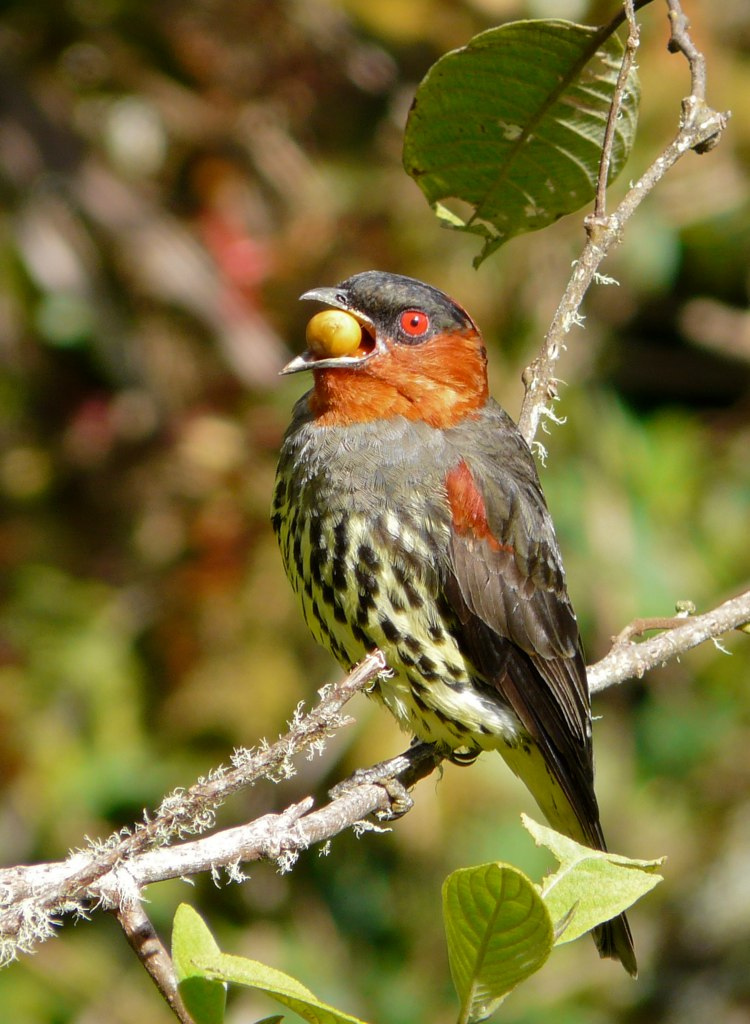
Spangled Cotinga
Cotinga cayana
Order: Passeriformes / Family: Cotingidae

Wikimedia Commons
About the Spangled Cotinga
The Spangled Cotinga (Cotinga cayana) is one of the most visually stunning birds found in the neotropical regions of South America. This species is especially prominent in the Amazon Basin, which includes countries like Brazil, Peru, Colombia, and Venezuela. The ecological significance of the Spangled Cotinga is multifaceted. As a frugivore, it plays a crucial role in seed dispersal, contributing to forest regeneration and plant diversity. Its presence in these ecosystems is an indicator of healthy forest environments.
In terms of habitat, the Spangled Cotinga primarily inhabits the canopy layers of humid lowland rainforests. It is often observed perched high in the trees, scanning for food. Its seasonal behaviors include some local movements influenced by fruit availability rather than long migratory patterns. During the breeding season, males become more vocal and visible as they engage in displays to attract females. The bird's bright, iridescent colors are not just for show; they play a significant role in its mating rituals.
The Cotinga family, to which the Spangled Cotinga belongs, is renowned for its vibrant colors and intriguing behaviors. Among these, the Spangled Cotinga stands out due to its distinctive plumage and its role in the ecosystem as a seed disperser. Despite its apparent abundance in suitable habitats, the species faces threats from deforestation and habitat fragmentation, which can impact its populations. However, as a forest specialist, it generally thrives in protected areas, where it can continue to perform its ecological roles unhindered.
The Spangled Cotinga belongs to the family Cotingidae, within the order Passeriformes. These birds typically live average 8-10 years with a maximum recorded of 12 years..
How to Identify a Spangled Cotinga
The Spangled Cotinga is easily identifiable by its vibrant turquoise body, adorned with black speckles across its back and wings, which give it a spangled appearance. Adult males display a striking mix of turquoise and vibrant pink throat patches, which are especially visible during courtship displays. Females, in contrast, are more subdued, with a predominantly gray-brown plumage, lacking the bright throat patch of the males. Juveniles resemble females but may show a slightly duller coloration.
This species is often mistaken for the Blue Cotinga, but the Spangled Cotinga's distinctive spangled effect and pink throat differentiate it. In flight, the Spangled Cotinga maintains a steady, direct path with slow wingbeats, characteristic of many cotingas. When perched, it adopts an upright posture, often remaining motionless for extended periods, blending surprisingly well with the dappled light of the canopy. Such adaptations make it well-suited to its arboreal lifestyle.
Having trouble telling birds apart? Upload a photo to our bird identification tool for an instant species match.
Spangled Cotinga Habitat and Range
Preferred Habitat
Primarily, the Spangled Cotinga resides in the dense, humid lowland rainforests of the Amazon Basin. It thrives in the canopy layer, where it finds its preferred food sources and mates. These areas are typically below 1000 meters in elevation, although they can occasionally be found in slightly higher elevations if suitable forest habitat exists. Unlike some other cotingas, the Spangled Cotinga does not adapt well to urban settings and is rarely seen outside its forested habitat. It remains a year-round resident in these tropical environments, with any movements being local rather than migratory.
Geographic Range
The Spangled Cotinga's range spans several countries within the Amazon Basin, including Brazil, Peru, Colombia, Venezuela, and parts of Bolivia. It is primarily a resident breeder throughout these regions, with no significant migratory movements. However, within its range, the bird may move locally to track fruiting trees, which are its primary food source. Population density hotspots occur in regions where forest cover remains intact, such as the Brazilian Amazon and Peru's Manu National Park. These areas offer the optimal conditions of dense canopy cover and abundant fruit, supporting healthy populations of the Spangled Cotinga.
Want to know which birds visit your area? Browse our backyard birds by location guides for region-specific species lists.
What Does the Spangled Cotinga Eat?
The Spangled Cotinga's diet primarily consists of a diverse array of fruits and berries found in the canopy layer of its rainforest habitat. In particular, it favors figs and fruits from the Lauraceae and Clusiaceae families. During periods of food abundance, it may feed almost continuously, playing a vital role in seed dispersal. In addition to fruits, this cotinga occasionally supplements its diet with insects, especially during the breeding season when protein demands increase. The bird employs a sit-and-wait foraging strategy, watching for ripe fruit from a high perch before making short flights to pluck its food.
Spangled Cotinga Behavior and Social Structure
The Spangled Cotinga is largely solitary but can sometimes be seen in loose associations with other frugivorous birds, especially in fruiting trees. It is not known to be particularly territorial, although males become more active and visible during the breeding season as they perform elaborate aerial displays to attract females. These displays are a key part of their courtship, showcasing their vibrant plumage. The Spangled Cotinga is diurnal, most active in the early morning and late afternoon when it forages for food. In response to predators, it relies on its ability to remain motionless and its camouflaged appearance against the canopy to avoid detection.
Spangled Cotinga Nesting and Reproduction
The Spangled Cotinga typically constructs its nest high in the forest canopy, often on a sturdy horizontal branch away from the trunk. Nests are shallow and cup-shaped, made from twigs and lined with softer plant material. Clutch size is usually two eggs, which the female incubates alone for about 20 days. After hatching, the chicks are altricial and remain in the nest for approximately three weeks before fledging. Both parents participate in feeding the young, although the female takes on a more significant role. The species typically raises one brood per year, timed to coincide with periods of fruit abundance.
Spangled Cotinga Sounds and Vocalizations
The Spangled Cotinga's vocalizations are surprisingly understated for such a colorful bird. Its primary call is a series of soft, melodic whistles, often delivered from a high perch. These calls can sometimes resemble those of a distant flute. During the breeding season, males may become more vocal, using their calls to advertise their presence and attract females. Alarm calls are sharper, more abrupt notes, used to alert others of potential danger. Unlike some songbirds, it does not participate in a dawn chorus, preferring instead to vocalize sporadically throughout the day.
Interesting Facts About the Spangled Cotinga
- 1The Spangled Cotinga is one of the few birds that can appear both turquoise and pink depending on the light, due to its unique feather structure.
- 2Despite its striking appearance, the Spangled Cotinga's call is surprisingly soft, often going unnoticed in the dense forest canopy.
- 3The vibrant plumage of the male Spangled Cotinga is used primarily for attracting mates, as their coloration plays a minor role in predator avoidance.
- 4Spangled Cotingas have a unique breeding display, involving aerial acrobatics and vocalizations to court females.
- 5These birds can consume fruits that are toxic to many other species, aiding in the dispersal of various plant seeds.
- 6Spangled Cotingas, along with other members of the cotinga family, are known for their iridescent plumage, which is created by microscopic structures in their feathers.
- 7The Spangled Cotinga is almost exclusively found in the canopy, rarely descending to lower forest levels, which helps it avoid predators.
Spangled Cotinga Conservation Status
The Spangled Cotinga is currently listed as Least Concern by the IUCN, thanks to its relatively stable population across its extensive range. However, ongoing deforestation and habitat fragmentation in the Amazon pose significant threats to its long-term survival. Conservation efforts in the region, such as protected areas and sustainable land management practices, are crucial to maintaining viable populations. Historical data suggest the species has maintained stable numbers where forest cover remains intact, underscoring the importance of preserving its natural habitat.