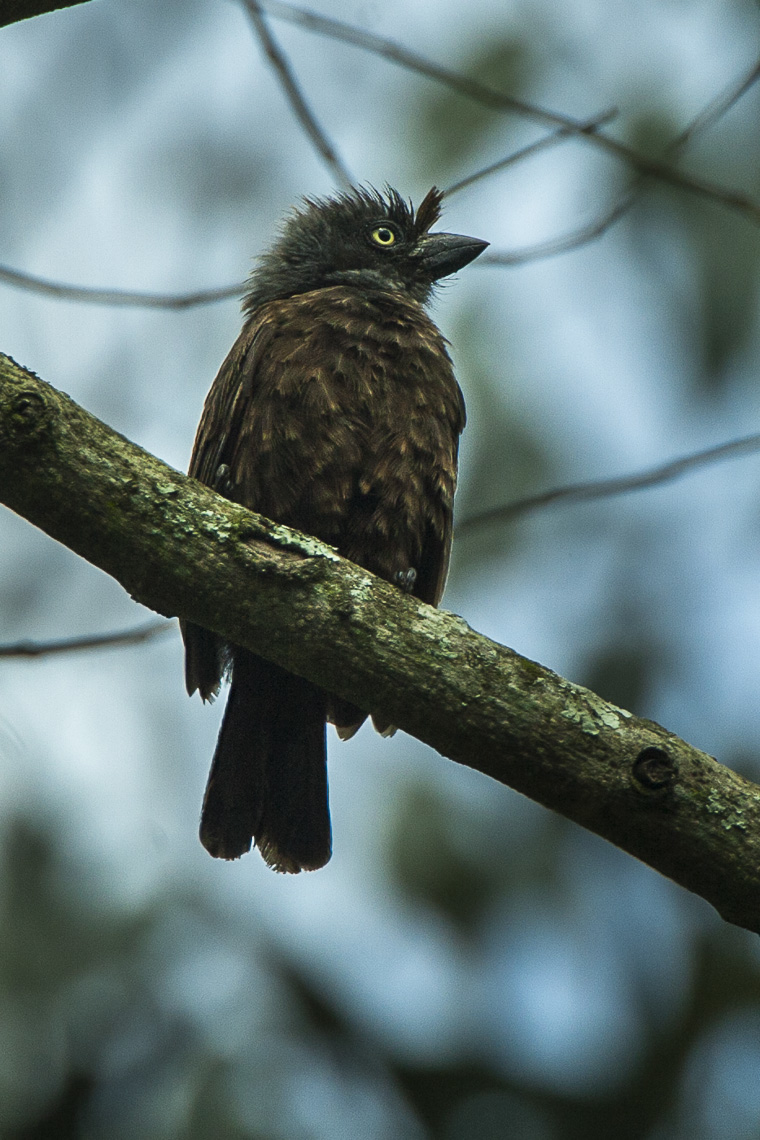
Spot-flanked Barbet
Tricholaema lacrymosa
Order: Piciformes / Family: Lybiidae

Wikimedia Commons
About the Spot-flanked Barbet
The Spot-flanked Barbet (Tricholaema lacrymosa) is a captivating member of the Lybiidae family found mainly in East Africa. Its range spans countries like Kenya, Tanzania, Uganda, and Rwanda. This bird thrives in various habitats, from savannahs and acacia-dominated woodlands to cultivated areas and gardens. The species plays a critical role in its ecosystem by dispersing seeds and controlling insect populations. Observers frequently spot these birds in the mid to upper canopy, where they exhibit their vibrant colors and distinctive calls. During the breeding season, which corresponds with the rainy months in its range, the Spot-flanked Barbet becomes particularly vocal and active. This seasonality ensures ample food supply for their chicks, which mostly consist of insects and fruit. The Spot-flanked Barbet's ecological significance extends beyond its dietary habits. Its presence indicates a healthy, biodiverse environment, acting as a bioindicator species. The bird's preference for semi-open habitats allows it to serve as a bridge between forested areas and more open landscapes. By preying on insects, it helps maintain population balance, indirectly supporting agricultural activities. This dual role underscores the Spot-flanked Barbet's importance, not only to local ecosystems but also to human communities reliant on farming. Despite its apparent abundance, the Spot-flanked Barbet faces challenges from habitat fragmentation and changes in land use. Conservation efforts focus on protecting its natural habitats and maintaining ecological corridors to allow for genetic diversity. Its adaptability to modified landscapes offers some hope for resilience in changing environments, yet continued vigilance remains crucial. The Spot-flanked Barbet represents more than a colorful addition to East Africa's avian fauna. Its interactions with the environment and contributions to ecological stability highlight the intricate web of life in which this bird plays a part. Efforts to conserve its habitats ensure the preservation of not just a single species, but the broader ecosystems it supports.
The Spot-flanked Barbet belongs to the family Lybiidae, within the order Piciformes. These birds typically live average 5 years, with a maximum recorded lifespan of 10 years..
How to Identify a Spot-flanked Barbet
Spot-flanked Barbets are medium-sized birds characterized by their bright coloration and distinctive flank spots. Adults measure about 17-20 cm in length. Their plumage predominantly features a blend of black and white, with notable yellow streaks on the face and a red patch above the bill. A key identifying feature is the series of white spots on their dark flanks, providing a stark contrast and giving the species its name. Juveniles sport a duller appearance, lacking the vivid hues of their adult counterparts. They show less defined flank spots, making them more challenging to identify at a glance. Both males and females exhibit similar plumage, with subtle differences in size, as males tend to be slightly larger. In flight, the Spot-flanked Barbet presents a rounded silhouette with broad wings and a relatively short tail. Its perching posture is upright, often seen on exposed branches where it can easily spot potential threats and food sources. The species might be confused with other barbet species like the Black-collared Barbet, but the distinctive flank spots and facial markings help distinguish it. Observers should note the bird's bill shape and coloration, as these features remain consistent across various lighting conditions, aiding in accurate identification.
Having trouble telling birds apart? Upload a photo to our bird identification tool for an instant species match.
Spot-flanked Barbet Habitat and Range
Preferred Habitat
The Spot-flanked Barbet occupies diverse habitats across East Africa, preferring areas with open or semi-open vegetation. It thrives in woodlands, savannahs, and bushlands, particularly those dominated by acacias. The species often inhabits areas at elevations ranging from lowland plains to higher altitudes of up to 2,400 meters. Seasonal movements are minimal, as the barbet tends to remain within its established range year-round. Although primarily associated with rural and natural habitats, it shows adaptability to human-altered landscapes, such as gardens and agricultural fields. This flexibility allows the Spot-flanked Barbet to persist in regions experiencing moderate habitat modification, although it still relies on the presence of native flora for optimal foraging and nesting. Urban presence is rare, as the species avoids densely populated areas lacking suitable vegetation. However, in areas where urban sprawl includes ample green spaces, Spot-flanked Barbets may establish territories.
Geographic Range
The Spot-flanked Barbet's range extends across several East African countries, including Kenya, Tanzania, Uganda, and Rwanda. It occupies a relatively stable range throughout the year, with no significant migratory patterns observed. The bird's range overlaps with various ecological zones, from the coastal regions of Kenya to the highland areas of western Tanzania. Population density is highest in regions where suitable habitats are abundant, such as the savannahs and open woodlands of the Serengeti and Maasai Mara ecosystems. These areas support large numbers of the species, providing ideal conditions for breeding and foraging. The Spot-flanked Barbet's relatively broad range and stable population trends suggest resilience in the face of habitat changes. However, localized declines may occur due to deforestation and land conversion, emphasizing the need for habitat conservation efforts in these biodiverse regions. Monitoring programs focus on maintaining population connectivity and ensuring that these birds can continue to thrive across their range.
Want to know which birds visit your area? Browse our backyard birds by location guides for region-specific species lists.
What Does the Spot-flanked Barbet Eat?
The Spot-flanked Barbet maintains a diet primarily composed of fruits and insects, reflecting its role as both a seed disperser and insectivore. It consumes fruits from a variety of plant species, including figs and berries, aiding in seed distribution across its habitat. Insects form a crucial part of its diet, especially during the breeding season when protein demands increase. The barbet employs a sit-and-wait strategy, perching on branches to spot insects before making quick flights to capture them. This method allows it to catch a wide range of prey, from beetles to caterpillars, which vary in size depending on availability. Seasonal variations in diet occur as fruit abundance fluctuates, with the Spot-flanked Barbet adjusting its feeding habits to capitalize on the most accessible food sources. The bird usually forages alone or in pairs, although it may join mixed-species flocks to exploit food resources more efficiently. Morning and late afternoon are peak feeding times, aligning with cooler temperatures and increased insect activity.
Want to attract Spot-flanked Barbets to your yard? See our recommended feeders and seed types for the best results.
Spot-flanked Barbet Behavior and Social Structure
Spot-flanked Barbets exhibit a social structure centered around pairs or small family groups, reflecting their monogamous nature. They defend their territories vigorously, engaging in vocal displays and physical confrontations to deter intruders. Territorial calls serve as both a warning to rivals and an invitation to potential mates. During courtship, males perform elaborate displays that include singing and presenting food to the female, strengthening pair bonds. The species generally remains within its established territory year-round, showing limited migratory behavior. However, it participates in mixed-species flocks outside the breeding season, enhancing foraging efficiency and predator avoidance. Daily activities involve a pattern of feeding, resting, and social interactions, with peak activity occurring during the cooler morning and evening hours. Spot-flanked Barbets respond to predators with alarm calls and evasive maneuvers, relying on dense vegetation for concealment. Their alertness and group cohesion aid in predator detection, enhancing survival chances.
Spot-flanked Barbet Nesting and Reproduction
Spot-flanked Barbets nest in tree cavities, often selecting sites with existing holes excavated by other species or naturally occurring in decayed wood. They use minimal nesting material, sometimes adding leaves or grass to the cavity. The species shows a preference for nesting in dead trees or branches, where competition for sites may be lower. Clutch size typically ranges from 2 to 4 eggs. Both parents share incubation duties, which last approximately 14 to 16 days. After hatching, the chicks remain in the nest for about 20 to 25 days before fledging. Parental care continues post-fledging, with both adults involved in feeding and protecting the young. The Spot-flanked Barbet may raise two broods per year, depending on food availability and environmental conditions. This reproductive strategy allows the species to maintain stable population levels, even in areas subject to environmental pressures.
Spot-flanked Barbet Sounds and Vocalizations
The Spot-flanked Barbet's primary song consists of a rhythmic series of 'tuk-tuk-tuk' notes, delivered at a steady tempo and medium pitch. This song serves dual purposes, functioning as both a territorial marker and a courtship display. Call notes include sharp, staccato 'chuk' sounds used in communication between mates and alarms when predators are nearby. During the dawn chorus, the Spot-flanked Barbet's song becomes more pronounced, contributing to the acoustic environment of its habitat. Compared to other barbet species, its calls are relatively soft and less resonant, making them more challenging to detect from a distance. This acoustic profile aids in distinguishing the Spot-flanked Barbet from similar species within its range.
Interesting Facts About the Spot-flanked Barbet
- 1Spot-flanked Barbets, with their striking flank spots, can be easily identified even from a distance in their natural habitat.
- 2These barbets play a crucial ecological role by dispersing seeds of various fruiting plants, aiding in forest regeneration.
- 3Their distinct 'tuk-tuk-tuk' call is a signature sound of East African woodlands, often heard during the early morning hours.
- 4Spot-flanked Barbets exhibit strong territorial instincts, defending their home ranges with persistent calls and displays.
- 5The species demonstrates notable adaptability, frequently inhabiting gardens and cultivated areas where native vegetation persists.
- 6Despite their colorful plumage, Spot-flanked Barbets can blend into their surroundings, aided by their preference for dense foliage.
- 7Studies show that these barbets often use the same nesting sites year after year, indicating strong site fidelity.
Spot-flanked Barbet Conservation Status
The IUCN lists the Spot-flanked Barbet as a species of Least Concern, reflecting its widespread distribution and stable population trends. However, habitat loss due to deforestation and agricultural expansion poses ongoing threats. Conservation efforts focus on habitat preservation and restoration, particularly in regions experiencing rapid land-use changes. Initiatives include creating protected areas and promoting sustainable land management practices. Historical population changes remain relatively minor, but continued monitoring is essential to detect potential declines. The Spot-flanked Barbet's adaptability to modified habitats offers some resilience, yet conservation actions remain necessary to ensure long-term survival.
Attracting Spot-flanked Barbets to Your Feeder
The Spot-flanked Barbet is a regular visitor to backyard bird feeders across its range. At the Eye On The Fly feeding station, we observe Spot-flanked Barbets regularly and capture footage with our feeder cameras.