Spotted Laughingthrush
Garrulax ocellatus
Order: Passeriformes / Family: Leiothrichidae

Wikimedia Commons
About the Spotted Laughingthrush
The Spotted Laughingthrush (Garrulax ocellatus) captivates birdwatchers with its unique combination of beauty and song. This medium-sized bird, part of the Leiothrichidae family, inhabits the dense, montane forests of the Himalayas, stretching across India, Nepal, Bhutan, and into parts of Tibet. Its presence is often a delightful surprise for those exploring forests at elevations between 1,500 to 3,500 meters. The Spotted Laughingthrush plays a vital ecological role as part of the avian community in these biodiverse regions. Its foraging habits help in seed dispersal and its insectivorous diet aids in controlling insect populations. In its natural habitat, this bird thrives in the undergrowth of evergreen and mixed forests, where it can be seen flitting among low shrubs and thickets. Seasonally, the Spotted Laughingthrush remains fairly sedentary, with movements largely dictated by food availability rather than long migrations. During the breeding season, which coincides with the warmer months, its vocalizations become even more prominent as it establishes territories and attracts mates. Its unmistakable, melodious song consists of varied whistles and chuckles, often heard echoing through the forested valleys. The species is integral to the ecosystem, contributing not only to the balance of insect populations but also serving as prey for larger predators. This interconnectedness highlights the importance of conserving its habitat, particularly in regions facing deforestation and human encroachment.
The Spotted Laughingthrush belongs to the family Leiothrichidae, within the order Passeriformes. These birds typically live typically around 6-9 years, with the maximum recorded at 12 years..
How to Identify a Spotted Laughingthrush
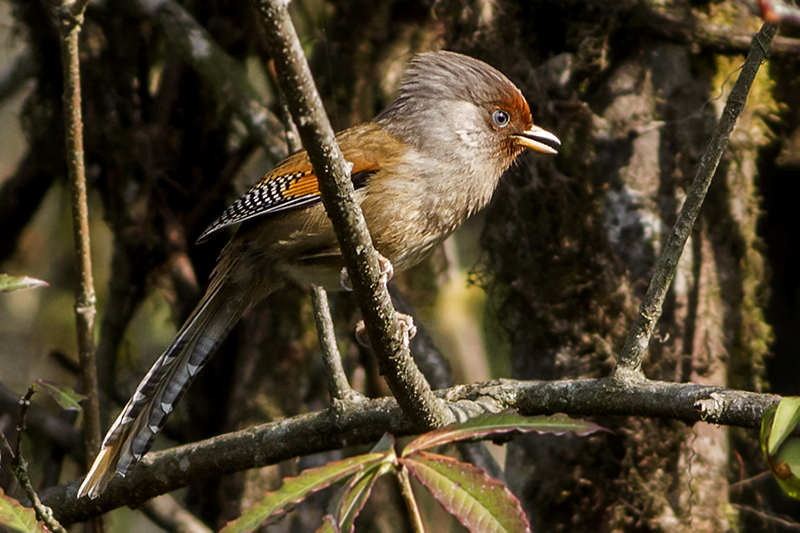
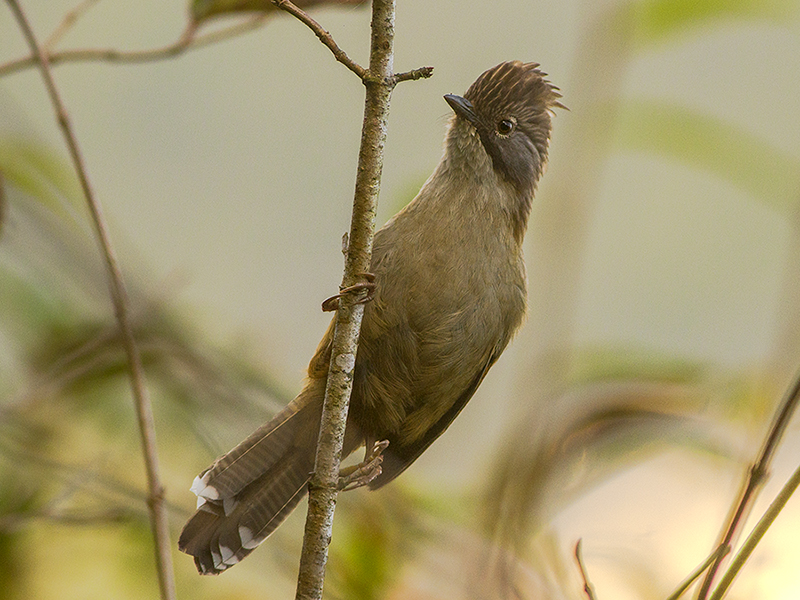
The Spotted Laughingthrush can be identified by its striking plumage, which features a rich, chestnut-brown body adorned with white spots across the wings and back. Its face exhibits a bold pattern with a black mask and white throat, providing a sharp contrast that aids in visual recognition. The tail is long and graduated, often flicked expressively while perched. Males and females are similar in appearance, though males can sometimes appear slightly larger. Juveniles resemble adults but may display less distinct spotting and a more muted coloration overall. This species might be confused with other laughingthrushes, but its unique combination of spots and facial markings helps distinguish it from similar species. In flight, the Spotted Laughingthrush maintains a direct and somewhat undulating pattern, typically staying within dense cover. When perched, it often adopts an upright posture, enabling a clear view of its surroundings.
Having trouble telling birds apart? Upload a photo to our bird identification tool for an instant species match.
Spotted Laughingthrush Habitat and Range
Preferred Habitat
The Spotted Laughingthrush primarily inhabits the temperate and subtropical forests of the Himalayas. It favors dense underbrush and thickets within evergreen and mixed woodland environments. These birds are typically found at elevations ranging from 1,500 to 3,500 meters, where they exploit the rich biodiversity for food and shelter. During the breeding season, they remain within these forested areas, taking advantage of the abundant foliage for nesting and protection. Unlike some other bird species, the Spotted Laughingthrush shows limited adaptability to urban areas, preferring the seclusion and resources of rural, forested habitats. Seasonal shifts in habitat are minimal, with any movements primarily influenced by changes in food availability rather than temperature.
Geographic Range
The range of the Spotted Laughingthrush spans the Himalayan foothills across several countries. It breeds and resides year-round in India, Nepal, Bhutan, and parts of southern China, including Tibet. Within this range, it occupies specific montane forest zones, where it is relatively common. The bird does not undergo long-distance migrations, instead displaying altitudinal movements in response to environmental conditions. Population density hotspots include the wooded areas of Sikkim and Arunachal Pradesh in India, where suitable habitat conditions are abundant. While its range does not extend outside of Asia, the Spotted Laughingthrush exhibits adaptability within its preferred habitat zones, thriving in the rich ecological niches provided by these regions.
Want to know which birds visit your area? Browse our backyard birds by location guides for region-specific species lists.
What Does the Spotted Laughingthrush Eat?
The Spotted Laughingthrush has a diverse diet that primarily consists of insects and seeds. During the warmer months, it feeds extensively on insects such as beetles, caterpillars, and ants, playing a crucial role in pest control within its habitat. Its foraging technique involves agile movements through dense foliage, often flipping over leaves and debris to uncover hidden prey. In addition to insects, it consumes a variety of seeds and berries, particularly in the colder months when insects are less abundant. The bird's diet shifts with the seasons, demonstrating its adaptability to available resources. Feeding typically occurs during daylight hours, with peak activity in the early morning and late afternoon, when food availability and temperature conditions are optimal.
Spotted Laughingthrush Behavior and Social Structure
The Spotted Laughingthrush exhibits intriguing social and territorial behaviors. It is often observed in pairs or small family groups rather than large flocks, indicative of its semi-social nature. During the breeding season, males become highly territorial, using their melodious song to establish boundaries and deter rivals. Courtship displays are elaborate, involving vocal duets and synchronized movements. Despite its territorial tendencies, the Spotted Laughingthrush shows a degree of tolerance towards other bird species, often foraging in mixed-species flocks outside the breeding season. Its response to predators involves a combination of alarm calls and evasive flight, utilizing the dense underbrush for quick escape. Daily activity patterns revolve around foraging, with periods of rest and preening interspersed throughout the day.
Spotted Laughingthrush Nesting and Reproduction
Nesting for the Spotted Laughingthrush occurs primarily in the dense foliage of its montane forest habitat. The birds construct cup-shaped nests using twigs, leaves, and moss, strategically placing them in low shrubs or small trees to provide concealment and protection from predators. A typical clutch consists of 2-4 eggs, which both parents incubate over approximately 14-16 days. Post-hatching, the fledging period lasts another 12-15 days, during which both parents actively feed and protect the chicks. The Spotted Laughingthrush may raise one or two broods per year, depending on environmental conditions and food availability. Parental roles are shared, with both males and females contributing to the feeding and care of the young.
Spotted Laughingthrush Sounds and Vocalizations
The Spotted Laughingthrush is renowned for its rich and varied vocal repertoire. Its primary song comprises a series of melodious whistles interspersed with chuckles, often described as joyous and infectious. This song is delivered with a clear rhythm, rising and falling in pitch, and can be heard echoing through the forest, especially during the breeding season. In addition to its song, the bird produces a variety of call notes used for communication within pairs and groups. Alarm calls are sharper and more abrupt, serving to alert others of potential threats. The dawn chorus of the Spotted Laughingthrush is a remarkable auditory experience, with multiple individuals contributing to a symphony of natural sound.
Interesting Facts About the Spotted Laughingthrush
- 1The Spotted Laughingthrush can be heard singing long before it is seen, thanks to its melodious and far-reaching calls.
- 2Despite its preference for dense forests, the Spotted Laughingthrush can sometimes be spotted in gardens near forest edges.
- 3This bird's diet shifts from primarily insects in the summer to seeds and berries in the winter, showcasing its adaptability.
- 4The Spotted Laughingthrush is part of a diverse family of laughingthrushes, known for their complex vocalizations and social behavior.
- 5Unlike many birds, the Spotted Laughingthrush does not migrate long distances, instead making local movements based on food availability.
Spotted Laughingthrush Conservation Status
The Spotted Laughingthrush is currently classified as Least Concern by the IUCN, with a stable population trend. Despite its stable status, the species faces threats from habitat destruction due to logging and agricultural expansion in some regions. Conservation efforts focus on habitat preservation and ensuring the protection of key forest areas. Historically, the population has remained stable, largely due to its adaptability within its preferred habitat zones. Continued monitoring and habitat conservation are essential to maintaining its population levels amidst growing environmental pressures.