Sunda Laughingthrush
Garrulax palliatus
Order: Passeriformes / Family: Leiothrichidae

Wikimedia Commons
About the Sunda Laughingthrush
The Sunda Laughingthrush, Garrulax palliatus, is a fascinating member of the Leiothrichidae family, noteworthy for its striking vocalizations and social behavior. This medium-sized bird inhabits the lush, dense forests of Southeast Asia, particularly on the Malay Peninsula and the islands of Sumatra and Borneo. With its preference for humid, montane forests, the Sunda Laughingthrush thrives in regions where vegetation is thick and the canopy offers ample cover. Its ecological role in these environments is multifaceted; not only does it contribute to seed dispersal through its frugivorous diet, but it also participates in controlling insect populations. The presence of the Sunda Laughingthrush often indicates a healthy, biodiverse forest ecosystem. This species prefers altitudes ranging from 600 to 2,000 meters, where it engages in a variety of social interactions. Remarkably, these birds are known to form complex social structures, often observed in small, gregarious flocks that forage through the understory. Seasonal behavior includes slight altitudinal movements, driven by food availability rather than migration, as the Sunda Laughingthrush is a resident species. During the breeding season, typically spanning from March to June, their calls become even more pronounced as they establish territories and attract mates. The birds' songs contribute significantly to the soundscape of their habitat, creating a lively atmosphere. Beyond their vocal prowess, Sunda Laughingthrushes are visually captivating. Their plumage, while primarily brown and gray, features subtle variations that aid in camouflage among the forest's shadows and dappled sunlight. Their physical characteristics, combined with their ecological significance, make them a subject of interest for ornithologists and birdwatchers alike.
The Sunda Laughingthrush belongs to the family Leiothrichidae, within the order Passeriformes. These birds typically live typically around 5-8 years, with the maximum recorded at 10 years..
How to Identify a Sunda Laughingthrush
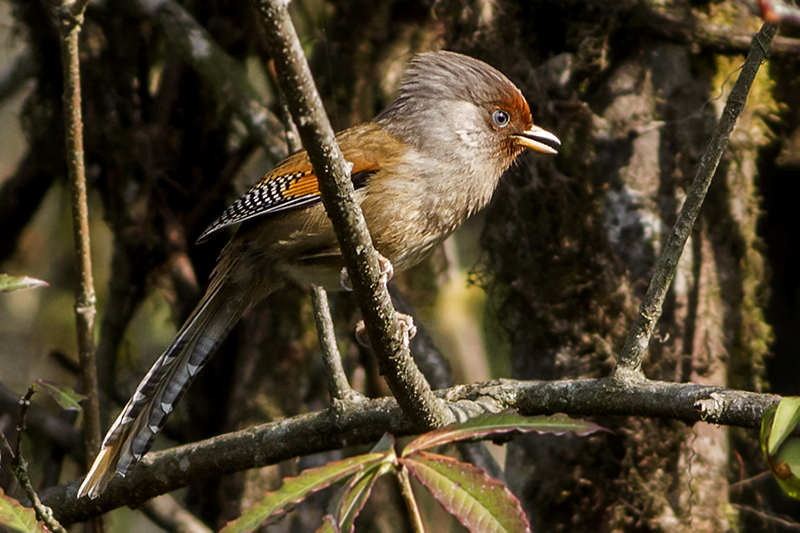
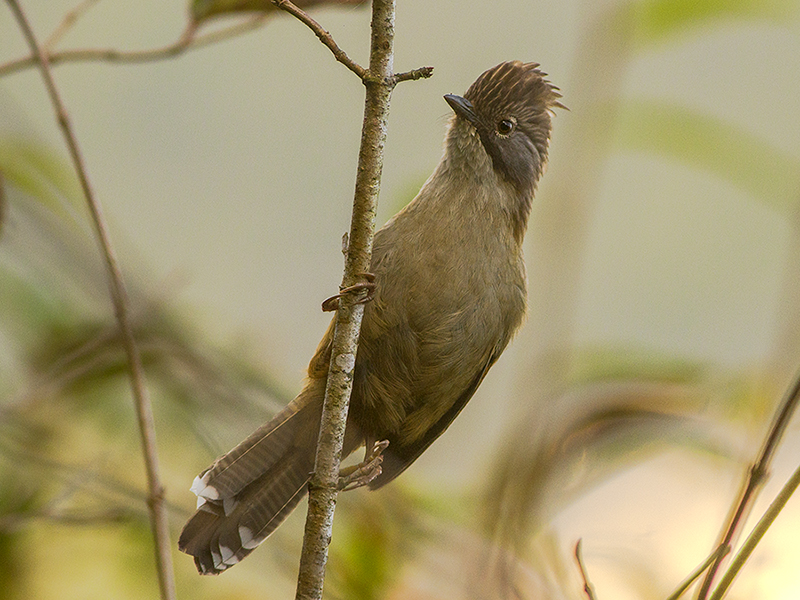
The Sunda Laughingthrush is recognizable by its medium size, measuring approximately 25 centimeters in length. Its plumage is primarily a soft, earthy brown, with darker grayish-brown on the wings and tail. The bird's head is marked by a prominent, black mask that extends from the base of the bill to the eyes, offering a striking contrast to its otherwise muted coloration. Juvenile birds display similar plumage to adults, though their colors may appear slightly duller and less defined until they mature. Male and female Sunda Laughingthrushes are similar in appearance, with no significant sexual dimorphism, which can sometimes make field identification challenging. When compared to similar species, such as the Chestnut-capped Laughingthrush, the Sunda Laughingthrush lacks the distinctive chestnut cap, instead featuring a more uniform head coloration. In flight, this bird displays a rounded silhouette with broad wings and a slightly fan-shaped tail. When perched, it often holds its tail slightly cocked, a behavior characteristic of the species. Observers can distinguish the Sunda Laughingthrush by its posture and its preference for remaining in the lower to mid-levels of the forest canopy.
Having trouble telling birds apart? Upload a photo to our bird identification tool for an instant species match.
Sunda Laughingthrush Habitat and Range
Preferred Habitat
The Sunda Laughingthrush inhabits dense, humid montane forests, thriving in the lush environments of Southeast Asia. It predominantly resides in the regions encompassing the Malay Peninsula and the islands of Sumatra and Borneo. These birds prefer elevation ranges between 600 and 2,000 meters, where the forest structure offers ample cover and resources for foraging. The primary habitat consists of primary and secondary forests, where the understory is rich in vegetation. Unlike some species that adapt to urban or heavily altered landscapes, the Sunda Laughingthrush remains primarily in forested areas, showing little inclination to venture into urban environments. Seasonal habitat shifts are minor, driven by slight altitudinal movements in response to changes in food availability rather than drastic migrations. The presence of the Sunda Laughingthrush is often associated with biodiverse forest ecosystems teeming with plant and animal life.
Geographic Range
The Sunda Laughingthrush occupies a relatively restricted range, confined to the forested regions of the Malay Peninsula, Sumatra, and Borneo. As a non-migratory species, its presence is consistent throughout the year within these territories. The bird's breeding and resident range overlap significantly, with no substantial migratory corridors due to its sedentary nature. Within these islands, population density tends to be higher in areas where montane forests are well-preserved and less disturbed by human activities. Conservation areas and national parks in these regions often serve as strongholds for the species, providing essential habitats that support their populations. Despite their restricted range, the Sunda Laughingthrush remains relatively widespread within its preferred habitats, although specific population density hotspots may vary based on local environmental conditions.
Want to know which birds visit your area? Browse our backyard birds by location guides for region-specific species lists.
What Does the Sunda Laughingthrush Eat?
The diet of the Sunda Laughingthrush primarily consists of fruits, insects, and small invertebrates, reflecting its opportunistic feeding habits. During the fruiting season, these birds often forage on berries and small fruits found within the dense forest understory. They play a critical role in seed dispersal, contributing to the regeneration of their forest habitats. Insects form a substantial component of their diet, especially during the breeding season when protein demands increase. The Sunda Laughingthrush employs a variety of foraging techniques, often seen hopping along branches or catching insects mid-flight. Prey size typically includes small arthropods such as beetles and caterpillars. Their feeding schedule aligns with daylight hours, with peak activity occurring in the early morning and late afternoon when temperatures are cooler and insect activity is high. Seasonal diet changes are minimal due to the stable climate of their habitat, ensuring consistent food availability throughout the year.
Sunda Laughingthrush Behavior and Social Structure
The Sunda Laughingthrush displays a complex social structure, often seen in small, cohesive flocks that exhibit strong social bonds. These flocks, usually consisting of family groups, forage together through the forest understory, communicating with a series of whistles and calls. Territorial behavior becomes more pronounced during the breeding season, with males establishing territories through vocal displays and occasional physical confrontations. Courtship displays involve both song and visual cues, with males often performing elaborate postures to attract mates. Despite their social nature, these birds maintain a level of territoriality that ensures sufficient resources for breeding pairs. The species shows a remarkable ability to adapt to the presence of predators, often relying on their vocalizations to alert other flock members of potential threats. Daily activity patterns are diurnal, with a significant portion of the day dedicated to foraging and social interactions. During peak heat, they may retreat to denser foliage for shade and protection.
Sunda Laughingthrush Nesting and Reproduction
Sunda Laughingthrushes construct cup-shaped nests using twigs, leaves, and moss, often placing them in the fork of a tree or shrub within the dense forest understory. The location of the nest, typically 1 to 3 meters above the ground, offers concealment from predators and protection from environmental elements. Clutch size usually consists of 2 to 3 eggs, which are pale blue with brownish spots. Both parents participate actively in incubation, which lasts approximately 14 to 16 days. Post-hatching, the chicks are altricial and require extensive parental care. Fledging occurs roughly 12 to 14 days after hatching, during which both parents continue to provide food and protection. The Sunda Laughingthrush generally raises one to two broods per year, depending on environmental conditions and food availability.
Sunda Laughingthrush Sounds and Vocalizations
The Sunda Laughingthrush is renowned for its rich, melodious songs, which feature a series of clear, flute-like notes delivered in a cascading rhythm. These vocalizations serve multiple purposes, including mate attraction and territory establishment. Call notes are softer and more conversational, often used in flock communication. Alarm calls are sharp and piercing, designed to alert fellow birds to imminent danger. During the dawn chorus, their songs contribute to the vibrant soundscape of the forest, signaling the start of a new day. The melodious quality of their song resembles that of a clear whistle, and it can be mistaken for other songbirds in the region, though the specific pattern and rhythm remain distinct.
Interesting Facts About the Sunda Laughingthrush
- 1The Sunda Laughingthrush's call can be heard over long distances, a useful trait for communicating across dense forest environments.
- 2Despite being a social species, the Sunda Laughingthrush exhibits strong territorial behavior during breeding, with males actively defending their area.
- 3This species plays a vital role in seed dispersal, helping to maintain the biodiversity of its forest habitat.
- 4The Sunda Laughingthrush is non-migratory, residing year-round within its limited geographic range in Southeast Asia.
- 5Their nests, typically concealed within dense vegetation, are built using a variety of natural materials, showcasing their adaptability in construction.
- 6Juvenile Sunda Laughingthrushes often join flocks of experienced adults, learning important survival and feeding skills.
- 7They are an important part of the forest soundscape, contributing to the dawn chorus with their melodious songs.
Sunda Laughingthrush Conservation Status
The Sunda Laughingthrush is currently listed as Least Concern by the IUCN, reflecting a stable population trend across its range. However, habitat destruction due to logging and agricultural expansion poses significant threats to its forest habitats. Conservation efforts primarily focus on preserving forest ecosystems within protected areas and promoting sustainable land-use practices. Historical population changes have seen fluctuations in local densities, often linked to habitat degradation or restoration efforts. Continued monitoring and habitat protection are critical to ensuring the long-term survival of this species.