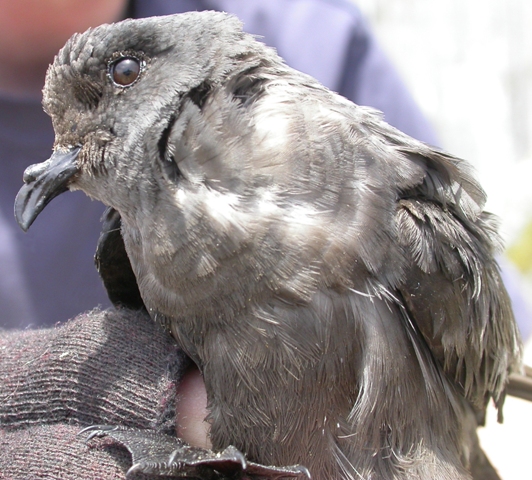
Swinhoe's Storm-Petrel
Oceanodroma monorhis
Order: Procellariiformes / Family: Hydrobatidae

Wikimedia Commons
About the Swinhoe's Storm-Petrel
The Swinhoe's Storm-Petrel (Oceanodroma monorhis) is a small seabird belonging to the family Hydrobatidae. This species is largely pelagic and spends most of its life over open waters, particularly along the Pacific Ocean's coastal regions. It is a member of the order Procellariiformes, which includes other petrels and albatrosses, known for their excellent flying abilities and oceanic lifestyles. Swinhoe's Storm-Petrel is named in honor of the British naturalist Robert Swinhoe, who first described the species in the 19th century. This storm-petrel plays a critical role in the marine ecosystem by participating in the nutrient cycle. As a predator of small fish and plankton, it helps regulate these populations, ensuring the balance of marine life. The bird's presence indicates healthy oceanic conditions, as it relies on abundant food sources found in nutrient-rich waters. The Swinhoe's Storm-Petrel is most commonly observed in the North Pacific, particularly around Japan, Korea, and the eastern coast of China. It breeds on remote islands, often choosing locations with minimal human disturbance. Its breeding season typically occurs from May to August when it returns to land to nest. During this time, the birds exhibit nocturnal behaviors to avoid predators and human activity. After the breeding season, these storm-petrels disperse widely across the Pacific, with some birds recorded as far south as the waters off Australia. The Swinhoe's Storm-Petrel's ability to thrive in diverse marine environments highlights its adaptability and resilience, yet also underscores the importance of preserving its habitats amidst growing environmental challenges.
The Swinhoe's Storm-Petrel belongs to the family Hydrobatidae, within the order Procellariiformes. These birds typically live average 15 years, with a maximum recorded of 22 years..
How to Identify a Swinhoe's Storm-Petrel
The Swinhoe's Storm-Petrel is a small seabird, measuring approximately 18 to 20 centimeters in length with a wingspan of about 45 centimeters. Adults possess a distinctive dark plumage with a subtle grayish tinge. Unlike many other storm-petrels, Swinhoe's Storm-Petrel lacks the white rump, which serves as a key differentiator in the field. Both sexes appear similar in plumage, making visual differentiation challenging. Juveniles closely resemble adults but may have slightly fresher feather wear. In flight, the Swinhoe's Storm-Petrel exhibits a characteristic bounding flight pattern with rapid wingbeats interspersed with glides. Its long wings are angled and narrow, assisting in agile maneuvers over the ocean surface. When perched, usually on rocky outcrops or nesting sites, the bird maintains a compact posture with its wings held close to the body. Observers may confuse this petrel with similar species such as the Leach's Storm-Petrel, which has a forked tail and distinctive white rump. However, the Swinhoe's Storm-Petrel's uniformly dark tail helps distinguish it from its relatives in the field.
Having trouble telling birds apart? Upload a photo to our bird identification tool for an instant species match.
Swinhoe's Storm-Petrel Habitat and Range
Preferred Habitat
Swinhoe's Storm-Petrel primarily inhabits open ocean environments, showing a preference for temperate and subtropical waters. During the breeding season, it nests on isolated islands with rocky terrain and sparse vegetation, such as those found in the East China Sea and the Sea of Japan. These islands provide safe nesting sites free from predators and minimal human interference. The bird's habitat extends from sea level to moderate elevations, depending on the availability of suitable nesting sites. While primarily pelagic, Swinhoe's Storm-Petrel demonstrates some degree of adaptability, occasionally venturing into coastal areas, particularly near breeding colonies. This species does not typically inhabit urban environments, instead thriving in remote, unspoiled locations.
Geographic Range
The Swinhoe's Storm-Petrel breeds on several remote islands in the North Pacific, including those off the coasts of Japan, Korea, and eastern China. Key breeding sites include Okinoshima Island in Japan and Chilbaldo in South Korea. During the non-breeding season, the bird disperses across the western Pacific Ocean, with some individuals traveling as far south as the waters near the Philippines and northern Australia. Migration corridors are not well-defined due to the species' elusive nature, but it is known to follow ocean currents that offer abundant feeding opportunities. The population density is highest near breeding colonies, with numbers decreasing as individuals disperse over the open ocean.
Want to know which birds visit your area? Browse our backyard birds by location guides for region-specific species lists.
What Does the Swinhoe's Storm-Petrel Eat?
Swinhoe's Storm-Petrel primarily feeds on small fish, plankton, and cephalopods, which it captures at the ocean's surface. Its diet shifts seasonally, aligning with the availability of prey. During the breeding season, the bird focuses on nutrient-rich areas with high concentrations of zooplankton and fish larvae to meet increased energy demands. Foraging techniques include surface seizing and dipping, where the bird hovers momentarily before snatching prey with its bill. Prey size typically ranges from a few millimeters to a couple of centimeters, small enough to consume while in flight. Swinhoe's Storm-Petrel often forages in the early morning and late afternoon when prey is more active near the surface.
Swinhoe's Storm-Petrel Behavior and Social Structure
Swinhoe's Storm-Petrel exhibits solitary and secretive behaviors, especially outside the breeding season. It is primarily nocturnal on breeding grounds, reducing the risk of predation and human disturbance. During courtship, males perform aerial displays involving rapid, erratic flight patterns to attract females. Once paired, partners engage in mutual preening, reinforcing pair bonds. Although generally solitary, Swinhoe's Storm-Petrel may form loose flocks during migration and at abundant feeding sites. When threatened by predators, such as gulls or skuas, it employs agile flight maneuvers to evade capture. Daily activity patterns revolve around feeding and nesting, with peak activity occurring during dawn and dusk.
Swinhoe's Storm-Petrel Nesting and Reproduction
Swinhoe's Storm-Petrel nests in burrows or crevices on sparsely vegetated islands. These nests are lined with plant material and feathers, providing insulation and protection for the eggs. Clutch size is typically one egg, which both parents incubate for about 40 to 50 days. The incubation process involves alternating shifts, allowing one parent to forage while the other remains with the egg. After hatching, the chick remains in the nest for approximately 60 to 70 days before fledging. Both parents participate in feeding the chick, regurgitating partially digested food. Swinhoe's Storm-Petrel generally raises one brood per year, timed with peak food availability.
Swinhoe's Storm-Petrel Sounds and Vocalizations
The vocalizations of Swinhoe's Storm-Petrel are relatively simple, consisting of soft, rhythmic calls used primarily during the breeding season. These calls help maintain contact between mates and establish nesting territories. The bird's song resembles a series of chirps and whistles, often delivered from within the safety of its burrow or during nocturnal flights. Alarm calls are harsher and more abrupt, serving to warn of potential threats. The species does not participate in dawn choruses, as its vocal activity peaks during nighttime hours when it is most active around the breeding colony.
Interesting Facts About the Swinhoe's Storm-Petrel
- 1Swinhoe's Storm-Petrel can travel thousands of miles from its breeding grounds during the non-breeding season.
- 2The species was named after Robert Swinhoe, a British naturalist who first described it in the 19th century.
- 3Despite being a small bird, it can cover vast oceanic distances, exemplifying incredible endurance.
- 4Swinhoe's Storm-Petrel lacks the white rump commonly seen in other storm-petrels, aiding in identification.
- 5Its diet includes fish larvae and plankton, crucial components of the marine food web.
- 6The bird's breeding is timed with seasonal peaks in plankton abundance, ensuring ample food supply.
- 7Swinhoe's Storm-Petrel often forages in mixed-species flocks, taking advantage of increased prey availability.
Swinhoe's Storm-Petrel Conservation Status
Swinhoe's Storm-Petrel is currently classified as Least Concern by the IUCN, with a stable population trend. However, it faces threats from habitat degradation, introduced predators on breeding islands, and pollution, particularly oil spills. Conservation efforts focus on monitoring populations, protecting breeding sites from invasive species, and mitigating pollution impacts. Historical population changes are not well-documented due to the bird's elusive nature, but ongoing research aims to enhance understanding and promote effective conservation strategies.