
Three-wattled Bellbird
Procnias tricarunculatus
Order: Passeriformes / Family: Cotingidae

Wikimedia Commons
About the Three-wattled Bellbird
The Three-wattled Bellbird (Procnias tricarunculatus) is a striking species belonging to the family Cotingidae, known for its remarkable vocalizations and ornate appearance. This bird is native to the montane forests of Central America, predominantly found in Costa Rica, Nicaragua, and Panama. The male Three-wattled Bellbird is renowned for its distinctive call, which can be heard over two kilometers away, a feature that plays a crucial role during the breeding season. Its call resonates through the forest, serving both as a territorial marker and a mating advertisement. In addition to its vocal prowess, the bird is characterized by three fleshy black wattles that dangle from the base of its beak, a feature unique to this species within its range. These wattles are more pronounced in males and can be raised or lowered as part of their courtship display. The species inhabits tropical cloud forests, where it plays a significant ecological role as a seed disperser. By feeding on various fruits, including those of the Lauraceae family, the Three-wattled Bellbird aids in the regeneration of its forest habitat. The bird's presence in these ecosystems underscores its importance to the local biodiversity, as it helps maintain the delicate balance of its native habitat. Seasonal altitudinal migration is a notable behavior of the Three-wattled Bellbird. During the breeding season, which typically spans from March to September, it resides in higher elevations, seeking the cooler climate of cloud forests. It descends to lower elevations in the non-breeding season, where it can be found in adjacent tropical forests. This movement between habitats reflects its adaptability and its reliance on specific environmental conditions for breeding success and survival. The Three-wattled Bellbird is not only a remarkable species due to its vocal and visual characteristics, but it also serves as an indicator of forest health. Its dependence on well-preserved forest areas makes the bird vulnerable to habitat destruction. Conservation efforts are vital to ensure the survival of this species, as it faces threats from deforestation and climate change. Protecting the montane and cloud forest habitats it relies on is crucial for the continued existence of the Three-wattled Bellbird and the biodiversity of the region.
The Three-wattled Bellbird belongs to the family Cotingidae, within the order Passeriformes. These birds typically live average 8 years with a maximum recorded of 13 years..
How to Identify a Three-wattled Bellbird
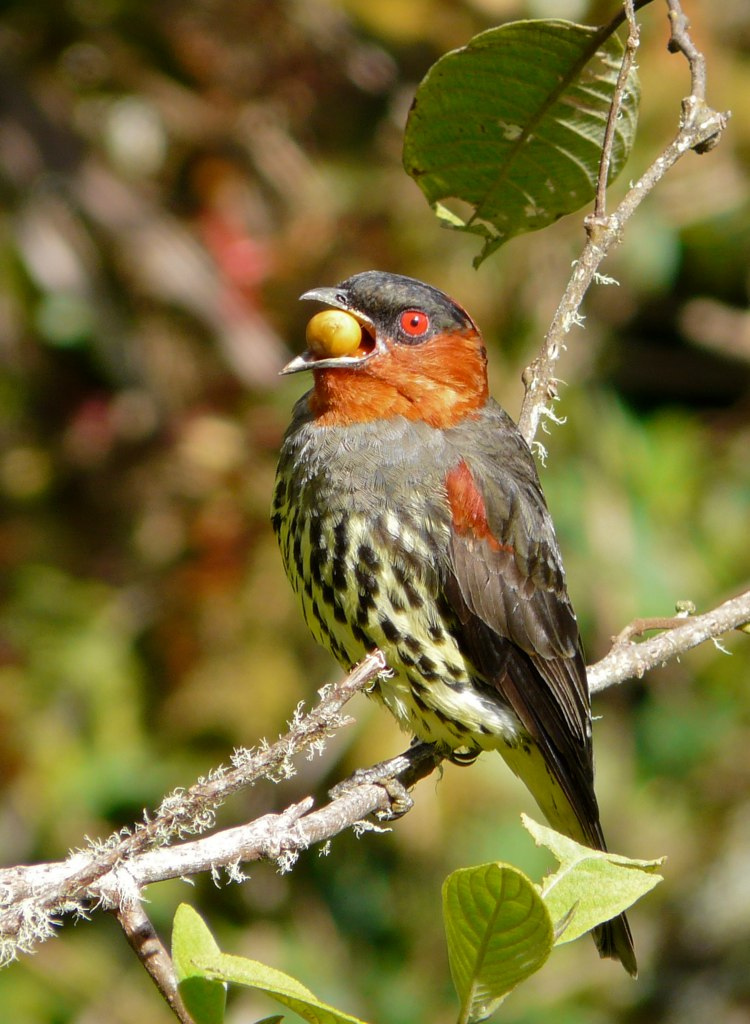
The Three-wattled Bellbird is a medium-sized bird, with males averaging around 25 cm in length. The adult male displays an impressive combination of chestnut and white plumage. Its head and neck are chestnut-colored, contrasting sharply with the white throat and belly. The hallmark feature of the male is the three elongated, black wattles that hang from the base of its beak. These wattles can be manipulated during courtship, adding to the bird's visual spectacle. In contrast, females and immature birds show a more subdued olive-brown plumage, lacking the wattles entirely. This sexual dimorphism makes the males particularly striking, while females blend more seamlessly into the forest canopy. The female's coloration serves as camouflage, providing protection while nesting. In flight, the Three-wattled Bellbird is robust and steady, with strong wingbeats. It often perches on exposed branches in the canopy, making itself visible when singing. This posture, combined with its vocalizations, helps in identifying the species even from a distance. Confusion with other species is minimized by the bird's unique combination of vocal and visual traits, notably the distinctive call and wattles. However, inexperienced birders might mistake it for other members of the Cotingidae family, though the unique wattles and voice of the male are unmistakable identifiers.
Having trouble telling birds apart? Upload a photo to our bird identification tool for an instant species match.
Three-wattled Bellbird Habitat and Range
Preferred Habitat
The Three-wattled Bellbird inhabits tropical montane forests, preferring the cloud forests of Central America. These forests, rich in epiphytes and mosses, provide the ideal environment for the species. Typically, the bird is found at elevations ranging from 600 to 2,100 meters. During the breeding season, it favors higher altitudes, where the cooler temperatures and dense canopy offer suitable conditions for nesting and calling. In non-breeding months, the bellbird descends to lower elevations, where it can exploit different fruiting trees. This altitudinal migration corresponds with the fruiting cycles of its food sources. Unlike some tropical birds, the Three-wattled Bellbird does not adapt well to urban environments. Its reliance on intact forest ecosystems makes it sensitive to habitat loss. The ongoing deforestation in Central America poses a significant threat to its habitat, accentuating the need for conservation measures.
Geographic Range
The Three-wattled Bellbird's range is restricted to Central America, with its presence predominantly noted in Costa Rica, Panama, and parts of Nicaragua. It breeds in the highland cloud forests, particularly within the Talamanca and Central Mountain ranges of Costa Rica and western Panama. During the non-breeding season, it moves to lower elevation forests, such as those in the Pacific lowlands of Costa Rica. The bird's migratory patterns are altitudinal rather than latitudinal, with movements dictated by the availability of food rather than temperature changes. These movements are vital for accessing different fruiting trees across seasons. The bellbird's population density is highest in well-preserved forest areas, such as the Monteverde Cloud Forest Reserve in Costa Rica, where conservation efforts have helped maintain its habitat. However, deforestation in the region threatens these critical areas, impacting the species' range and abundance.
Want to know which birds visit your area? Browse our backyard birds by location guides for region-specific species lists.
What Does the Three-wattled Bellbird Eat?
The diet of the Three-wattled Bellbird primarily consists of fruit, with a strong preference for members of the Lauraceae family. Avocados and related species form a significant part of its diet, providing the energy-rich resources needed for its active lifestyle. During the breeding season, when in higher elevations, it consumes a variety of fruits available in the cloud forests. As it migrates to lower elevations in the non-breeding season, the bird adapts its diet to the fruiting trees found there. Foraging strategies involve perching quietly in the canopy, waiting patiently to pluck ripe fruits. The bird swallows fruit whole, later regurgitating the seeds, which facilitates seed dispersal throughout the forest. This behavior underscores its integral role in maintaining forest ecology. Occasionally, the bellbird may consume insects, although this is relatively rare and occurs mainly to supplement its diet during times when fruit is less abundant.
Three-wattled Bellbird Behavior and Social Structure
The Three-wattled Bellbird exhibits fascinating social and territorial behaviors. Males are highly territorial during the breeding season, with each establishing a territory from which it calls to attract females and deter rival males. Their loud calls, a defining characteristic, serve as an auditory display of dominance and territoriality. Courtship involves both vocalizations and visual displays, with males flaunting their wattles to impress potential mates. Once a female selects a mate, the pair becomes less conspicuous, focusing on nesting and rearing their young. The species is generally solitary outside the breeding season, although individuals may occasionally be seen in loose associations when foraging. The bellbird's response to predators is notably vigilant; it relies on its position high in the canopy to spot approaching threats. Its daily routine typically involves periods of intense calling interspersed with foraging, mostly occurring in the early morning and late afternoon, times when fruit is most abundant.
Three-wattled Bellbird Nesting and Reproduction
Three-wattled Bellbirds build relatively simple nests, constructed by the female alone. The nests are typically placed high in the canopy, often on a forked branch for stability. Materials include twigs, leaves, and mosses, with the structure camouflaged against the forest backdrop. The typical clutch size is one to two eggs, which the female incubates for approximately 18 to 20 days. During this period, the male remains nearby, occasionally assisting by providing food to the female. After hatching, the chicks are altricial, requiring significant parental care. The female predominantly feeds and cares for the young, with fledging occurring about 23 to 27 days post-hatching. The species typically raises one brood per year, although the timing and success of breeding can vary with environmental conditions and food availability.
Three-wattled Bellbird Sounds and Vocalizations
The Three-wattled Bellbird's primary song is a series of loud, metallic notes that have been described as 'bonk,' 'bong,' and 'tonk' sounds. These notes are delivered in a rhythmic, repetitive sequence, with each note carrying over long distances. The volume and clarity of the call enable it to penetrate the dense forest canopy. Additionally, the bird produces softer calls and alarm notes, often used in closer social interactions. During the dawn chorus, the bellbird's call is among the most prominent sounds in the forest, providing a sonic backdrop to the awakening ecosystem. Its calls are often compared to the sound of a hammer striking an anvil, highlighting the distinctiveness and power of its voice.
Interesting Facts About the Three-wattled Bellbird
- 1The Three-wattled Bellbird's call is one of the loudest bird calls in the world, reaching up to 100 decibels.
- 2Males showcase their wattles during courtship, which can extend up to 10 centimeters in length.
- 3This species is one of the few birds that exhibit altitudinal migration rather than long-distance migration.
- 4The bellbird's diet heavily influences forest regeneration, thanks to its role as an effective seed disperser.
- 5The bird's metallic call is often compared to the sound of a hammer striking metal, unique among avian vocalizations.
- 6Climate change poses a significant threat by potentially reducing suitable cloud forest habitats in Central America.
- 7Despite its loud call, the Three-wattled Bellbird is elusive and can be challenging to spot in its dense forest habitat.
Three-wattled Bellbird Conservation Status
The Three-wattled Bellbird is currently classified as Vulnerable by the IUCN. The species faces significant threats from habitat destruction, primarily due to deforestation for agriculture and urban development. Climate change also poses a threat by altering the availability of suitable montane habitats. Conservation efforts focus on protecting and restoring its cloud forest habitat. These efforts include the establishment of protected areas and reserves, such as the Monteverde Cloud Forest Reserve in Costa Rica, which provides a crucial sanctuary for the species. Public awareness campaigns and ecotourism initiatives also contribute to conservation, emphasizing the bellbird's role as a flagship species for forest preservation.
Other Cotingidae Species



Birds Similar to the Three-wattled Bellbird
These species are often confused with the Three-wattled Bellbird due to similar appearance or overlapping range.

