
Vinous-throated Parrotbill
Sinosuthora webbiana
Order: Passeriformes / Family: Sylviidae

Wikimedia Commons
About the Vinous-throated Parrotbill
The Vinous-throated Parrotbill, Sinosuthora webbiana, is an engaging little songbird, primarily found in the dense, shrubby undergrowth of East Asia. This species is particularly notable for its adaptability to various local environments, from subtropical woodlands to more temperate zones. In China, Japan, and Korea, the Vinous-throated Parrotbill plays a vital role in the ecosystem by controlling insect populations and aiding in seed dispersal. Observers often find these birds in flocks, flitting through thickets and shrublands, their calls echoing softly in the understory. During the breeding season, typically from late spring to early summer, the Vinous-throated Parrotbill becomes more territorial and vocal, often heard before seen. This bird's resilience is evident in its ability to thrive in both natural and urban settings, where it adeptly navigates hedgerows and garden shrubbery. Its role in the ecological web is multifaceted: it acts as both predator and prey, maintaining the delicate balance within its habitat. The Vinous-throated Parrotbill's presence is a testament to the rich biodiversity of the regions it inhabits, contributing to the vibrancy of the natural landscapes it calls home.
The Vinous-throated Parrotbill belongs to the family Sylviidae, within the order Passeriformes. These birds typically live average 3-5 years; max recorded 8 years..
How to Identify a Vinous-throated Parrotbill
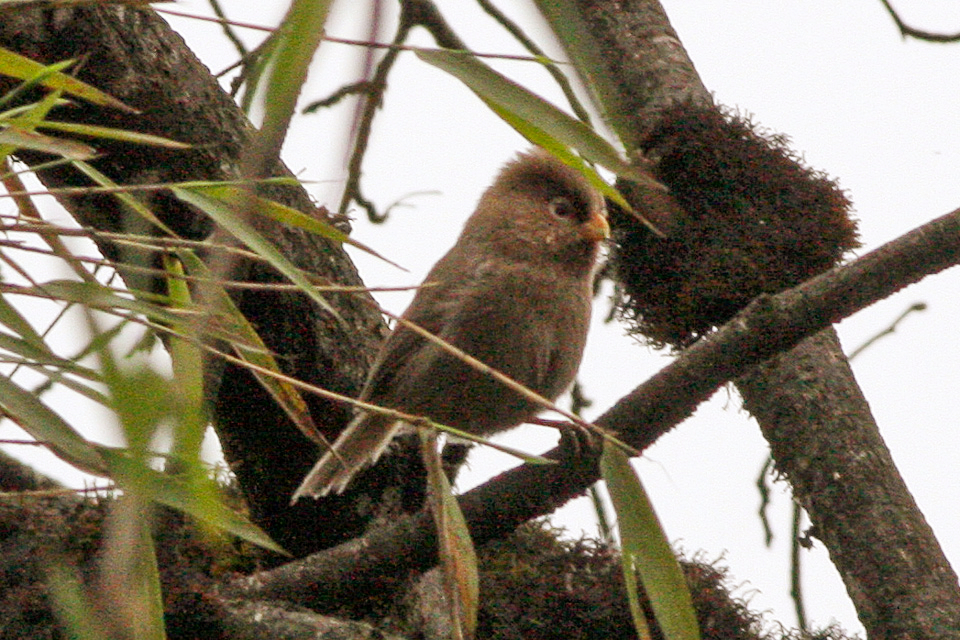
The Vinous-throated Parrotbill is a small bird, typically measuring around 11-13 cm in length. Its most distinctive feature is the vinous-colored throat, which contrasts with its otherwise brownish body. The upperparts are a warm brown, with subtle streaking on the back and wings, while the underparts tend to be a paler hue. The bill is relatively short and stout, characteristic of parrotbills, designed for a diet that includes seeds and insects. Juveniles resemble adults but with less pronounced throat coloring. Males and females appear similar, making sex differentiation challenging in the field. One might confuse this species with the Ashy-throated Parrotbill, yet the latter lacks the distinct vinous coloring. In flight, the Vinous-throated Parrotbill presents a compact silhouette, with wings and tail tucked closely to the body. When perched, it often adopts an upright posture, flitting from branch to branch with quick, agile movements.
Having trouble telling birds apart? Upload a photo to our bird identification tool for an instant species match.
Vinous-throated Parrotbill Habitat and Range
Preferred Habitat
The Vinous-throated Parrotbill prefers dense, shrubby areas where it can easily forage and nest. It inhabits regions ranging from lowland thickets to the edges of forests, often at elevations up to 1500 meters. This bird shows remarkable adaptability to various habitats, including suburban gardens and urban parks, where it seeks out hedgerows and dense planting for cover. Seasonal shifts do not significantly alter its habitat choice, though it may move to lower elevations during colder months. The parrotbill's ability to thrive in both rural and urban environments underscores its versatility and resilience.
Geographic Range
The breeding range of the Vinous-throated Parrotbill spans much of East Asia, with significant populations in China, Korea, and Japan. It does not undertake long migrations, instead, it exhibits some local movement depending on weather conditions and food availability. In China, it is particularly common in the southeastern provinces, while in Japan, it is frequently observed on the islands of Honshu and Kyushu. Population densities are highest in regions with ample undergrowth and thickets, which provide both food and nesting sites. This bird's presence across such a broad range highlights its adaptability to various environmental conditions.
Want to know which birds visit your area? Browse our backyard birds by location guides for region-specific species lists.
What Does the Vinous-throated Parrotbill Eat?
The Vinous-throated Parrotbill's diet consists mainly of small invertebrates and seeds, making it a versatile forager. During the spring and summer, it primarily consumes insects, which provide essential protein for breeding and raising young. As the seasons shift to autumn and winter, the parrotbill's diet transitions to a greater reliance on seeds and berries, which are more readily available. Foraging typically occurs in flocks, where these birds can be seen methodically working through dense foliage, gleaning prey from leaves and branches. Their strong, curved bills are particularly suited to cracking seeds and capturing small insects, allowing them to exploit a variety of food sources.
Vinous-throated Parrotbill Behavior and Social Structure
Vinous-throated Parrotbills exhibit highly social behavior, often forming flocks of 10-30 individuals outside the breeding season. These flocks navigate their habitat with a synchronized agility, communicating through a series of soft, tinkling calls. Territorial behavior becomes more pronounced during breeding, with pairs defending their chosen nesting areas vigorously. Courtship involves mutual preening and synchronized movements, strengthening pair bonds. When threatened by predators, parrotbills emit alarm calls, prompting rapid flock dispersal into dense cover. Daily activity peaks in the early morning and late afternoon, with much of the day spent foraging and engaging in social interactions.
Vinous-throated Parrotbill Nesting and Reproduction
The Vinous-throated Parrotbill constructs its nest low in dense shrubs or young trees, using twigs, grass, and leaves. The nest is cup-shaped and well-concealed within the foliage. A typical clutch consists of 3-5 eggs, which both parents incubate for approximately 12-14 days. Following hatching, the chicks remain in the nest for about 10-12 days before fledging. During this period, both parents are active in feeding and protecting the young, showcasing a strong cooperative breeding strategy. The species generally raises one or two broods per year, depending on environmental conditions and food availability.
Vinous-throated Parrotbill Sounds and Vocalizations
The primary song of the Vinous-throated Parrotbill is a series of soft, melodious whistles, often described as tinkling or bell-like. These vocalizations serve both to maintain flock cohesion and to establish territorial boundaries during the breeding season. Call notes are softer, often repeated in quick succession, aiding in communication within dense foliage. Alarm calls are sharper and more insistent, alerting the flock to potential threats. The dawn chorus is a particularly enchanting time to hear their vocalizations, as the parrotbills join the symphony of morning bird song.
Interesting Facts About the Vinous-throated Parrotbill
- 1The Vinous-throated Parrotbill is part of the family Sylviidae, once thought to be part of the Timaliidae family.
- 2With their strong, curved bills, these parrotbills can crack seeds that are too tough for many other small birds.
- 3The Vinous-throated Parrotbill's social structure often involves complex flock dynamics, with roles distributed among members.
- 4Despite their ability to live in urban areas, Vinous-throated Parrotbills maintain a preference for dense, natural foliage.
- 5These parrotbills are often mistaken for warblers due to their small size and insectivorous habits.
- 6The vinous coloration of their throats is not just for show; it plays a role in mate attraction during the breeding season.
- 7Vinous-throated Parrotbills have a relatively high reproductive success rate, with most pairs successfully raising two broods annually.
Vinous-throated Parrotbill Conservation Status
The Vinous-throated Parrotbill is classified as Least Concern by the IUCN, with population trends remaining stable. Its adaptability to varied habitats, including urban environments, has helped buffer against habitat loss in certain areas. However, ongoing threats such as deforestation and urban expansion pose challenges. Conservation efforts focus on habitat preservation and monitoring population dynamics to ensure long-term stability. Historical data indicates a stable population, thanks in part to the bird's ability to thrive in a range of environments.
Other Sylviidae Species



Birds Similar to the Vinous-throated Parrotbill
These species are often confused with the Vinous-throated Parrotbill due to similar appearance or overlapping range.

