
Gray-hooded Parrotbill
Sinosuthora zappeyi
Order: Passeriformes / Family: Sylviidae

Wikimedia Commons
About the Gray-hooded Parrotbill
The Gray-hooded Parrotbill (Sinosuthora zappeyi) is a small passerine bird characterized by its distinct gray hood and lively behavior. Found primarily in central and southwestern China, this bird inhabits subtropical and temperate regions where bamboo and dense underbrush provide ample cover. The parrotbill is a member of the Sylviidae family, notable for its closely-knit social structure and active foraging habits. Its population is relatively stable, although habitat fragmentation poses a threat. The Gray-hooded Parrotbill plays a vital role in its ecosystem by contributing to seed dispersal and controlling insect populations. During the breeding season, from March to July, the parrotbill remains in mountainous areas, thriving in elevations ranging from 1,200 to 2,400 meters. As winter approaches, it may descend to lower altitudes in search of food. Throughout the year, the Gray-hooded Parrotbill remains a permanent resident of its range, showing limited migratory behavior. This species exhibits a preference for bamboo-dominated forests, a niche that aligns with its dietary and nesting needs. Its presence indicates a healthy forest ecosystem, and its adaptability allows it to inhabit both primary and secondary growth forests. The parrotbill's social nature extends beyond its own species, as mixed-species foraging flocks are common during the non-breeding season, enhancing its ecological interactions. The Gray-hooded Parrotbill is a fascinating subject for ornithologists and bird enthusiasts, offering insights into the dynamics of forest bird communities.
The Gray-hooded Parrotbill belongs to the family Sylviidae, within the order Passeriformes. These birds typically live estimated 3-5 years; specific data is limited..
How to Identify a Gray-hooded Parrotbill
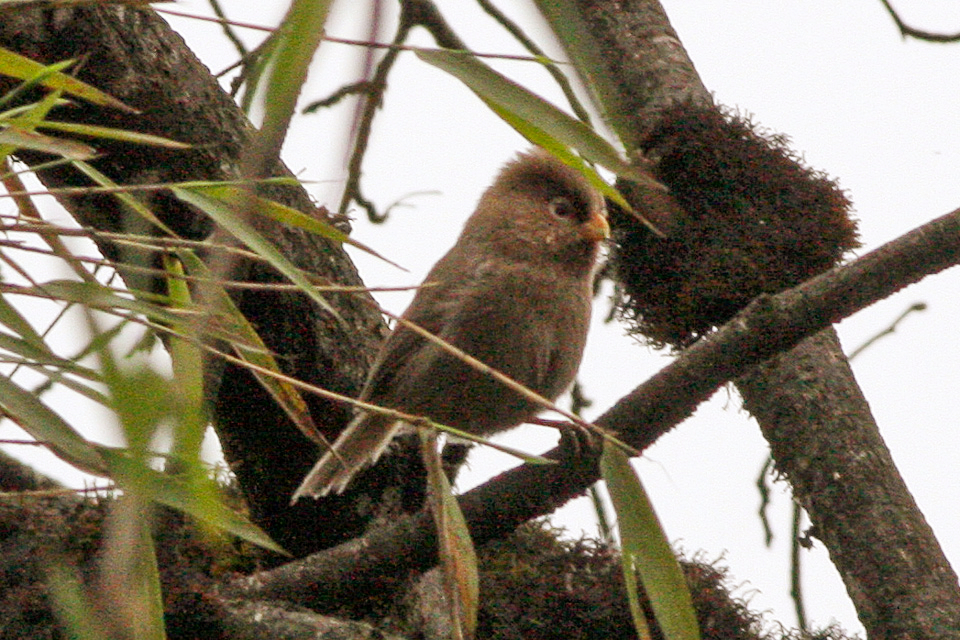
Adult Gray-hooded Parrotbills are easily recognized by their distinct slate-gray head, contrasting sharply with the warmer browns of their back and wings. Their underparts are a lighter buff color, providing a subtle but effective camouflage against the forest floor. The eyes are dark, set against the gray head, and they possess a sturdy, parrot-like bill which gives them their name. Juvenile parrotbills resemble adults but may have a slightly less defined head coloration. There is little sexual dimorphism in this species, with males and females appearing similar in plumage. However, males may be slightly larger. When perched, the Gray-hooded Parrotbill often holds its tail at an angle, a common stance among parrotbills. In flight, its short wings and rounded tail are distinctive. Confusion may arise with other parrotbill species, but the gray hood is a reliable differentiator.
Having trouble telling birds apart? Upload a photo to our bird identification tool for an instant species match.
Gray-hooded Parrotbill Habitat and Range
Preferred Habitat
The Gray-hooded Parrotbill favors dense, bamboo-rich forests in mountainous regions. These habitats are typically found at elevations between 1,200 and 2,400 meters, where the climate remains cool and moist. Such environments include the subtropical forests of Sichuan and Yunnan provinces in China. During winter, some individuals may move to lower altitudes within the same regions to escape the harsher mountain conditions. While primarily forest dwellers, they occasionally venture into forest edges and secondary growth areas. Urban presence is minimal, as this bird prefers the cover and resources provided by forested habitats.
Geographic Range
The Gray-hooded Parrotbill is endemic to China, with its core population centered in the provinces of Sichuan and Yunnan. It breeds in mountainous regions, particularly in areas with abundant bamboo. Unlike many passerines, it does not undertake long migrations, instead making altitudinal movements within its range. While it is not considered a migratory bird, local movements are influenced by seasonal food availability and weather conditions. Hotspots of population density often coincide with undisturbed forests, reflecting the bird's reliance on such habitats. Though its range is relatively restricted, the Gray-hooded Parrotbill is considered locally common within suitable environments.
Want to know which birds visit your area? Browse our backyard birds by location guides for region-specific species lists.
What Does the Gray-hooded Parrotbill Eat?
The diet of the Gray-hooded Parrotbill primarily consists of insects and bamboo seeds, which it skillfully extracts using its robust bill. During spring and summer, when insect activity peaks, it feeds more heavily on caterpillars and beetles, providing crucial protein for breeding and chick-rearing. In autumn and winter, when insects are scarce, bamboo seeds become a reliable food source. This dietary shift exemplifies the bird's adaptability to seasonal changes. Foraging involves agile movements through the underbrush, often within mixed-species flocks, which help in locating food sources. The bird's feeding schedule is largely diurnal, with peak activity during the early morning and late afternoon.
Gray-hooded Parrotbill Behavior and Social Structure
The Gray-hooded Parrotbill exhibits a highly social behavior, often seen in small, cohesive groups throughout the year. It engages in cooperative feeding and displays a complex social structure within flocks. Territorial behavior is less pronounced in this species, as it relies on group dynamics for survival and foraging efficiency. During the breeding season, pairs may isolate slightly from larger groups to focus on nesting duties. Courtship displays include mutual preening and synchronized movements, which strengthen pair bonds. When faced with threats, the parrotbill emits high-pitched alarm calls, alerting its flock mates to potential danger. Daily activities include periods of intense feeding interspersed with social interactions and rest.
Gray-hooded Parrotbill Nesting and Reproduction
Gray-hooded Parrotbills build cup-shaped nests using bamboo leaves, grass, and other plant fibers. These nests are typically positioned low within dense underbrush, providing concealment from predators. The female lays a clutch of 3 to 5 eggs, which she incubates for approximately 14 to 16 days. Both parents participate in feeding the chicks, which fledge around 12 to 15 days post-hatching. The species generally raises one brood per year, although favorable conditions may occasionally permit a second. Parental roles are fairly equitable, with both adults involved in nest construction, incubation, and chick-rearing.
Gray-hooded Parrotbill Sounds and Vocalizations
The vocalizations of the Gray-hooded Parrotbill are a distinctive feature of its presence in the forest. Its primary song is a series of high-pitched, melodic notes delivered in rapid succession, often described as a tinkling or chirping chorus. Call notes are sharp and metallic, serving as contact calls between flock members. Alarm calls are higher-pitched and more urgent, signaling the presence of predators. During the dawn chorus, the parrotbill's song intermingles with those of other forest inhabitants, creating a vibrant symphony of sound that defines its habitat.
Interesting Facts About the Gray-hooded Parrotbill
- 1The Gray-hooded Parrotbill's robust, parrot-like bill is perfectly adapted for breaking into bamboo shoots and seeds.
- 2Despite its small size, the Gray-hooded Parrotbill can exert considerable force with its bill, akin to a small pair of pliers.
- 3This species is one of the few birds that thrive in dense bamboo thickets, highlighting its specialized ecological niche.
- 4Gray-hooded Parrotbills often join mixed-species flocks, benefiting from increased foraging efficiency and predator detection.
- 5The bird's song, a tinkling series of notes, is often mistaken for the sound of a small woodland brook.
- 6Gray-hooded Parrotbills are more likely to be heard than seen, as their brown and gray plumage blends seamlessly with their environment.
- 7Unlike many birds, the Gray-hooded Parrotbill shows minimal sexual dimorphism, making it challenging to differentiate males from females at a glance.
Gray-hooded Parrotbill Conservation Status
The Gray-hooded Parrotbill is currently listed as Least Concern by the IUCN, with stable population trends. However, ongoing deforestation and habitat fragmentation pose significant threats to its long-term survival. Conservation efforts focus on preserving its bamboo-rich forest habitats, crucial for its continued existence. Historical data indicate that the population has remained relatively stable, although localized declines have occurred in areas where habitat loss is pronounced. Future conservation strategies must prioritize habitat protection and restoration.
Other Sylviidae Species



Birds Similar to the Gray-hooded Parrotbill
These species are often confused with the Gray-hooded Parrotbill due to similar appearance or overlapping range.

