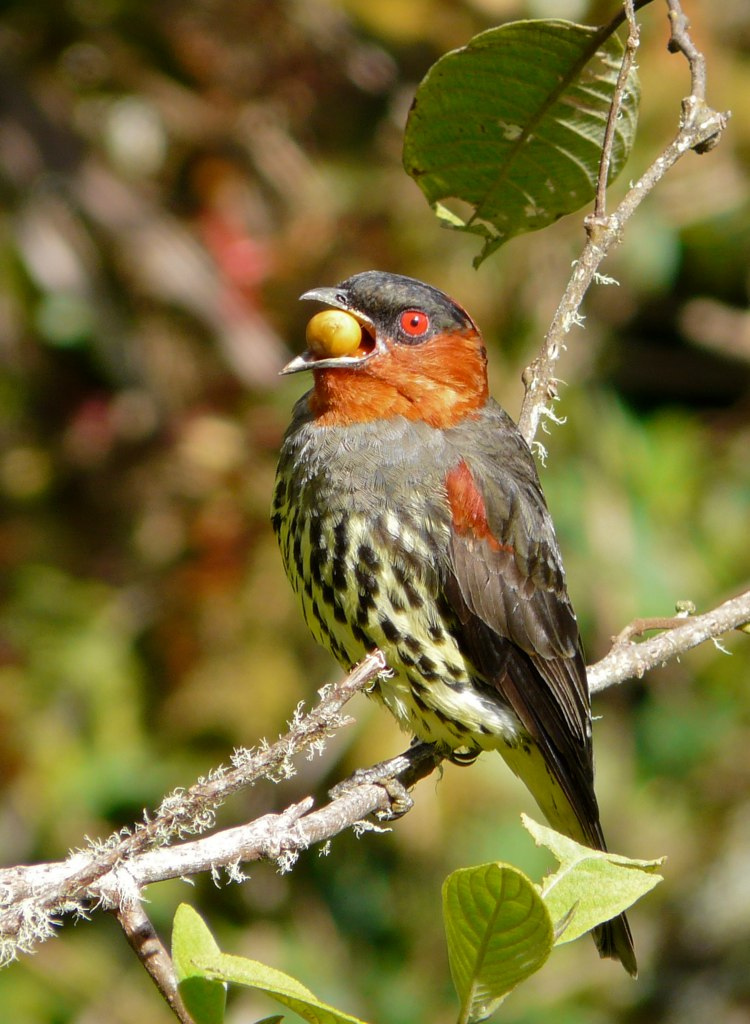
Western Grey-collared Becard
Pachyramphus uropygialis
Order: Passeriformes / Family: Cotingidae

Wikimedia Commons
About the Western Grey-collared Becard
The Western Grey-collared Becard, known scientifically as Pachyramphus uropygialis, is a small passerine bird belonging to the family Cotingidae. This species holds significance for its role in the ecological balance of subtropical and tropical forests, where it primarily resides. Found predominantly in the Andean regions, this bird makes its home in the lush forests of countries such as Colombia, Ecuador, Peru, and Bolivia. It occupies a niche where it contributes to insect population control and seed dispersal, making it an integral part of its habitat's ecosystem. The Western Grey-collared Becard thrives in montane cloud forests, where dense foliage provides both food and shelter. Its presence is often a good indicator of healthy forest ecosystems. During the breeding season, which typically spans from February to July, the becard engages in various behaviors that support its reproductive success. The male can often be seen performing intricate displays to attract a mate, showcasing its agility and vitality. As seasons change, the Western Grey-collared Becard may exhibit altitudinal migration, moving to lower elevations during colder months to find suitable foraging grounds. Its adaptability to these environmental shifts highlights its resilience, although it remains dependent on specific forest habitats. This dependency underscores its vulnerability to habitat loss, a pressing conservation concern. Despite these challenges, the Western Grey-collared Becard continues to play a vital role in its native ecosystem, maintaining the delicate balance of its forest environment.
The Western Grey-collared Becard belongs to the family Cotingidae, within the order Passeriformes. These birds typically live average lifespan is around 4-6 years, with some individuals reaching 8 years..
How to Identify a Western Grey-collared Becard
The Western Grey-collared Becard can be identified by its unique plumage and size. Adults feature a striking grey collar that contrasts with their otherwise black and white appearance. The male typically exhibits a more vivid coloration, with a deeper black upper body and a more pronounced grey collar, while the female tends to have a duller, more subdued hue. Juveniles resemble females but possess even less distinct coloring, which can make them harder to distinguish in the field. The bird's size is small to medium, measuring around 14-16 cm in length, with a wingspan that complements its agile movements through the forest canopy. When perched, the Western Grey-collared Becard maintains an upright posture, often sitting quietly for extended periods as it surveys its surroundings. In flight, its silhouette is compact, with rapid wingbeats and short glides that allow it to maneuver adeptly among trees. One might confuse the Western Grey-collared Becard with similar species such as the Barred Becard, but the latter lacks the characteristic grey collar and has a more uniform coloration. Observing these field marks is crucial for accurate identification, especially in dense forest environments.
Having trouble telling birds apart? Upload a photo to our bird identification tool for an instant species match.
Western Grey-collared Becard Habitat and Range
Preferred Habitat
The Western Grey-collared Becard inhabits subtropical and tropical forests, with a particular preference for montane cloud forests. These areas are characterized by high humidity, frequent cloud cover, and a rich diversity of plant life, providing ample food and shelter. This bird is often found at elevations ranging from 1,000 to 3,000 meters, depending on the region and availability of suitable habitats. While primarily a forest-dwelling species, the Western Grey-collared Becard can occasionally be spotted in secondary growth areas and forest edges, where it exploits the abundance of insects and other food resources. Seasonal shifts in habitat usage are evident, as the bird may descend to lower elevations during colder months to maintain access to food sources. Despite its adaptability, the Western Grey-collared Becard is seldom seen in urban environments, as it depends heavily on the complex structure of its forest habitat for survival.
Geographic Range
The Western Grey-collared Becard is native to the Andean regions of South America, with its range extending through Colombia, Ecuador, Peru, and into Bolivia. Its breeding range aligns closely with these areas, as it relies on the montane cloud forests that are prevalent in this part of the continent. During non-breeding months, some populations may engage in altitudinal migration, moving to lower elevations to escape colder temperatures and find more abundant food supplies. The bird's range is relatively limited geographically, but within these countries, it can be found in high densities in suitable habitats, particularly in protected areas where conservation efforts have helped maintain forest integrity. These areas often serve as hotspots for the species, ensuring that the Western Grey-collared Becard remains a visible and audible component of the local avifauna.
Want to know which birds visit your area? Browse our backyard birds by location guides for region-specific species lists.
What Does the Western Grey-collared Becard Eat?
The Western Grey-collared Becard primarily feeds on insects, making it an effective insectivore within its habitat. It employs a variety of foraging techniques, such as gleaning from foliage, sallying from perches to catch flying insects, and occasionally hovering to inspect leaves for hidden prey. Its diet consists mainly of small arthropods, including beetles, caterpillars, and spiders, which it skillfully captures with its slightly hooked bill. Seasonal variations in food availability can lead to shifts in diet, with the becard occasionally consuming fruits and berries during periods when insects are less abundant. This dietary flexibility is essential for its survival in the variable conditions of montane cloud forests. The Western Grey-collared Becard often forages alone or in pairs, though it may join mixed-species flocks, which can enhance its foraging efficiency by taking advantage of the diverse hunting strategies employed by other birds.
Western Grey-collared Becard Behavior and Social Structure
The Western Grey-collared Becard exhibits fascinating behaviors that reflect its adaptability and ecological role. Socially, it tends to be seen in pairs or small family groups, although it can join mixed-species flocks, particularly during foraging. This behavior enhances its ability to find food while reducing the risk of predation. Territoriality is evident during the breeding season, with males actively defending their chosen nesting sites through displays and vocalizations. Courtship involves the male performing aerial displays and presenting food to the female, a gesture that strengthens pair bonds. Daily activity patterns show the Western Grey-collared Becard to be diurnal, with peak activity occurring during the early morning and late afternoon. During these periods, it engages in feeding, grooming, and territory maintenance. The becard's response to predators includes evasive flight and giving alarm calls to alert other birds of danger. This cautious behavior aids in its survival within the dense forest environment, where predators can include raptors and snakes. Overall, the Western Grey-collared Becard's behaviors are well-suited to its ecological niche, allowing it to thrive in the complex and competitive ecosystems of the Andean forests.
Western Grey-collared Becard Nesting and Reproduction
The nesting behavior of the Western Grey-collared Becard involves constructing a small, cup-shaped nest from twigs, moss, and other plant materials. These nests are typically placed in the forks of trees, often concealed by dense foliage to protect against predators and the elements. The female primarily builds the nest, though the male may assist by gathering materials. Clutch size generally ranges from two to three eggs, which the female incubates over a period of approximately 14-16 days. During this time, the male plays a crucial role in providing food for the incubating female. Once hatched, the chicks remain in the nest for about two to three weeks. Both parents participate in feeding and caring for the young, ensuring their rapid growth and development. The fledging timeline is closely linked to environmental conditions, with favorable weather and abundant food leading to faster growth rates. The Western Grey-collared Becard typically raises one to two broods per year, depending on resource availability and climatic factors. This reproductive strategy allows the species to maintain stable population numbers despite the challenges posed by its environment.
Western Grey-collared Becard Sounds and Vocalizations
The vocalizations of the Western Grey-collared Becard are distinctive, featuring a series of short, melodious whistles that vary in pitch and rhythm. The primary song consists of a sequence of clear, flute-like notes that can be heard echoing through the forest, especially during the breeding season. These songs serve both to establish territory and attract mates. In addition to its song, the Western Grey-collared Becard produces a variety of call notes, including sharp 'chip' sounds used for communication between mates and family members. Alarm calls are more urgent and are employed to warn of nearby predators. During the dawn chorus, the becard's song contributes to the symphony of forest sounds, often standing out due to its clarity and distinct pattern. This auditory presence is an essential aspect of its behavior, facilitating interaction with other birds and adaptation to its habitat.
Interesting Facts About the Western Grey-collared Becard
- 1The Western Grey-collared Becard can be found at elevations up to 3,000 meters, demonstrating its adaptability to high-altitude environments.
- 2This species is skilled at capturing flying insects mid-air, a behavior known as 'sallying,' which is crucial for its insectivorous diet.
- 3The Western Grey-collared Becard often participates in mixed-species flocks, gaining protection and increased foraging efficiency.
- 4Despite its small size, this bird plays a significant role in seed dispersal, impacting plant community dynamics in its habitat.
- 5The becard's melodious song can travel over long distances, making it an auditory hallmark of the Andean cloud forests.
- 6It adapts to seasonal changes by shifting to lower elevations during colder months, showcasing its flexibility in habitat use.
- 7The Western Grey-collared Becard's nest construction involves an intricate weaving of twigs and moss, showcasing its architectural skill.
Western Grey-collared Becard Conservation Status
The Western Grey-collared Becard is currently classified as Least Concern by the IUCN, but its population trend is somewhat uncertain due to habitat loss. Deforestation poses the primary threat to its habitat, as logging and agricultural expansion continue to reduce the extent of montane cloud forests. Conservation efforts focus on preserving these critical habitats through the establishment of protected areas and sustainable land management practices. Historical population changes are not well-documented, but localized declines have been observed in heavily deforested regions. Despite these challenges, the species benefits from its presence in several national parks and reserves, which provide refuge and help maintain stable population levels. Continued conservation attention is necessary to ensure the Western Grey-collared Becard remains a thriving component of its ecosystem.