White-cheeked Laughingthrush
Ianthocincla vassali
Order: Passeriformes / Family: Leiothrichidae

Wikimedia Commons
About the White-cheeked Laughingthrush
The White-cheeked Laughingthrush (Ianthocincla vassali) is a captivating bird belonging to the family Leiothrichidae. This medium-sized passerine is known for its vivacious social behavior and striking appearance. Found predominantly in Vietnam and southern China, the White-cheeked Laughingthrush inhabits dense montane forests and subtropical woodlands, often at elevations ranging from 800 to 2,500 meters. Its presence is a testament to the rich avian biodiversity of these regions. This bird plays a significant ecological role as both a seed disperser and an insect predator, contributing to the maintenance of forest health. Due to its preference for dense undergrowth, the White-cheeked Laughingthrush is often heard before it is seen, its calls forming a key part of the soundscape in its native habitats. Seasonally, this species may exhibit altitudinal movements, descending to lower elevations in search of food during the non-breeding season when resources in the higher altitudes become scarce. The White-cheeked Laughingthrush is an important member of mixed-species flocks, often seen foraging in groups. Its gregarious nature helps in forming complex social structures which are crucial for survival during the harsh winter months. This bird's adaptability to different forest types, from evergreen to deciduous forests, highlights its ecological versatility. However, habitat loss due to deforestation poses a significant threat to its population. Conservation efforts focusing on habitat preservation are vital for ensuring the survival of the White-cheeked Laughingthrush.
The White-cheeked Laughingthrush belongs to the family Leiothrichidae, within the order Passeriformes. These birds typically live average lifespan is 6-9 years, with the oldest known individual reaching 12 years..
How to Identify a White-cheeked Laughingthrush
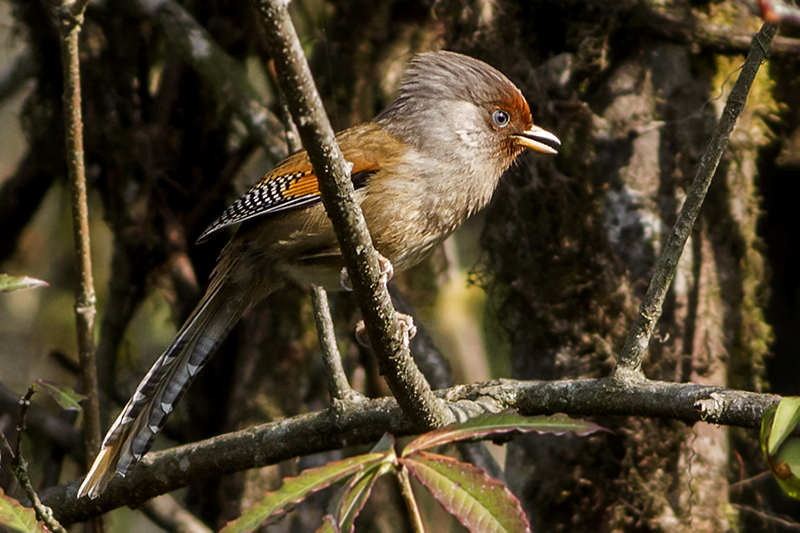
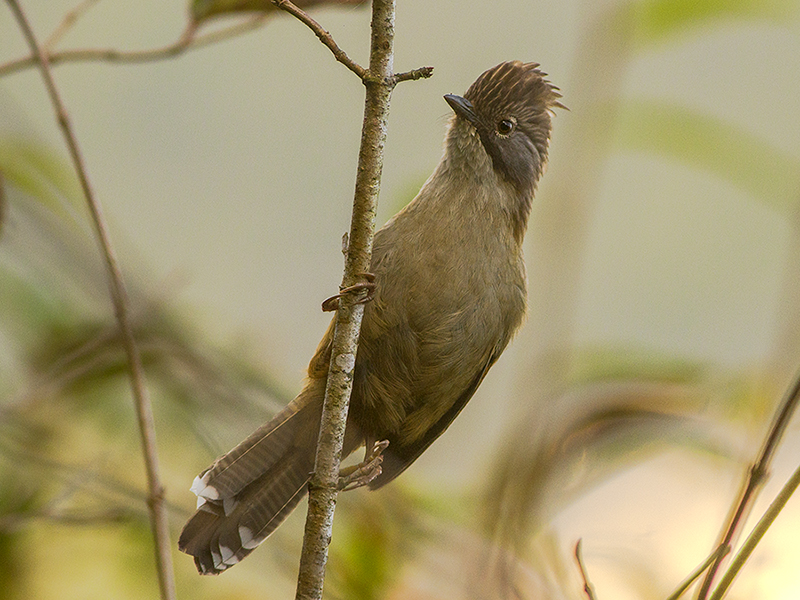
The White-cheeked Laughingthrush is easily identified by its striking plumage, characterized by a white patch on the cheeks which contrasts sharply with its otherwise dark brown body. Adults exhibit a robust body with a long, slightly curved bill and strong legs. Both males and females are similar in appearance, though males may appear slightly larger. Juveniles resemble adults but possess duller plumage and less pronounced facial markings. In flight, the White-cheeked Laughingthrush displays a broad, rounded wing shape and a short, slightly rounded tail. Its flight pattern is somewhat undulating, typical of many forest-dwelling passerines. When perched, the bird exhibits an upright posture, often using its strong legs to maintain a steady grip on branches. The White-cheeked Laughingthrush could be confused with similar species like the Black-faced Laughingthrush, but can be distinguished by the distinct white cheek patch.
Having trouble telling birds apart? Upload a photo to our bird identification tool for an instant species match.
White-cheeked Laughingthrush Habitat and Range
Preferred Habitat
The White-cheeked Laughingthrush predominantly inhabits montane and subtropical forests. It thrives in areas with dense undergrowth, which provide ample cover and food resources. Commonly found at elevations between 800 and 2,500 meters, this bird prefers forest edges and clearings where sunlight allows for a rich growth of shrubs and small trees. Seasonal shifts in habitat are observed, with the species moving to lower elevations during colder months. This bird can adapt to a variety of forest types, from evergreen to mixed-deciduous forests, although it is less frequently found in heavily urbanized areas.
Geographic Range
The White-cheeked Laughingthrush primarily occupies regions in Southeast Asia, predominantly within Vietnam and southern China. This bird's range includes the Annamite Range and extends into parts of Laos. It is a resident species, with non-migratory behavior, although some altitudinal movement is noted during different seasons. In these core areas, the bird can be found in significant numbers, especially in protected forest reserves where habitat conditions remain optimal.
Want to know which birds visit your area? Browse our backyard birds by location guides for region-specific species lists.
What Does the White-cheeked Laughingthrush Eat?
The diet of the White-cheeked Laughingthrush consists mainly of insects and small invertebrates, complemented by fruits and seeds. During the breeding season, insects become a primary food source, providing the necessary protein for chick development. This bird engages in active foraging, often seen rummaging through leaf litter or probing bark for hidden prey. Its strong bill is well-suited for cracking open seeds and extracting insects. Seasonal changes influence its diet, with a greater reliance on fruits during the non-breeding season when insects are less abundant. The White-cheeked Laughingthrush often forages in mixed-species flocks, increasing its foraging efficiency.
White-cheeked Laughingthrush Behavior and Social Structure
The White-cheeked Laughingthrush is known for its highly social behavior, often forming small to medium-sized flocks outside of the breeding season. These flocks facilitate foraging and predator vigilance. In terms of territorial behavior, this species tends to be more aggressive during the breeding season, defending nesting sites from intruders. Courtship displays are subtle, involving mutual preening and vocal exchanges. The bird's response to predators includes alarm calls and flocking together to mob potential threats. Daily activity patterns show a peak in foraging during the early morning and late afternoon, aligning with the availability of insects and cooler temperatures.
White-cheeked Laughingthrush Nesting and Reproduction
The White-cheeked Laughingthrush constructs cup-shaped nests using twigs, grasses, and leaves. These nests are typically located within dense shrubs or small trees, providing concealment from predators. A typical clutch consists of 2 to 3 eggs, with incubation lasting about 14 days. Both parents share responsibilities in incubating the eggs and feeding the chicks. Fledging occurs approximately 12 to 14 days after hatching, with the young remaining dependent on the parents for food for several weeks. This species generally raises one brood per year, though favorable conditions may result in a second.
White-cheeked Laughingthrush Sounds and Vocalizations
The primary song of the White-cheeked Laughingthrush is a series of melodious whistles and chatters that create a lively soundscape within its forest habitat. These vocalizations are complex and vary between individuals, serving both communication and territorial purposes. Call notes are short and sharp, often used to maintain contact within a flock. Alarm calls are more strident, alerting others to potential danger. The dawn chorus of this species is particularly notable, with their songs heralding the start of a new day.
Interesting Facts About the White-cheeked Laughingthrush
- 1The White-cheeked Laughingthrush can form flocks of up to 20 individuals, enhancing its foraging success.
- 2Despite its lively name, the White-cheeked Laughingthrush's actual call is more musical than a human laugh.
- 3Researchers have observed that this bird can adapt to secondary forests, showcasing its resilience to habitat changes.
- 4The species plays a crucial role in seed dispersal, aiding in forest regeneration and plant diversity.
- 5White-cheeked Laughingthrushes have a strong pair bond, often seen engaging in mutual preening with their mates.
- 6Their nests are typically placed 1 to 3 meters above ground, hidden within thick foliage for protection.
- 7This species' adaptability to various forest types makes it less vulnerable to habitat-specific threats compared to more specialized birds.
White-cheeked Laughingthrush Conservation Status
The White-cheeked Laughingthrush is currently classified as Least Concern by the IUCN, though its population trend is decreasing due to habitat destruction. Deforestation for agriculture and logging poses the greatest threat, leading to fragmentation of its natural habitat. Conservation efforts are focused on protecting forest reserves and restoring degraded habitats to ensure long-term survival. Historically, the population was more widespread, but human activities have significantly impacted its range.