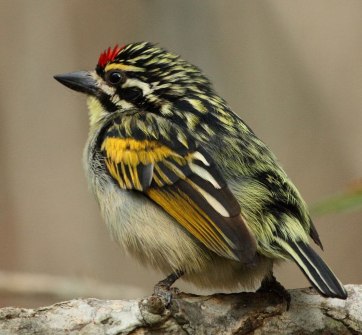
White-chested Tinkerbird
Pogoniulus makawai
Order: Piciformes / Family: Lybiidae

Wikimedia Commons
About the White-chested Tinkerbird
The White-chested Tinkerbird, scientifically known as Pogoniulus makawai, holds a unique place in avian biodiversity. This elusive species is endemic to Africa, specifically found in the lush regions of Zambia. Its discovery was a significant event in ornithological circles, as it was initially described from a single specimen collected in 1964 and went unseen for many years. The White-chested Tinkerbird's role in its ecosystem is crucial, serving as both a pollinator and a seed disperser within its habitat. These birds are integral to the health of the forest ecosystems they inhabit. Their presence is often an indicator of a biodiverse and thriving ecosystem. The White-chested Tinkerbird frequents the dense tropical and subtropical forests, where it plays a role in maintaining the ecological balance. These forests, rich in flowering plants, provide the bird with both food and nesting sites. During the breeding season, which aligns with the rainy season, the White-chested Tinkerbird becomes particularly active, engaging in courtship behaviors and establishing territories. The bird's significance extends beyond its ecological role, as it has become a focus of conservation efforts due to its limited range and specific habitat requirements. Understanding the seasonal behaviors of the White-chested Tinkerbird is essential for its conservation. During the dry season, the bird may move to slightly more open areas within the forest, but it rarely leaves the cover of the canopy. Such movements ensure that it remains in proximity to its primary food sources and nesting sites. The bird's activity patterns and habitat preferences make it a key species for understanding the dynamics of African forest ecosystems.
The White-chested Tinkerbird belongs to the family Lybiidae, within the order Piciformes. These birds typically live estimated 5-8 years, though data is limited..
How to Identify a White-chested Tinkerbird
The White-chested Tinkerbird can be identified by its striking white chest, which contrasts sharply with its otherwise dark plumage. Adults exhibit a predominantly black upper body, with a glossy sheen that can appear bluish in certain lighting. The wings and tail are also black, with subtle white spots that become more pronounced in juveniles. These spots help distinguish younger birds from adults at a glance. Both males and females share similar plumage, making sex differentiation in the field challenging without observing behavior. However, males tend to be slightly larger, a subtle difference that requires careful observation. The White-chested Tinkerbird's compact body and stout bill are typical of the Lybiidae family, and its flight is characterized by rapid, direct movements. When perched, the bird often adopts an upright posture, allowing birders to appreciate its distinctive chest pattern. In terms of comparison, the White-chested Tinkerbird might be confused with other small black-and-white barbet species, but its unique chest pattern and vocalizations help distinguish it from similar species.
Having trouble telling birds apart? Upload a photo to our bird identification tool for an instant species match.
White-chested Tinkerbird Habitat and Range
Preferred Habitat
The White-chested Tinkerbird primarily inhabits tropical and subtropical forest regions within Zambia. These forests provide a dense canopy and an abundance of flowering plants and fruit-bearing trees, essential for the bird's diet and nesting. The bird is typically found at elevations ranging from 500 to 1500 meters, where the forest is most lush and diverse. During the wet season, the White-chested Tinkerbird remains in the denser parts of the forest, taking advantage of the increased food availability. In contrast, during drier months, it may be seen at the forest edges, where it continues to forage. Despite its dependence on forest habitats, the White-chested Tinkerbird occasionally ventures into wooded areas adjacent to human settlements, especially where natural forest borders agricultural land. Such adaptability ensures its survival despite habitat fragmentation, but it remains predominantly a forest-dwelling species.
Geographic Range
The White-chested Tinkerbird's range is highly localized, with its primary distribution limited to the forests of Zambia. It is a non-migratory species, residing year-round within its territory. While some local movements occur, particularly in response to seasonal changes in food availability, these are typically short-range and confined within its core habitat. The bird's population density is highest in undisturbed forest regions, where the canopy remains intact, and human intervention is minimal. Conservationists have identified specific hotspots within Zambia, where the White-chested Tinkerbird's presence is more frequent. However, its limited range and specific habitat requirements contribute to its rarity, emphasizing the importance of habitat protection and conservation measures.
Want to know which birds visit your area? Browse our backyard birds by location guides for region-specific species lists.
What Does the White-chested Tinkerbird Eat?
The diet of the White-chested Tinkerbird consists primarily of fruits and insects, reflecting its role as both a frugivore and insectivore. The bird shows a preference for figs and other soft fruits, which are abundant in its forest habitat. During the dry season, when fruit availability decreases, the White-chested Tinkerbird increases its consumption of insects, such as beetles and caterpillars. This dietary flexibility allows it to adapt to seasonal variations in food supply. The bird employs a foraging technique that involves deftly plucking fruits from branches and capturing insects mid-air or from foliage. Its stout bill is well-suited for crushing fruit and accessing the soft interior. Feeding typically occurs during the early morning and late afternoon when temperatures are cooler, allowing the bird to conserve energy while foraging.
White-chested Tinkerbird Behavior and Social Structure
The White-chested Tinkerbird exhibits a solitary or paired lifestyle, with individuals or mated pairs maintaining small territories within the forest. Territorial behavior is most pronounced during the breeding season when males engage in vocal displays to ward off rivals and attract mates. Courtship involves a combination of song and visual displays, with males showcasing their plumage and engaging in synchronized movements with their partners. The bird's daily activity patterns align with the cooler hours of the day, with peak foraging occurring in the morning and late afternoon. White-chested Tinkerbirds are generally non-flocking, preferring the company of their mate or foraging alone. When threatened by predators, they rely on their cryptic plumage and the dense forest canopy to evade detection. Alarm calls are used to alert mates to potential danger, and the bird's agile flight helps it navigate through the forest understory swiftly.
White-chested Tinkerbird Nesting and Reproduction
White-chested Tinkerbirds construct their nests in tree cavities, often choosing locations in the middle to upper levels of the forest canopy. The selection of a nesting site involves both partners, but the male typically initiates by locating potential sites. The nest itself is a simple structure made from plant fibers, feathers, and other soft materials, providing insulation and comfort for the eggs. The typical clutch size ranges from two to four eggs, which the female incubates for approximately 14-16 days. During this period, the male assists by bringing food to the female, ensuring she remains well-nourished. Once hatched, the chicks are altricial, requiring constant care from both parents. Fledging occurs around 25 days after hatching, but the young birds continue to rely on parental support for several weeks. The White-chested Tinkerbird may raise one or two broods per year, depending on environmental conditions and food availability.
White-chested Tinkerbird Sounds and Vocalizations
The White-chested Tinkerbird's vocalizations are a distinctive feature, with a primary song consisting of a series of rapid, melodious notes repeated in a rhythmic sequence. The pitch is moderately high, and the quality is clear and resonant, carrying through the forest canopy. In addition to its main song, the bird produces a variety of call notes used for communication between mates and to alert others to potential threats. Alarm calls are sharper and more abrupt, serving to warn of approaching predators. The dawn chorus features the White-chested Tinkerbird prominently, as it joins other forest species in a symphony of morning calls, marking the start of the day's activities.
Interesting Facts About the White-chested Tinkerbird
- 1The White-chested Tinkerbird was described from a single specimen collected in 1964, making it one of the most enigmatic bird discoveries of the 20th century.
- 2Unlike many birds, the White-chested Tinkerbird does not migrate, residing year-round in the same forested territories in Zambia.
- 3The diet of the White-chested Tinkerbird includes a high proportion of figs, which play a crucial role in its nutritional balance.
- 4The White-chested Tinkerbird's song is so distinct that it can be used to identify the species even when it is hidden within dense foliage.
- 5Despite its striking appearance, the White-chested Tinkerbird remains elusive, with few confirmed sightings since its initial discovery.
- 6The bird's role as a seed disperser helps maintain the ecological balance of its forest habitat, contributing to plant diversity.
- 7White-chested Tinkerbirds are known for their strong pair bonds, with mated pairs often seen foraging and nesting together.
White-chested Tinkerbird Conservation Status
The International Union for Conservation of Nature (IUCN) currently lists the White-chested Tinkerbird as Data Deficient, reflecting the limited information on its population status and trends. However, habitat destruction and fragmentation pose significant threats to its survival, as these activities reduce the availability of suitable nesting and foraging sites. Conservation efforts focus on habitat preservation and restoration, particularly in regions identified as critical for the species' survival. Historical records suggest that the bird's population has experienced fluctuations, likely due to changes in forest cover. Continued research and monitoring are essential to develop effective conservation strategies and ensure the White-chested Tinkerbird's future.
Other Lybiidae Species


Birds Similar to the White-chested Tinkerbird
These species are often confused with the White-chested Tinkerbird due to similar appearance or overlapping range.