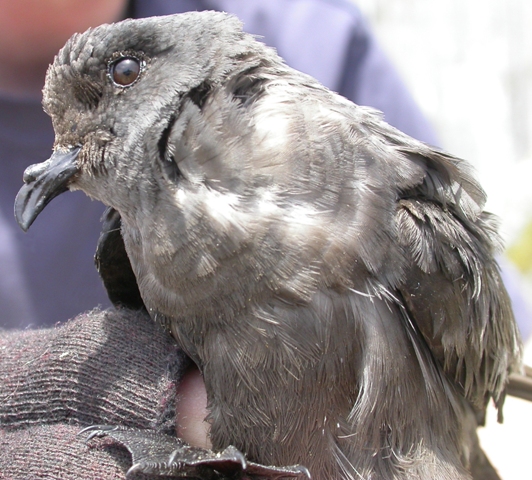
White-faced Storm-Petrel
Pelagodroma marina
Order: Procellariiformes / Family: Hydrobatidae

Wikimedia Commons
About the White-faced Storm-Petrel
The White-faced Storm-Petrel, Pelagodroma marina, is a captivating species of seabird belonging to the family Hydrobatidae. This bird is renowned for its unique foraging technique of bouncing or 'pattering' across the surface of the ocean as it feeds. Occupying a significant ecological niche, it typically inhabits the open oceans and relies on the vast expanse of the marine environment for sustenance. This species plays an integral role in the oceanic ecosystems, contributing to the control of plankton populations and providing a food source for larger predators. Found primarily in the Southern Hemisphere, the White-faced Storm-Petrel breeds on remote islands including those in the Atlantic, Indian, and Pacific Oceans. Notable breeding colonies exist on islands such as the Cape Verde Islands, Canary Islands, and the Desventuradas Islands. During the breeding season, it is highly dependent on these isolated landmasses, where it nests in burrows to raise its young. The bird's life cycle is intricately linked to the seasonality of ocean currents and food availability, which dictates their breeding timing and success. White-faced Storm-Petrels exhibit a fascinating migratory pattern, as they disperse widely across oceans post-breeding, reaching as far as the coasts of South America and South Africa. Their ability to navigate these vast distances speaks to their remarkable adaptability and endurance. The ecological significance of the White-faced Storm-Petrel is further underscored by its role as an indicator species, reflecting the health of the marine environment. Changes in their population trends can signal shifts in oceanic conditions, such as prey abundance and sea temperature changes. Understanding the dynamics of this species is crucial for marine conservation efforts, as it provides insights into the broader state of ocean health.
The White-faced Storm-Petrel belongs to the family Hydrobatidae, within the order Procellariiformes. These birds typically live typically around 20 years, with some living longer in ideal conditions..
How to Identify a White-faced Storm-Petrel
The White-faced Storm-Petrel is a small seabird distinguished by its striking white face surrounded by a stark contrast of dark gray to brown plumage. Adults typically measure around 19-21 cm in length, with a wingspan of 41-43 cm. Their upperparts are primarily dark, with a subtly lighter rump, while the underparts are mostly white, enhancing their facial features. Juveniles resemble adults but may exhibit a slightly duller plumage, lacking the sharp contrast seen in mature birds. There is little sexual dimorphism in this species, meaning males and females look alike, which can make field identification challenging. When observing these birds in flight, their distinctive bounding and pattering behavior is unmistakable. They skim lightly above the water's surface with wings held stiffly outstretched. This flight silhouette is unlike any similar storm-petrel species, helping distinguish them from others such as Wilson's Storm-Petrel. When perched, which is a rare sight given their pelagic nature, their posture is upright, often with their distinctive head pattern visible.
Having trouble telling birds apart? Upload a photo to our bird identification tool for an instant species match.
White-faced Storm-Petrel Habitat and Range
Preferred Habitat
The White-faced Storm-Petrel thrives in open ocean habitats, rarely venturing close to land except during the breeding season. These birds are predominantly pelagic, preferring the nutrient-rich waters of continental shelves and upwelling zones where plankton is abundant. Elevation is not a primary concern for this species, as it spends the majority of its life at sea. However, during the breeding season, White-faced Storm-Petrels seek out remote islands with suitable burrowing grounds. These islands are typically devoid of significant human disturbance and provide safety from terrestrial predators. The bird shows little preference for urban or heavily populated areas, as their life is intrinsically tied to marine environments.
Geographic Range
White-faced Storm-Petrels exhibit a wide geographical range, primarily inhabiting the Southern Hemisphere. Their breeding range includes islands such as Cape Verde, the Canary Islands, and the Desventuradas Islands. During non-breeding seasons, they migrate across vast expanses of the Atlantic, Indian, and Pacific Oceans. They are known to travel extensive distances, with some populations reaching as far south as the coasts of South America and South Africa. While they are not restricted by national boundaries, their presence is dictated by ocean currents and food availability. Population density hotspots are often associated with regions of high marine productivity, such as the convergence zones where warm and cold ocean currents meet.
Want to know which birds visit your area? Browse our backyard birds by location guides for region-specific species lists.
What Does the White-faced Storm-Petrel Eat?
The diet of the White-faced Storm-Petrel consists primarily of small crustaceans and planktonic organisms, which they capture using their distinctive surface pattering technique. This method involves the bird bounding just above the ocean's surface, using its feet to stir up prey which it then picks up with its bill. During different seasons, the composition of their diet may shift slightly depending on prey availability. In some regions, these birds may also feed on small fish and squid, particularly when these are abundant. Prey size is generally small, often limited to what can be easily swallowed whole. Feeding occurs predominantly during daylight hours, aligning with the availability of their prey near the ocean's surface.
White-faced Storm-Petrel Behavior and Social Structure
White-faced Storm-Petrels exhibit fascinating social and foraging behaviors. They are generally observed alone or in small groups when feeding, although larger gatherings can occur in areas with abundant food. These birds are not particularly territorial, as their vast oceanic habitat provides ample space for foraging. Courtship displays are subtle, often involving synchronized movements and vocalizations near nesting sites. During the breeding season, pairs exhibit strong site fidelity, returning to the same burrowing locations each year. Their response to predators includes swift, erratic flight patterns to evade capture. Daily activity peaks during the morning and late afternoon when feeding conditions are optimal.
White-faced Storm-Petrel Nesting and Reproduction
The nesting habits of the White-faced Storm-Petrel involve burrowed nests, typically dug into sandy or friable soil on remote islands. These burrows provide protection from predators and environmental extremes. The clutch size is usually one egg per breeding attempt, with both parents sharing responsibilities for incubation, which lasts approximately 40-50 days. Once hatched, chicks remain in the burrow for about 60-75 days before fledging. Parental roles are shared, with both adults taking turns feeding the chick with regurgitated food. The species typically raises a single brood per year, focusing on maximizing the survival of their offspring in challenging conditions.
White-faced Storm-Petrel Sounds and Vocalizations
The vocalizations of the White-faced Storm-Petrel are relatively quiet compared to many seabirds. Their calls consist of soft, repetitive chirps, often described as a high-pitched 'peep' or 'purr'. These sounds are most commonly heard around breeding colonies, particularly during the night when they return to their burrows. Alarm calls, though infrequent, are sharper and more urgent, intended to alert fellow storm-petrels of potential threats. Their calls are not easily mistaken for those of other seabirds, as they lack the harshness often associated with larger species.
Interesting Facts About the White-faced Storm-Petrel
- 1The White-faced Storm-Petrel is one of the few bird species known to 'walk on water', using a technique called pattering.
- 2These birds can cover remarkable distances during migration, sometimes traveling thousands of kilometers from their breeding grounds.
- 3Despite their small size, White-faced Storm-Petrels can survive for months at sea without returning to land, a feat unmatched by many birds.
- 4Their distinctive feeding method involves using their feet to create ripples, helping to dislodge prey from the water surface.
- 5The White-faced Storm-Petrel's burrows can be up to 1 meter deep, providing excellent protection for their single egg and chick.
White-faced Storm-Petrel Conservation Status
The IUCN currently lists the White-faced Storm-Petrel as a species of Least Concern, with stable population trends across most of its range. However, the species faces threats from introduced predators, such as rats and cats, on breeding islands. Conservation efforts focus on habitat protection and predator control to ensure successful breeding. Historically, some populations have been affected by habitat degradation and human disturbance, but recent conservation actions have helped stabilize numbers. Ongoing monitoring and protection of breeding sites remain crucial for the species' long-term survival.