White-necked Laughingthrush
Garrulax strepitans
Order: Passeriformes / Family: Leiothrichidae

Wikimedia Commons
About the White-necked Laughingthrush
The White-necked Laughingthrush (Garrulax strepitans) is a captivating bird species belonging to the Leiothrichidae family, known for its charismatic vocalizations and social behavior. This bird inhabits the lush subtropical and tropical forests primarily in the Southeast Asian regions, including countries such as Thailand, Malaysia, and Indonesia. Its presence is often detected by its loud, melodious calls that resonate through the forest canopy, alerting experienced birders to its presence long before it is seen. The species thrives in dense woodland environments, where it plays a crucial ecological role as both predator and prey. By preying on insects and small invertebrates, the White-necked Laughingthrush helps to control insect populations, which could otherwise grow to levels that might be detrimental to plant life and thus the forest's overall health. In turn, the bird serves as prey for larger avian predators, forming a vital link in the food chain. Seasonal behavior of the White-necked Laughingthrush includes slight altitudinal migrations, where it may descend to lower elevations during colder months, although it generally remains within its home range, exhibiting strong site fidelity. The bird's social nature is particularly evident during the breeding season, when small groups cooperate in raising young, showcasing a fascinating example of avian cooperative breeding behavior. This species contributes to the rich biodiversity of its native habitats, making it a species of interest for conservationists and naturalists alike.
The White-necked Laughingthrush belongs to the family Leiothrichidae, within the order Passeriformes. These birds typically live average 5-7 years, with a maximum recorded of 12 years..
How to Identify a White-necked Laughingthrush
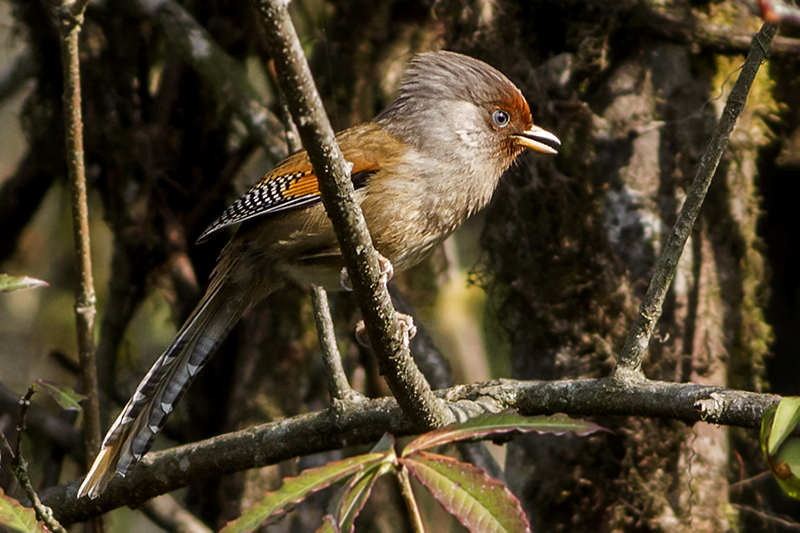
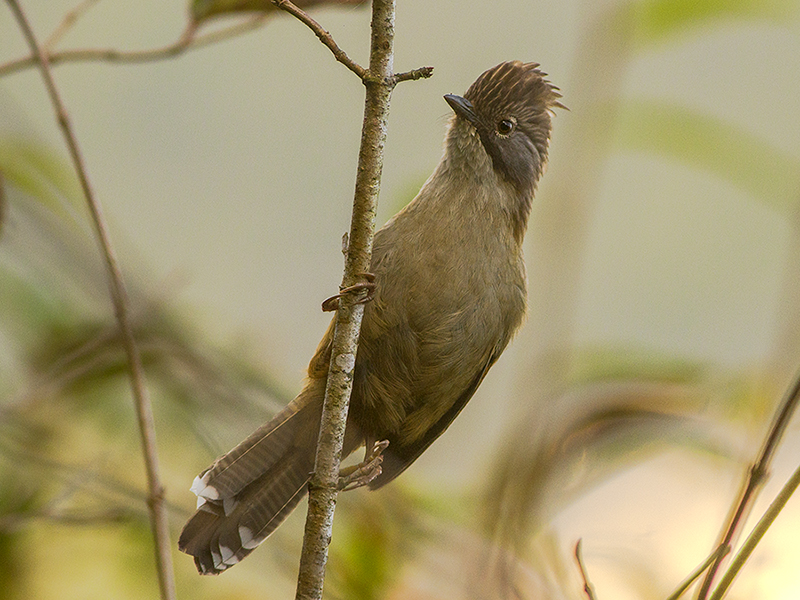
The White-necked Laughingthrush is characterized by its striking white neck and chest, contrasting with a generally dark brown to gray body. Adult plumage features a distinct chestnut crown and a subtle black eye stripe, which can assist in accurate field identification. The wings are adorned with subtle rufous patches, particularly noticeable during flight. Juveniles resemble adults but have slightly duller coloration and lack the fully developed white neck. Both male and female birds share similar plumage, making sexual dimorphism minimal and challenging for visual distinction in the field. Among similar species, the White-necked Laughingthrush can be confused with the Rufous-necked Laughingthrush, yet the latter lacks the pure white throat and exhibits a more rufous neck region. In flight, the White-necked Laughingthrush presents a silhouette marked by rounded wings and a moderately long tail, often fanned during movement through the forest canopy. When perching, this bird assumes a slightly hunched posture, often seen in pairs or small groups, which is typical of laughingthrushes.
Having trouble telling birds apart? Upload a photo to our bird identification tool for an instant species match.
White-necked Laughingthrush Habitat and Range
Preferred Habitat
White-necked Laughingthrushes occupy dense, humid forests, typically found in subtropical and tropical regions. They prefer lower and middle elevations, generally ranging from 500 to 1500 meters above sea level. The species is commonly encountered in secondary forests, bamboo thickets, and areas with dense undergrowth, where they can forage and nest in relative safety. During the non-breeding season, these laughingthrushes may venture into more disturbed habitats, including forest edges and occasionally gardens adjacent to forested areas, although they are less frequently observed in highly urbanized environments. Seasonal shifts in habitat preference are subtle, mainly involving altitudinal movements in response to temperature and food availability.
Geographic Range
The White-necked Laughingthrush is predominantly found in Southeast Asia, with its range extending across parts of Thailand, Malaysia, and the Indonesian archipelago. Within these countries, it inhabits the forested regions of the Malay Peninsula and Sumatra, among other localities. Breeding occurs within this range, and the species is generally considered non-migratory, although local movements between elevations are noted. Population density can vary with habitat quality, with higher densities observed in regions where forest cover is intact and human disturbance is minimal. In terms of conservation status, the bird's range does not currently extend into areas facing rapid habitat loss, contributing to its stable population trend.
Want to know which birds visit your area? Browse our backyard birds by location guides for region-specific species lists.
What Does the White-necked Laughingthrush Eat?
The diet of the White-necked Laughingthrush primarily consists of insects and other small invertebrates, which it actively forages for in the leaf litter and understory of dense forests. This includes beetles, ants, and caterpillars, among other arthropods. During certain times of the year, the bird may also consume a variety of fruits and berries, supplementing its diet with plant matter when insect abundance decreases. Foraging typically occurs in small groups, an activity characterized by systematic searching through foliage and ground cover. The bird uses its strong beak to turn over leaves and probe into crevices, a technique that proves effective for capturing elusive prey. Feeding activity peaks during the early morning and late afternoon, aligning with cooler temperatures and increased insect activity.
White-necked Laughingthrush Behavior and Social Structure
Social behavior is a hallmark of the White-necked Laughingthrush, as it forms small flocks that can range from a few individuals to over a dozen. These groups are often family units that engage in cooperative behaviors, especially during the breeding season. Within these flocks, birds communicate through a series of complex vocalizations, which serve to establish group cohesion and territorial boundaries. Territorial disputes, though rare, are resolved through vocal displays rather than physical confrontation. Courtship displays involve synchronized vocal duets between mating pairs, accompanied by ritualistic movements such as bowing and wing fluttering. The White-necked Laughingthrush exhibits a diurnal activity pattern, with most activity occurring during daylight hours. The bird is vigilant against predators, relying on its sharp calls to alert the flock of potential threats. When threatened, the group may employ mobbing behavior to deter intruders, showcasing their collective defensive strategies.
White-necked Laughingthrush Nesting and Reproduction
Nesting in the White-necked Laughingthrush involves constructing cup-shaped nests, typically placed in the dense foliage of shrubs or low trees. These nests are built from twigs, leaves, and grasses, bound together with mud or spider silk for added stability. The preferred nesting sites are well-concealed within dense vegetation, providing protection from predators. The typical clutch size ranges from two to four eggs, which are pale blue or greenish-blue, sometimes speckled with fine markings. Both parents participate in incubation, which lasts approximately 14 to 16 days. After hatching, the altricial chicks remain in the nest for another 12 to 15 days, during which both parents, and occasionally other group members, assist in feeding and caring for the young. The species usually raises one or two broods per year, with breeding closely tied to periods of food abundance.
White-necked Laughingthrush Sounds and Vocalizations
The White-necked Laughingthrush is best known for its melodious song, a series of rich, flute-like notes that rise and fall in a rhythmic sequence. This primary song serves as a means of communication within the group and is often heard at dawn, when the birds are most vocally active. Call notes are varied, including sharp, chattering sounds used as contact calls and lower-pitched whistles employed during foraging. Alarm calls are harsh and rapid, designed to alert other members of the flock to danger. These vocalizations can be reminiscent of human laughter, contributing to the bird's common name. During the breeding season, vocal duets between pairs feature a complex interplay of calls, highlighting their strong pair bonds.
Interesting Facts About the White-necked Laughingthrush
- 1White-necked Laughingthrushes participate in cooperative breeding, where multiple adults help raise the young.
- 2They are named for their loud, laughter-like calls, which can be heard from great distances in dense forests.
- 3The species exhibits altitudinal migration, moving to lower elevations in cooler months while remaining within their general range.
- 4They often forage in mixed-species flocks, benefitting from the collective vigilance against predators.
- 5Unlike many birds that rely heavily on visual cues, the White-necked Laughingthrush uses complex vocalizations for social interactions.
- 6Their nests are often well-hidden in dense foliage, offering protection and reducing the risk of predation.
- 7These birds are particularly adept at exploiting disturbed habitats, thriving in areas where other species may struggle.
White-necked Laughingthrush Conservation Status
The White-necked Laughingthrush is currently classified as Least Concern by the IUCN, with a stable population trend. The bird's resilience in the face of habitat changes is attributed to its adaptability to secondary forests and less disturbed areas. Primary threats include habitat loss due to deforestation and land conversion for agriculture, which pose risks to local populations. Conservation efforts focus on habitat preservation and the creation of protected areas to safeguard essential forest ecosystems. Historical population data suggest that while some local declines have occurred, particularly in heavily logged regions, the overall population remains robust across its range.