White-throated Laughingthrush
Ianthocincla albogularis
Order: Passeriformes / Family: Leiothrichidae

Wikimedia Commons
About the White-throated Laughingthrush
The White-throated Laughingthrush (Ianthocincla albogularis) holds a distinctive place in the avian world, renowned for its gregarious behavior and melodious vocalizations. This bird is predominantly found in the rich, diverse forests of the Himalayan foothills, ranging across countries like India, Nepal, Bhutan, and extending into parts of China and northern Myanmar. The White-throated Laughingthrush thrives in subtropical or tropical moist montane forests, where it plays a critical role in seed dispersal and insect population control. This species is a vital part of the ecosystem, contributing to the health of forested landscapes by ensuring the propagation of various plant species through its foraging activities. Its presence also supports the complex food web, serving as both predator and prey within its habitat.
The ecological significance of the White-throated Laughingthrush extends beyond its immediate environment. As an insectivorous bird, it helps manage pest populations, indirectly benefiting agricultural areas adjacent to its native forests. This symbiotic relationship underscores the importance of preserving its natural habitat, which faces pressures from deforestation and human encroachment. The species exhibits seasonal behaviors, often altering its diet and foraging patterns in response to changing weather conditions and food availability. During colder months, the White-throated Laughingthrush may venture to lower altitudes in search of sustenance, showcasing its adaptability to varying environmental conditions.
Social by nature, these birds are often seen in large flocks, particularly outside the breeding season. Their communal lifestyle facilitates efficient foraging and offers protection against predators. The White-throated Laughingthrush's role as a sentinel species makes it an excellent indicator of forest health. Changes in its population dynamics often reflect broader ecological shifts, making it a species of interest for conservationists and researchers alike. As forests face unprecedented challenges, the continued study and protection of this bird become increasingly significant.
The White-throated Laughingthrush belongs to the family Leiothrichidae, within the order Passeriformes. These birds typically live typically around 5-8 years, with a maximum recorded lifespan of 10 years..
How to Identify a White-throated Laughingthrush
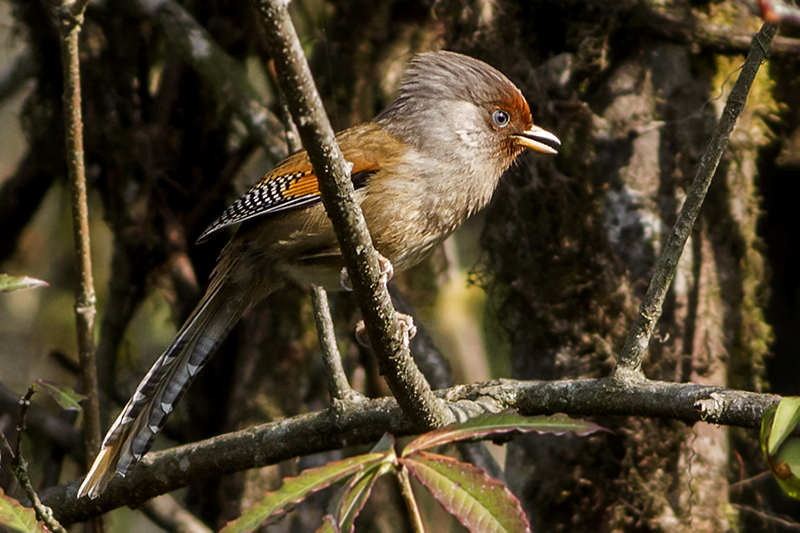
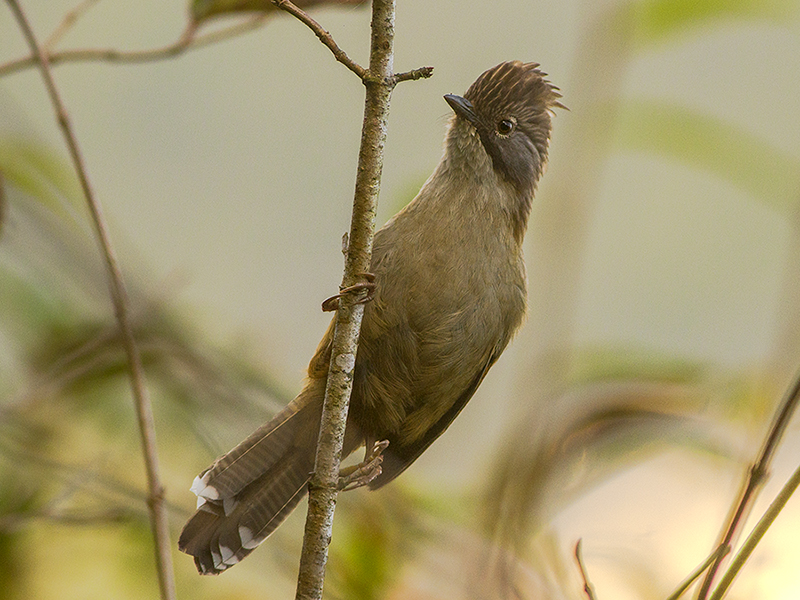
The White-throated Laughingthrush is a medium-sized bird with a length ranging from 26 to 28 cm. Its plumage is predominantly brown, with a striking white throat that serves as a key identifying feature. This contrast between the brown body and white throat is accentuated by a subtle grayish hue on the breast. The bird's head is adorned with a black mask, enhancing its distinctive appearance. Juveniles resemble adults but exhibit a slightly duller coloration, lacking the sharp contrast of mature birds.
Both male and female White-throated Laughingthrushes appear similar, making sex differentiation challenging without close observation of behavior, particularly during the breeding season. In flight, these birds display a relatively short, rounded tail and broad wings, which aid in maneuverability through dense foliage. Their flight silhouette is not as streamlined as some other passerines, reflecting their preference for hopping and short bursts of flight within their arboreal habitats.
Confusion with similar species, such as the Rufous-necked Laughingthrush, may arise due to overlapping ranges and habitat preferences. However, the latter species can be distinguished by its rufous throat and neck, in contrast to the white throat of Ianthocincla albogularis. When perched, the White-throated Laughingthrush often adopts an upright stance, showcasing its full profile and allowing for easier identification.
Having trouble telling birds apart? Upload a photo to our bird identification tool for an instant species match.
White-throated Laughingthrush Habitat and Range
Preferred Habitat
The White-throated Laughingthrush inhabits montane forests, predominantly in regions with a high density of shrubs and undergrowth. These birds favor the subtropical and tropical moist forests of the Himalayan foothills. They are generally found at elevations ranging from 1,500 to 3,000 meters, although they may descend to lower altitudes during winter.
Forests with a mix of broadleaf and coniferous trees provide the ideal habitat for these birds, offering ample foraging opportunities and nesting sites. The White-throated Laughingthrush is more common in rural and forested areas than in urban environments, as it relies on dense vegetation for both food and protection. Seasonal habitat shifts occur as the birds move in response to temperature changes and food availability, often seeking out forest edges and clearings for foraging.
While they are not typically urban dwellers, some populations may adapt to semi-urban areas that provide sufficient cover and food resources. The preservation of forest corridors is crucial for maintaining the natural movement and population dynamics of this species, as habitat fragmentation poses a significant threat to its survival.
Geographic Range
The White-throated Laughingthrush has a broad but specific range across the Asian continent. Its breeding range encompasses the Himalayan regions, including northern India, Nepal, Bhutan, and parts of China, particularly in the Sichuan and Yunnan provinces. The species is resident across much of its range, but populations in higher altitudes may migrate to lower elevations during the colder months.
In India, these birds are found in the states of Himachal Pradesh, Uttarakhand, and Sikkim, extending into the northeastern states and the foothills of Arunachal Pradesh. In Nepal and Bhutan, they inhabit the temperate forests and are a common sight in protected areas such as national parks and wildlife sanctuaries. The presence of the White-throated Laughingthrush in northwestern and southwestern China marks the easternmost extent of its range.
Migration corridors are not as defined as those of long-distance migratory birds, but seasonal movements are observed, particularly in response to food availability and climatic conditions. Population density is highest in areas with dense forest cover and minimal human disturbance, making national parks and remote forested regions hotspots for observing this species.
Want to know which birds visit your area? Browse our backyard birds by location guides for region-specific species lists.
What Does the White-throated Laughingthrush Eat?
The White-throated Laughingthrush's diet is diverse, primarily consisting of insects and other invertebrates, supplemented with fruits and seeds. This omnivorous diet allows it to adapt to seasonal changes in food availability. During the breeding season, the bird's diet shifts towards a higher proportion of protein-rich invertebrates, such as caterpillars and beetles, which are crucial for feeding growing chicks.
In autumn and winter, when insect availability declines, the White-throated Laughingthrush relies more heavily on fruits and seeds. Berries, figs, and small fruits become important dietary components, and the bird plays a role in seed dispersal through its foraging activities. The species is known for its ground-foraging behavior, often seen rummaging through leaf litter and undergrowth in search of food.
Foraging occurs throughout the day, with peaks in activity during the cooler morning and late afternoon hours. The White-throated Laughingthrush often feeds in flocks, a behavior that enhances foraging efficiency and offers protection against predators. Its ability to exploit a wide range of food sources contributes to its resilience in the face of environmental changes.
White-throated Laughingthrush Behavior and Social Structure
White-throated Laughingthrushes exhibit highly social behavior, often forming large flocks that can number up to 30 individuals. These flocks are dynamic, with members joining or leaving throughout the day, reflecting the bird's adaptable social structure. This sociality extends to their feeding habits, as they forage together, which increases efficiency and reduces the risk of predation.
Territorial behavior is most pronounced during the breeding season, when pairs establish and defend nesting territories. Courtship displays are subtle, involving mutual preening and low-level chases as part of pair bonding. Communication within flocks is constant, with a variety of vocalizations used to maintain group cohesion and alert others to potential threats.
The White-throated Laughingthrush is diurnal, with most activity occurring during daylight hours. They are particularly active during the early morning, a time when they engage in vocal displays and foraging. As highly vigilant birds, they respond swiftly to predators, often mobbing intruders in large numbers to drive them away. This communal defense strategy is effective against a range of predators, including raptors and terrestrial threats.
White-throated Laughingthrush Nesting and Reproduction
Nesting for the White-throated Laughingthrush typically occurs between April and July, coinciding with the warmer months when food is abundant. The nests are cup-shaped and constructed with twigs, leaves, and grass, often lined with softer materials such as feathers and moss for insulation. These nests are usually situated in dense shrubbery or low trees, providing both concealment and protection from predators.
A typical clutch consists of 2 to 4 eggs, which are pale blue with brown speckles. Both parents share incubation duties, which last approximately 14 to 16 days. After hatching, the chicks remain in the nest for another 12 to 14 days before fledging. Parental care extends beyond fledging, as the young birds are fed and protected by both adults until they are fully independent.
The White-throated Laughingthrush typically raises one brood per year, although in favorable conditions, some pairs may attempt a second. The presence of cooperative breeding behaviors, where non-breeding individuals assist with feeding and protection, suggests a complex social structure that enhances reproductive success.
White-throated Laughingthrush Sounds and Vocalizations
The vocalizations of the White-throated Laughingthrush are melodious and varied, characterized by a series of cheerful, loud calls. Their primary song consists of a rhythmic sequence of whistles, chirps, and chatters that carries well through dense foliage. These birds often engage in a dawn chorus, producing a symphony of sounds that signal the start of a new day.
In addition to their musical songs, White-throated Laughingthrushes emit distinct call notes used for communication within flocks. Alarm calls are sharp and quick, serving as an immediate warning to other flock members of potential danger. These calls can often be heard when a predator is spotted, prompting a concerted defensive response.
The complexity and variety of their vocal repertoire make them a captivating subject for ornithologists and birdwatchers alike. Their songs and calls, reminiscent of the sounds of bubbling brooks and wind through trees, contribute to the rich acoustic environment of their forest habitats.
Interesting Facts About the White-throated Laughingthrush
- 1White-throated Laughingthrushes can form flocks of up to 30 birds, showcasing their highly social nature.
- 2These birds are known for their complex vocalizations, which include over a dozen different call types.
- 3The White-throated Laughingthrush often forages on the ground, searching through leaf litter for insects.
- 4Unlike many birds, White-throated Laughingthrushes are cooperative breeders, with non-breeding birds helping care for young.
- 5Their diet shifts seasonally, relying more on fruits in winter when insects are scarce.
- 6White-throated Laughingthrushes play a crucial role in seed dispersal, aiding in the propagation of many plant species.
- 7These birds are excellent indicators of forest health, with their presence often signaling a healthy ecosystem.
White-throated Laughingthrush Conservation Status
As of October 2023, the IUCN lists the White-throated Laughingthrush as Least Concern, with a stable population trend. Although not currently at risk of extinction, the species faces threats from habitat destruction due to logging and agricultural expansion. Conservation efforts focus on preserving forest habitats and maintaining ecological corridors that allow for natural movement and genetic exchange between populations. Historically, the White-throated Laughingthrush has maintained stable population levels, partly due to its adaptability and broad diet. However, continued habitat fragmentation poses a significant challenge. Protected areas and national parks play a crucial role in safeguarding viable populations, and ongoing monitoring is essential to detect and address any potential declines in numbers. The involvement of local communities in conservation efforts, alongside national and international organizations, helps to mitigate the impact of human activities on their natural habitats. Awareness and education programs are key to ensuring the continued prosperity of this species and its forest environment.