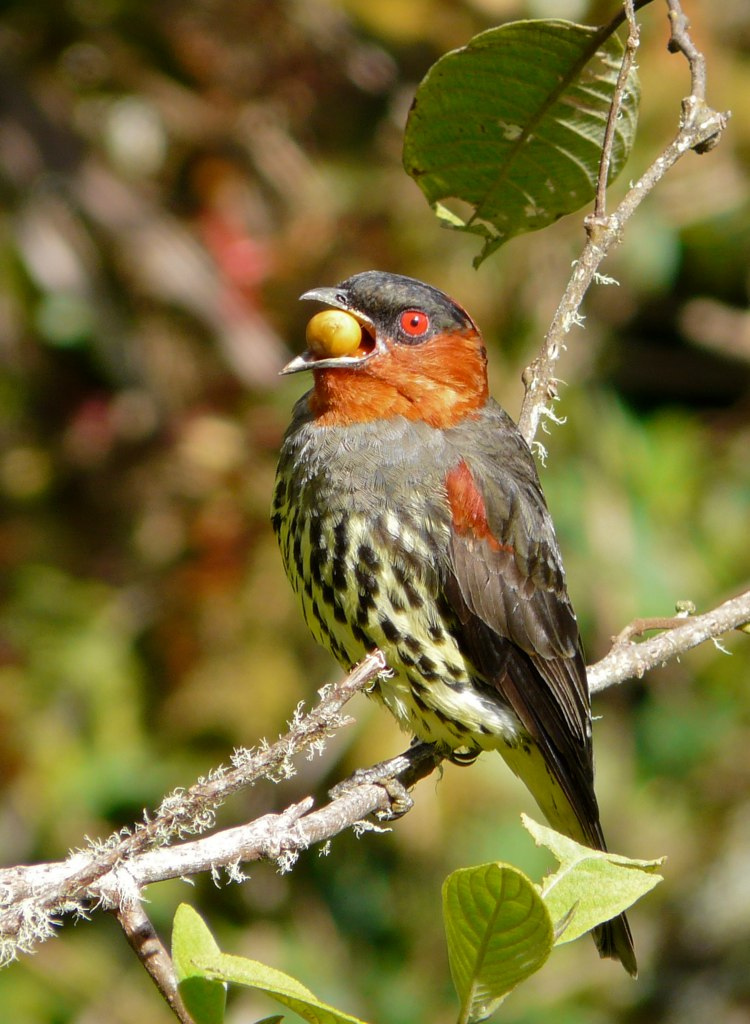
White-tipped Plantcutter
Phytotoma rutila
Order: Passeriformes / Family: Cotingidae

Wikimedia Commons
About the White-tipped Plantcutter
The White-tipped Plantcutter (Phytotoma rutila) is a captivating bird that belongs to the family Cotingidae. This species, distinguished by its unusual dietary habits, primarily inhabits the temperate and subtropical regions of South America. Found in countries such as Argentina, Paraguay, Uruguay, and southern Brazil, the plantcutter thrives in a variety of habitats, including grasslands, shrublands, open woodlands, and even urban gardens. Its adaptability to altered landscapes makes it a common sight in rural areas, where it frequents orchards and parks.
The ecological role of the White-tipped Plantcutter extends beyond its role as a consumer. By feeding on plant material, including leaves, buds, and fruits, it influences the vegetative composition of its habitat. This, in turn, can affect the availability of resources for other species, highlighting its role in the ecosystem. Seasonally, the plantcutter displays different behavioral patterns, often seen foraging in pairs or small groups outside the breeding season. During the breeding period, however, it becomes more territorial, with males actively defending their chosen areas.
In the context of ecological significance, the White-tipped Plantcutter serves as an indicator of habitat health. Its presence in an area often suggests a well-functioning ecosystem with a diverse plant community. This adaptability also underscores its resilience in the face of environmental changes, although habitat loss due to agricultural expansion remains a concern. As a species that has adjusted to both natural and human-altered landscapes, it provides unique insights into the interactions between birds and their environments.
The White-tipped Plantcutter belongs to the family Cotingidae, within the order Passeriformes. These birds typically live typically 6-8 years in the wild..
How to Identify a White-tipped Plantcutter
The White-tipped Plantcutter is a medium-sized bird, measuring approximately 18-20 cm in length. Its most distinguishing feature is the white tips on its tail feathers, which contrast sharply with its otherwise rufous and mottled plumage. Adult males display a more vibrant coloration than females, with a reddish-brown head and upperparts, while females have a more subdued, grayish-brown appearance with a streaked breast. Juveniles resemble females but are generally duller.
In flight, the plantcutter exhibits broad, rounded wings and a slightly undulating flight pattern. When perched, it often adopts an upright posture, which helps to accentuate its tail and the white tips that give the species its name. This posture, combined with its distinctive call, makes it easier to identify.
While the White-tipped Plantcutter could be confused with other members of the Cotingidae family, its unique feeding habits and the conspicuous white-tipped tail help differentiate it from similar species. Observers should note these features when attempting to identify the bird in the field.
Having trouble telling birds apart? Upload a photo to our bird identification tool for an instant species match.
White-tipped Plantcutter Habitat and Range
Preferred Habitat
The White-tipped Plantcutter favors a range of habitats, including temperate and subtropical grasslands, shrublands, and open woodlands. It is particularly fond of areas with abundant vegetation, where it can easily find food. In urban environments, it adapts well to parks and gardens, taking advantage of ornamental plants and hedges. The species is commonly found from sea level up to elevations of around 1,500 meters.
Seasonal shifts in habitat are minimal, although the plantcutter may alter its range slightly in response to food availability. In rural areas, it frequently inhabits agricultural lands, especially those with orchards and vineyards, where it can exploit cultivated plants. Despite its adaptability, the bird prefers regions with a mix of open space and vegetation, ensuring ample feeding opportunities.
Geographic Range
The White-tipped Plantcutter's range encompasses much of the southern half of South America. It breeds across a wide area, including central and northern Argentina, southern Paraguay, Uruguay, and southern Brazil. During the non-breeding season, the species may move slightly northward, although it largely remains within the same general range.
The species is a year-round resident in most parts of its range, showing only limited migratory behavior. Population densities are highest in regions like the Pampas and other fertile lowlands, where food resources are abundant. In contrast, its presence is less concentrated in mountainous regions and dense forested areas, where its preferred open habitats are less prevalent.
Want to know which birds visit your area? Browse our backyard birds by location guides for region-specific species lists.
What Does the White-tipped Plantcutter Eat?
The diet of the White-tipped Plantcutter primarily consists of plant material, a characteristic trait that sets it apart from many other passerines. It feeds on leaves, buds, flowers, and fruits, using its specialized beak to clip vegetation effectively. Among its favored food sources are the leaves of various shrubs and trees, as well as berries and small fruits.
Seasonal changes in diet are evident as the bird takes advantage of different plant resources available throughout the year. In spring and summer, it consumes more buds and flowers, while in autumn and winter, fruits become a crucial component of its diet. This adaptability in feeding habits allows the plantcutter to thrive in diverse environments.
Its foraging technique involves perching on branches and deftly snipping off plant parts with its beak. This behavior is often observed early in the morning and late in the afternoon, although the bird remains active throughout the day.
White-tipped Plantcutter Behavior and Social Structure
White-tipped Plantcutters exhibit a variety of interesting behaviors, particularly in their social and territorial interactions. They are generally monogamous, with pairs often seen foraging together or defending their territory during the breeding season. Males perform conspicuous displays, such as singing and wing-flashing, to establish dominance and attract mates.
Outside the breeding season, the plantcutter may form small flocks, although these groups remain loosely organized. In terms of daily activity, they are diurnal, with increased feeding activity during the cooler parts of the day. The plantcutter's response to predators involves a mix of alarm calls and evasive flight maneuvers.
Their territorial nature becomes pronounced during the breeding months, with males actively engaging in vocalizations to ward off rivals. This behavior ensures that each pair has access to sufficient food resources and suitable nesting sites, crucial for successful reproduction.
White-tipped Plantcutter Nesting and Reproduction
The nesting habits of the White-tipped Plantcutter reveal much about its adaptability and resourcefulness. Pairs typically build cup-shaped nests using twigs, grasses, and other plant materials, often lined with softer substances for comfort. These nests are usually positioned in shrubs or small trees, providing protection from predators and the elements.
Clutch size ranges from 2 to 4 eggs, with both parents participating in incubation, which lasts approximately 14 to 16 days. After hatching, the chicks remain in the nest for about 14 to 20 days before fledging. Parental care is a joint effort, with both male and female sharing responsibilities such as feeding and protecting the young.
The White-tipped Plantcutter usually raises one brood per year, although in optimal conditions, a second brood is possible. This reproductive strategy ensures the continuation of the species despite environmental challenges.
White-tipped Plantcutter Sounds and Vocalizations
The primary song of the White-tipped Plantcutter is a series of melodious, flute-like notes that vary in pitch and rhythm. These songs serve to establish territory and attract mates. Call notes are generally softer but can become more strident when the bird is alarmed.
During the dawn chorus, the plantcutter's song is particularly prominent, adding a distinct musical quality to the soundscape of its habitat. Compared to other birds in its range, its song is more complex and varied, making it a pleasure for birdwatchers to identify by ear.
Interesting Facts About the White-tipped Plantcutter
- 1The White-tipped Plantcutter's diet is predominantly herbivorous, a rarity among passerines.
- 2Despite its name, the White-tipped Plantcutter is not closely related to any other bird known for cutting plants.
- 3It can consume up to 70% of its body weight in plant material each day, highlighting its role as a significant herbivore.
- 4In urban areas, the White-tipped Plantcutter often frequents gardens, adapting to ornamental plants as a food source.
- 5Males are known for their vibrant plumage, using it to attract females and intimidate rivals during courtship displays.
- 6The species exhibits a unique foraging behavior, using its beak to snip off pieces of vegetation with precision.
- 7Its presence in an area serves as an indicator of healthy plant diversity, crucial for maintaining ecosystem balance.
White-tipped Plantcutter Conservation Status
The White-tipped Plantcutter is currently listed as Least Concern by the IUCN, with a stable population trend. However, habitat destruction due to agricultural expansion poses a threat to its natural habitats. Conservation efforts focus on preserving key areas and promoting sustainable agricultural practices. Historically, the bird has shown a degree of resilience, adapting to human-altered landscapes. Continued monitoring and habitat protection are essential to prevent future declines. Despite its adaptability, maintaining biodiversity and ecosystem health remains crucial for its continued survival.