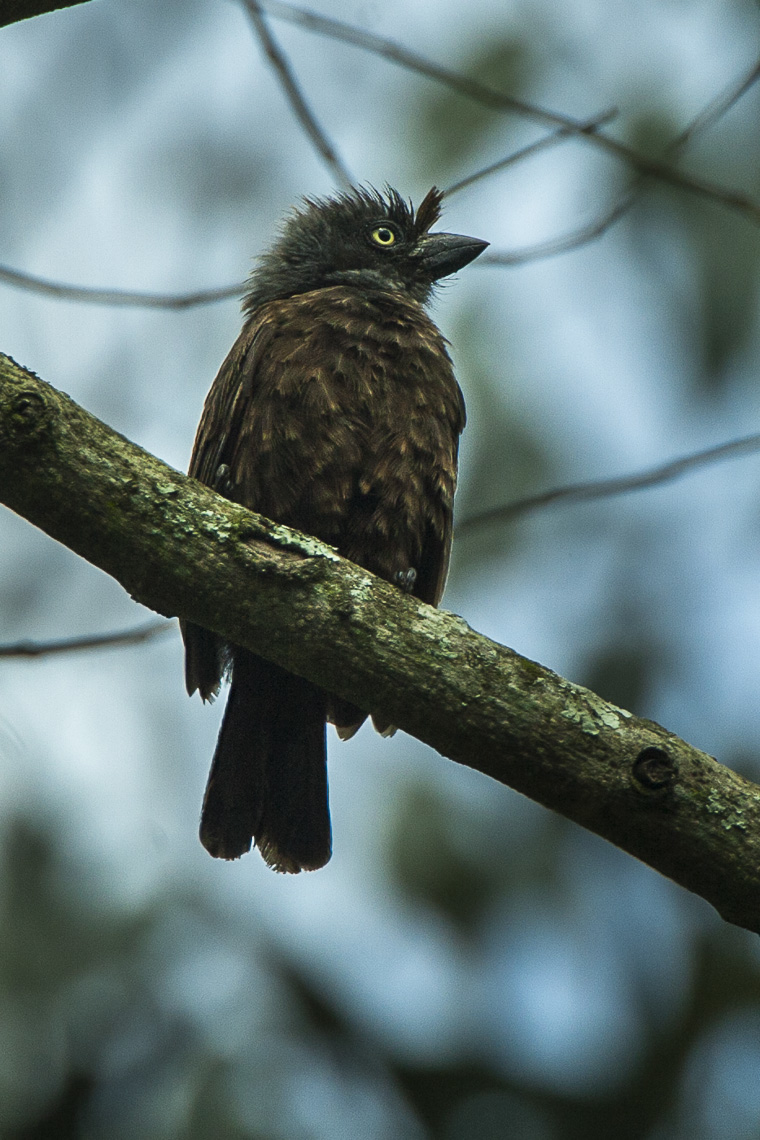
Yellow-billed Barbet
Trachyphonus purpuratus
Order: Piciformes / Family: Lybiidae

Wikimedia Commons
About the Yellow-billed Barbet
The Yellow-billed Barbet, scientifically known as Trachyphonus purpuratus, is a remarkable bird native to the dense forests and open savannas of Central and West Africa. This species plays a crucial ecological role by consuming fruits and dispersing seeds, thus aiding in forest regeneration. Its presence is often noted in countries such as Ghana, Nigeria, and Cameroon, where it thrives in humid and semi-humid forests. During the breeding season, the Yellow-billed Barbet becomes particularly vocal, filling the air with its distinctive calls to establish territory and attract mates. This bird is a resident species, meaning it does not partake in large migratory movements, although it may exhibit some altitudinal migration, moving to lower elevations during harsher weather conditions. The Yellow-billed Barbet's vibrant coloration and vocalizations make it a popular subject of study and interest among birdwatchers and ornithologists. Its adaptability to various forested environments highlights its resilience, yet it remains susceptible to habitat loss due to deforestation. Conservation efforts are critical in regions where logging and agricultural expansion threaten its natural habitat. Understanding its behavior, such as its preference for cavity nesting in dead trees, can inform conservation strategies that protect both the bird and its habitat. The Yellow-billed Barbet's ecological significance extends beyond its role as a seed disperser; it also serves as a bioindicator for healthy forest ecosystems. Its presence often indicates a well-balanced environment, rich in biodiversity. As forests face increasing human pressures, monitoring the Yellow-billed Barbet populations can provide valuable insights into the health of these ecosystems. Thus, the Yellow-billed Barbet is not only a fascinating subject of study but also a key player in maintaining the ecological equilibrium of its native regions.
The Yellow-billed Barbet belongs to the family Lybiidae, within the order Piciformes. These birds typically live average 6-8 years, with a maximum recorded of 11 years..
How to Identify a Yellow-billed Barbet
The Yellow-billed Barbet is a medium-sized bird, noted for its robust appearance and vivid coloration. Adult birds exhibit a striking yellow bill, which is one of their most distinguishing features. Their plumage is predominantly green, with a touch of red and yellow on the head and breast, making them quite conspicuous in their natural habitat. Juveniles tend to have duller plumage compared to adults, lacking the full vibrancy until they mature. Males and females are similar in appearance, though subtle differences in size or coloration may occur, often requiring keen observation to discern. In flight, the Yellow-billed Barbet's silhouette reveals broad wings and a short tail, characteristics typical of the Lybiidae family. When perched, it sits upright, often on exposed branches, making it easier to spot. Confusion with similar species can occur, particularly with other barbets in overlapping ranges. However, the combination of its yellow bill and the unique pattern of green, red, and yellow plumage helps differentiate it from others. Observers should also note the characteristic calls, which aid in identification when visual confirmation is difficult.
Having trouble telling birds apart? Upload a photo to our bird identification tool for an instant species match.
Yellow-billed Barbet Habitat and Range
Preferred Habitat
The Yellow-billed Barbet inhabits a variety of forested environments, including tropical rainforests, woodland savannas, and secondary growth forests. It is commonly found at elevations up to 2000 meters, though it prefers lower altitudes in dense forest regions. Seasonal changes may prompt minor shifts in habitat preference, particularly in response to food availability. In urban settings, the Yellow-billed Barbet occasionally ventures into gardens and parks, especially where old trees provide suitable nesting sites. However, it is predominantly a forest dweller, favoring habitats that offer abundant fruiting trees and dense foliage for cover.
Geographic Range
The range of the Yellow-billed Barbet extends across Central and West Africa, from Sierra Leone in the west to Uganda in the east. It has a significant presence in countries such as Liberia, Ivory Coast, and Gabon, where it occupies both primary and secondary forests. The bird is largely sedentary, with no significant migratory patterns, though local movements may occur in search of food or nesting sites. Population densities are highest in regions where forests remain intact and are less affected by human activity. As forests fragment, the barbet's range may contract, emphasizing the importance of conservation efforts in maintaining its habitats.
Want to know which birds visit your area? Browse our backyard birds by location guides for region-specific species lists.
What Does the Yellow-billed Barbet Eat?
The diet of the Yellow-billed Barbet primarily consists of fruits and seeds, making it an important seed disperser in its ecosystem. It favors figs and other fleshy fruits, which it consumes with its powerful bill. During certain seasons, it may also consume insects and small invertebrates, which provide essential protein, particularly during breeding periods. The barbet forages by hopping along branches and pecking at fruit clusters, occasionally hanging upside down to reach its food. It typically feeds in the early morning and late afternoon, taking advantage of the cooler temperatures and peak fruit availability.
Want to attract Yellow-billed Barbets to your yard? See our recommended feeders and seed types for the best results.
Yellow-billed Barbet Behavior and Social Structure
The Yellow-billed Barbet exhibits a range of behaviors that highlight its adaptability and social nature. It is often seen alone or in pairs, though small family groups may form, especially outside the breeding season. Territorial behavior is pronounced, with males vocalizing loudly to defend their territory from intruders. Courtship displays involve vocal duets and synchronized movements, showcasing the bond between mates. The Yellow-billed Barbet is diurnal, active mainly during daylight hours, and spends considerable time foraging and maintaining its territory. When threatened by predators, it relies on its keen eyesight and swift flight to escape, often retreating to dense foliage for cover.
Yellow-billed Barbet Nesting and Reproduction
The nesting habits of the Yellow-billed Barbet involve excavating cavities in dead trees or large branches. These cavities provide protection and insulation for the eggs and chicks. The female typically lays a clutch of 2-4 eggs, which she incubates for about 13-15 days. Both parents participate in feeding the chicks, which fledge approximately 30 days after hatching. The Yellow-billed Barbet usually raises one brood per year, though favorable conditions may allow for a second. Parental roles are well-defined, with both parents sharing responsibilities in nest defense and chick rearing.
Yellow-billed Barbet Sounds and Vocalizations
The Yellow-billed Barbet's primary song is a series of rhythmic, melodic whistles, often described as a repetitive 'hoo-hoo-hoo' that resonates through the forest. Its calls serve both to establish territory and to maintain contact between mates. Alarm calls are sharper and more urgent, alerting others to potential dangers. During the dawn chorus, the Yellow-billed Barbet's voice is prominent, contributing to the rich tapestry of sounds that define the African forest mornings.
Interesting Facts About the Yellow-billed Barbet
- 1The Yellow-billed Barbet can recognize over 15 different fruit calls, making it a versatile forager.
- 2Despite its colorful appearance, the Yellow-billed Barbet can blend seamlessly into leafy canopies.
- 3A Yellow-billed Barbet's bill grows continuously, requiring regular use to prevent overgrowth.
- 4Yellow-billed Barbets often use the same nesting site year after year, showcasing strong site fidelity.
- 5The barbet's call can travel over 500 meters, an adaptation for dense forest environments.
- 6Yellow-billed Barbets are one of the few birds that can digest certain toxic fruits, aiding in seed dispersal.
- 7Their pair bond can last several years, with couples often seen grooming each other as a sign of affection.
Yellow-billed Barbet Conservation Status
The Yellow-billed Barbet is currently listed as a species of Least Concern by the IUCN, with stable population trends across much of its range. However, habitat loss due to deforestation and agricultural expansion poses significant threats to its long-term survival. Conservation efforts focus on habitat preservation and reforestation projects, particularly in regions where logging is prevalent. Historical population changes have been minimal, but continued vigilance is necessary to ensure the species remains common throughout its range.
Attracting Yellow-billed Barbets to Your Feeder
The Yellow-billed Barbet is a regular visitor to backyard bird feeders across its range. At the Eye On The Fly feeding station, we observe Yellow-billed Barbets regularly and capture footage with our feeder cameras.