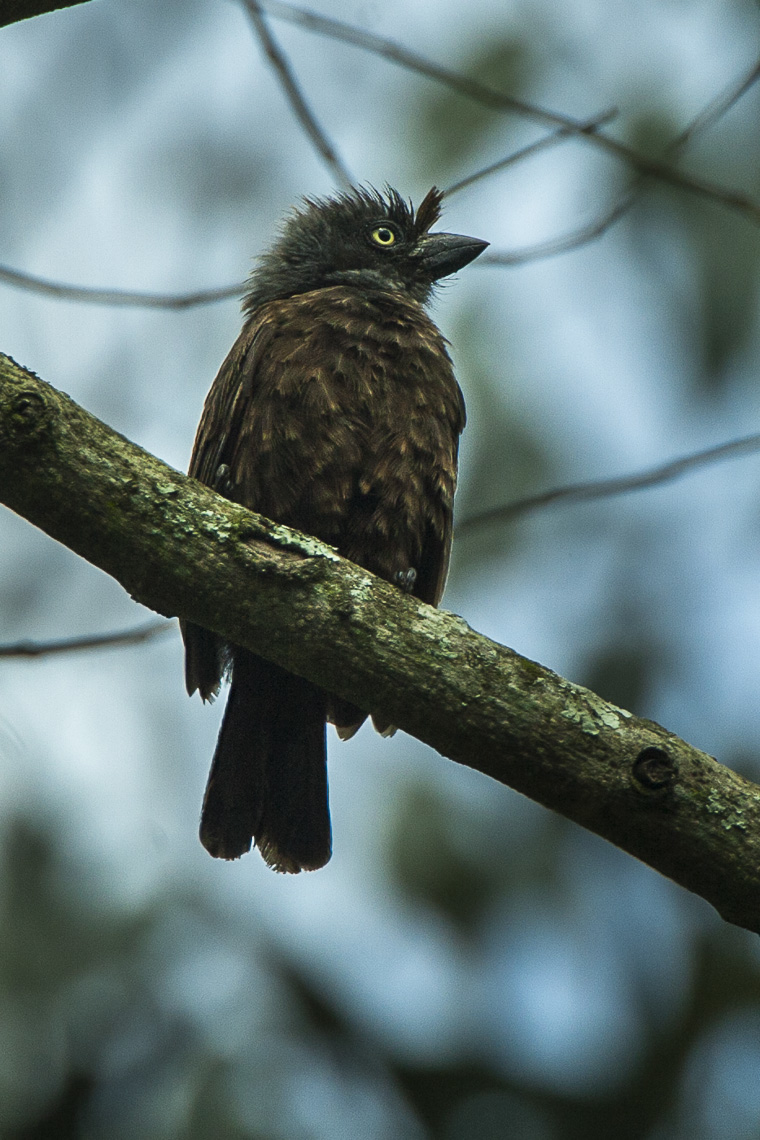
Yellow-rumped Tinkerbird
Pogoniulus bilineatus
Order: Piciformes / Family: Lybiidae

Wikimedia Commons
About the Yellow-rumped Tinkerbird
The Yellow-rumped Tinkerbird (Pogoniulus bilineatus) is a small, vibrantly colored member of the family Lybiidae, inhabiting the lush forest regions of sub-Saharan Africa. Its compact size, coupled with a striking yellow rump and a melodic call, makes it a prominent figure among birdwatchers and researchers alike. This species thrives in a variety of habitats, ranging from lowland rainforests to montane woodlands, often observed in elevations from sea level up to 2000 meters.
Their ecological role is significant, as they are key seed dispersers and pollinators within their environment. The Yellow-rumped Tinkerbird feeds primarily on fruits and insects, playing a vital part in controlling insect populations and aiding in the regeneration of forest vegetation. Their presence indicates a healthy ecosystem, as they require habitats rich in flora and fauna.
Seasonally, Yellow-rumped Tinkerbirds exhibit some movement patterns, though they are not considered migratory. Instead, they may shift slightly in range depending on fruiting seasons and availability of resources. During breeding seasons, typically coinciding with the onset of the rains, these birds become particularly vocal, with their calls resonating through their territories as they establish breeding pairs and defend their space against competitors. This species is a delightful subject for study due to its ecological significance and the vibrant life it brings to its surroundings.
The Yellow-rumped Tinkerbird belongs to the family Lybiidae, within the order Piciformes. These birds typically live typically 4-6 years, with some individuals living up to 8 years..
How to Identify a Yellow-rumped Tinkerbird
The Yellow-rumped Tinkerbird is easily recognizable by its small size, approximately 10-12 cm in length, and its bright yellow rump, which stands out against its predominantly olive and black plumage. The adult tinkerbird has a black crown with white streaks, a white eyebrow stripe, and a yellowish belly, which helps distinguish it from similar species. Males and females exhibit similar plumage, making it challenging to differentiate between sexes in the field.
Juveniles resemble adults but tend to have duller plumage and less distinct markings. This differentiation can be subtle and requires a keen eye to discern in the field. The bird's bill is stout and slightly hooked, characteristic of the Lybiidae family, assisting in fruit consumption and insect hunting.
Confusion may arise with the Red-fronted Tinkerbird, which shares a similar range. However, the Yellow-rumped Tinkerbird lacks the red frontal mark, focusing instead on its signature yellow rump. In flight, this species displays rapid, direct movements, with the yellow rump providing a key identification mark. When perched, it adopts an upright posture, often seen in pairs or small family groups.
Having trouble telling birds apart? Upload a photo to our bird identification tool for an instant species match.
Yellow-rumped Tinkerbird Habitat and Range
Preferred Habitat
The Yellow-rumped Tinkerbird inhabits a diverse array of forested environments, including lowland rainforests, montane forests, and secondary growth areas. They can be found from sea level to elevations reaching 2000 meters, adapting well to various forest types. This adaptability allows them to exploit a range of ecological niches within their geographic range.
These birds exhibit some tolerance for disturbed habitats, often seen in plantations and gardens adjacent to more pristine forest areas, making them more resilient to habitat changes compared to some strictly forest-dependent species. Despite their adaptability, they are primarily forest dwellers and rely on the presence of mature trees for nesting and foraging.
Seasonally, they may shift their habitat preference slightly, following fruiting cycles and insect availability. While they are not typically found in highly urbanized settings, they can occasionally be spotted in suburban areas with significant vegetative cover.
Geographic Range
The Yellow-rumped Tinkerbird's range spans across sub-Saharan Africa, thriving in regions with abundant forest cover. They are distributed from West Africa, through Central Africa, and into East Africa, inhabiting countries such as Sierra Leone, Nigeria, Uganda, and Kenya. This species is notably absent from the more arid regions of the continent, favoring instead the humid, forested zones.
Yellow-rumped Tinkerbirds are non-migratory, residing year-round within their established territories. However, they may demonstrate local movements in response to food availability, particularly during fruiting seasons. Within their range, they are commonly encountered, although population densities can vary widely depending on habitat quality and food resources.
In certain areas, particularly in well-preserved forests and protected reserves, their populations are denser, providing excellent opportunities for observation and study. As forested areas become fragmented due to human activities, their range may experience localized contractions, highlighting the importance of conservation efforts in maintaining suitable habitats.
Want to know which birds visit your area? Browse our backyard birds by location guides for region-specific species lists.
What Does the Yellow-rumped Tinkerbird Eat?
The Yellow-rumped Tinkerbird primarily consumes a diet rich in fruits, with a preference for figs and other small berries. They play a significant role as seed dispersers, contributing to forest regeneration and biodiversity. In addition to fruits, these birds actively hunt insects, including beetles, ants, and caterpillars, providing a dual ecological service as both pollinators and pest controllers.
Seasonal variations in diet occur as the availability of fruits and insects changes throughout the year. During the dry season, when fruits are scarce, the tinkerbird increases its reliance on insects, which remain abundant due to its foraging prowess. These birds employ a gleaning technique, carefully picking insects from foliage and bark with their strong, slightly hooked bills.
Their feeding schedule is predominantly diurnal, with peak activity occurring during the early morning and late afternoon when temperatures are cooler and prey is more active. They often feed in the mid-canopy, making them a bit challenging to observe but rewarding for those who are patient.
Yellow-rumped Tinkerbird Behavior and Social Structure
The Yellow-rumped Tinkerbird exhibits a fascinating array of behaviors, marked by its territoriality and vocal nature. These birds are predominantly monogamous, forming lifelong pairs that defend their territory with vigor. Their territorial calls, a series of repetitive notes often compared to a tinkling bell, serve as both a declaration of presence and a deterrent to potential intruders.
Socially, they are relatively solitary compared to some flocking species, typically seen in pairs or small family groups outside the breeding season. During the breeding season, pairs become particularly active in defending their nesting sites, often engaging in vocal duets that strengthen pair bonds and reinforce territory boundaries.
Their response to predators involves a mix of vocal alarms and evasive flight, utilizing their swift, direct flying capabilities to escape threats. Daily activity patterns show a preference for cooler parts of the day, with periods of rest during the heat of midday. This behavior maximizes their efficiency in foraging and reduces exposure to predators during vulnerable times.
Yellow-rumped Tinkerbird Nesting and Reproduction
Yellow-rumped Tinkerbirds display a unique nesting behavior, utilizing cavities in trees for nesting purposes. They often excavate these cavities themselves, a task made possible by their robust bills. Preferred nesting sites include dead tree trunks or branches, where they can carve out a suitable space for their clutch.
The nests are constructed primarily from plant fibers, feathers, and other soft materials that provide insulation and comfort for the eggs and chicks. A typical clutch consists of 2 to 4 eggs, which the female incubates for approximately 12 to 14 days. During this period, the male assists by providing food and maintaining territory security.
Once the eggs hatch, both parents share the responsibility of feeding and caring for the chicks. The fledging period lasts about 20 to 25 days, after which the young birds begin exploring the surrounding environment, though they often remain dependent on their parents for several more weeks. Yellow-rumped Tinkerbirds typically raise one brood per year, although in favorable conditions, they may attempt a second.
Yellow-rumped Tinkerbird Sounds and Vocalizations
The primary vocalization of the Yellow-rumped Tinkerbird is a series of clear, rhythmic notes that resemble the sound of a small bell or a tinker. This call is repetitive and can carry over considerable distances, serving both as a territorial advertisement and a contact call between mates.
In addition to their primary song, these birds produce a variety of call notes that include sharp 'chik' sounds used as alarm calls when predators are near. These alarm calls prompt immediate responses from nearby birds, alerting them to potential threats.
During the dawn chorus, the Yellow-rumped Tinkerbird's song often stands out due to its clarity and persistence, contributing to the rich tapestry of sounds that characterize their forest habitats. Their calls are comparable to the sound of a distant wind chime, providing an auditory signature that is both beautiful and functional.
Interesting Facts About the Yellow-rumped Tinkerbird
- 1The Yellow-rumped Tinkerbird has a distinctive call that can be heard over 500 meters away in dense forest habitat.
- 2Despite their small size, Yellow-rumped Tinkerbirds can excavate nesting cavities in tree trunks, showing remarkable strength.
- 3These birds play a crucial role in seed dispersal, particularly for fig trees, aiding forest regeneration.
- 4Yellow-rumped Tinkerbirds are known to consume over 100 different fruit species, showcasing their dietary diversity.
- 5Their territorial calls can last for several minutes, allowing them to effectively communicate across dense foliage.
- 6They have been observed using their strong bills to break open hard insect exoskeletons, demonstrating their adaptability.
- 7Yellow-rumped Tinkerbirds have a lifespan of up to 10 years in the wild, a testament to their resilience and adaptability.
Yellow-rumped Tinkerbird Conservation Status
According to the IUCN Red List, the Yellow-rumped Tinkerbird is currently classified as a species of Least Concern, with stable population trends across its range. Despite this, ongoing habitat loss and fragmentation pose potential threats, as these birds rely on forested environments for survival. Conservation efforts focus on protecting existing forests and promoting sustainable land-use practices that minimize further habitat destruction. While their adaptability to some disturbed environments provides a buffer against immediate declines, maintaining large tracts of continuous forest is crucial for their long-term conservation. Historical data indicate that populations have remained relatively stable over recent decades, thanks in part to conservation initiatives and the establishment of protected areas within their range. Continued monitoring and habitat preservation are essential to ensure their ongoing survival and ecological contributions.