Yellow-throated Laughingthrush
Ianthocincla galbana
Order: Passeriformes / Family: Leiothrichidae

Wikimedia Commons
About the Yellow-throated Laughingthrush
The Yellow-throated Laughingthrush (Ianthocincla galbana) is a striking member of the Leiothrichidae family, widely recognized for its vibrant plumage and distinctive calls. This medium-sized songbird predominantly inhabits the subtropical and tropical forests of the Himalayan foothills and Southeast Asia, including regions like Bhutan, northeastern India, and northern Myanmar. The bird's preference for dense forested areas, often at elevations ranging from 1500 to 3000 meters, makes it a unique representative of the montane ecosystems of these regions.
The Yellow-throated Laughingthrush plays a vital role in its ecosystem. As a frugivore, it aids in seed dispersal, contributing to forest regeneration and health. Insectivory complements its diet, helping control insect populations and maintaining ecological balance. Seasonal changes influence its behavior and movement patterns. During the breeding season, typically from April to July, these birds become more territorial and conspicuous, vocalizing more frequently to establish dominance and attract mates. Outside the breeding months, they often form small flocks, sometimes mingling with other laughingthrush species and forest birds, enhancing their social interactions and foraging efficiency.
Their presence signifies a healthy, biodiverse forest, as they thrive in undisturbed habitats. However, habitat loss due to deforestation and human encroachment poses significant threats to their populations. Conservation efforts aim to preserve their natural habitats, ensuring these charismatic birds continue to thrive in the wild. The Yellow-throated Laughingthrush's ecological role and its melodious calls make it a fascinating subject for ornithologists and bird enthusiasts alike.
The Yellow-throated Laughingthrush belongs to the family Leiothrichidae, within the order Passeriformes. These birds typically live average 5-7 years with max recorded 9 years.
How to Identify a Yellow-throated Laughingthrush
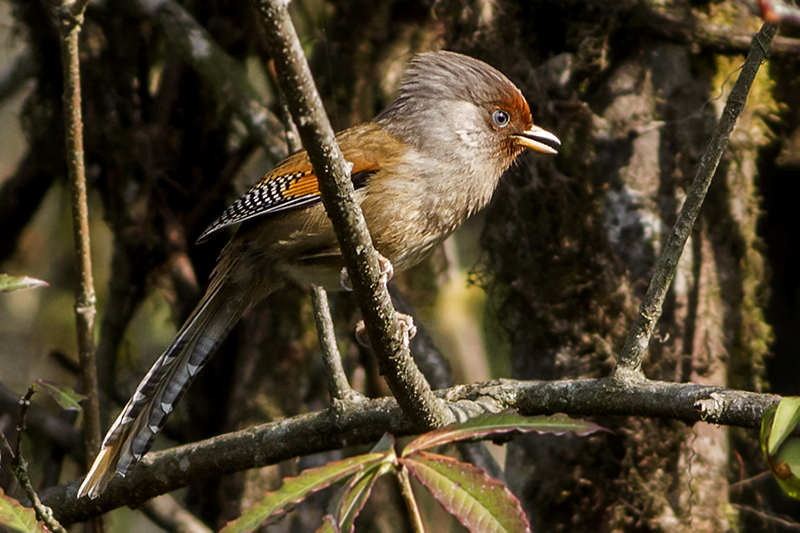
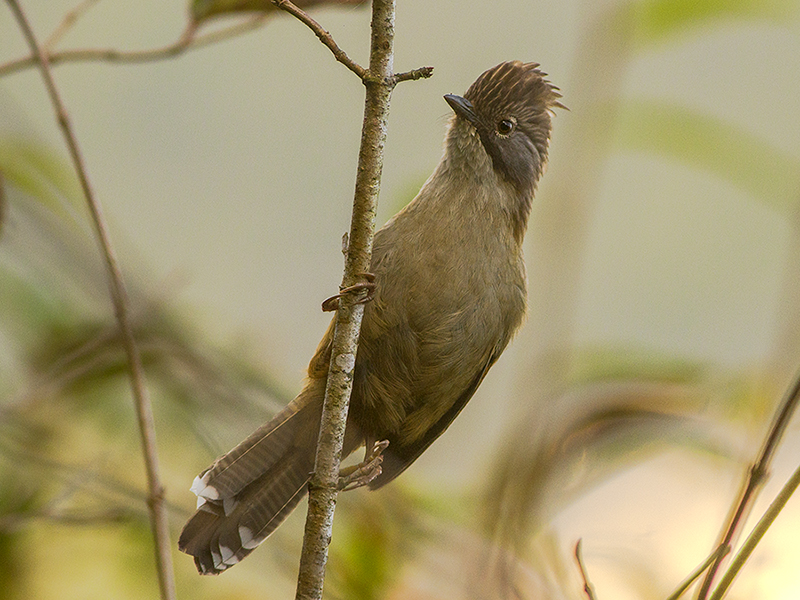
Adult Yellow-throated Laughingthrushes possess a striking combination of colors that makes them relatively easy to identify. The most notable feature is their bright yellow throat, which stands out against their olive-brown upperparts. Their chest and belly display a paler, more subdued yellow, creating a gradient effect. The head is adorned with a conspicuous dark mask that extends from the bill through the eyes, adding to their distinctive appearance. Their wings and tail are a darker brown, sometimes with a hint of rufous at the edges.
Juveniles resemble adults but exhibit duller plumage, lacking the vibrant yellow and pronounced facial markings. Males and females appear similar, though females may have slightly less intense coloration. This lack of sexual dimorphism can make field identification of gender challenging without behavioral context. In flight, these birds present a strong, slightly rounded silhouette, with broad wings and a long tail that aids in maneuvering through dense foliage.
The Yellow-throated Laughingthrush can be confused with other laughingthrush species, such as the similar-toned White-throated Laughingthrush. However, the yellow throat and less pronounced white markings help differentiate them. When perched, they often adopt an upright posture, making their bright throat visible even from a distance.
Having trouble telling birds apart? Upload a photo to our bird identification tool for an instant species match.
Yellow-throated Laughingthrush Habitat and Range
Preferred Habitat
The Yellow-throated Laughingthrush thrives in dense, humid forests, particularly in subtropical or tropical montane regions. It is typically found in areas with ample undergrowth and a variety of fruiting trees, which provide both food and shelter. In the eastern Himalayas, it frequents broadleaf forests, often at elevations between 1500 and 3000 meters.
Seasonal habitat shifts are minimal, as these birds prefer to remain within forested areas year-round. However, they might descend to slightly lower elevations during colder months in search of food. Unlike some other bird species, the Yellow-throated Laughingthrush rarely ventures into urban or heavily disturbed areas, indicating its reliance on pristine habitats.
The bird's presence is most notable in protected areas and national parks, which offer the undisturbed environments necessary for its survival. These habitats support a rich biodiversity, with the laughingthrush contributing to the ecological complexity.
Geographic Range
The Yellow-throated Laughingthrush has a relatively confined range within the eastern Himalayan region and parts of Southeast Asia. It breeds and resides primarily in Bhutan, northeastern India, and northern Myanmar. In India, its presence is significant in states like Arunachal Pradesh and Assam, where the forested hill regions provide ideal conditions.
Unlike many other passerine birds, this species does not undertake long migratory journeys, preferring to remain within its established range throughout the year. This sedentary behavior emphasizes the importance of maintaining quality habitats within its range for its continued survival.
Population density tends to be higher in protected regions where human disturbance is minimal, and suitable habitat is abundant. In areas like the Bumdeling Wildlife Sanctuary in Bhutan, the Yellow-throated Laughingthrush is a common sight, providing keen birders with ample opportunities for observation.
Want to know which birds visit your area? Browse our backyard birds by location guides for region-specific species lists.
What Does the Yellow-throated Laughingthrush Eat?
The Yellow-throated Laughingthrush primarily consumes a diet of fruits and insects, making it a key frugivore and insectivore within its ecosystem. Figs, berries, and wild fruits constitute the bulk of its fruit intake, while beetles, caterpillars, and other arthropods provide essential protein, especially during the breeding season.
Seasonal variations in fruit availability prompt these birds to adjust their diet, leaning more towards insects in times of fruit scarcity. Foraging typically occurs in the early morning and late afternoon, when the birds actively search through the undergrowth and lower canopy for food.
Their technique involves hopping along branches and occasionally sallying to catch flying insects. The Yellow-throated Laughingthrush's adaptability in diet reflects its ability to thrive in diverse forest habitats, aiding in its survival despite environmental changes.
Yellow-throated Laughingthrush Behavior and Social Structure
Yellow-throated Laughingthrushes are highly social birds, often found in small, cohesive groups that communicate through a complex array of vocalizations. These groups, sometimes mixed with other laughingthrushes and babblers, provide safety in numbers, reducing the risk of predation. Their social structure is relatively loose, with few observable hierarchical behaviors.
Territoriality emerges prominently during the breeding season, with pairs establishing and defending nesting territories. Males engage in vocal displays to ward off rivals and attract mates, their calls echoing through the forest. Courtship involves mutual preening and food offerings, reinforcing pair bonds.
Daily activities follow a predictable pattern, with feeding occurring during cooler parts of the day and resting during the peak heat. In the presence of predators, these birds exhibit coordinated alarm calls and evasive maneuvers, often retreating to denser foliage for cover.
Yellow-throated Laughingthrush Nesting and Reproduction
Yellow-throated Laughingthrushes build cup-shaped nests, usually located in dense shrubs or small trees, a few meters above ground to avoid ground predators. The nests comprise twigs, leaves, and grass, lined with soft materials for insulation.
A typical clutch consists of 2 to 4 eggs, with both parents sharing incubation duties over approximately two weeks. The altricial chicks hatch helpless and require constant care and feeding. Fledging occurs about 14 to 16 days post-hatching, with both parents actively feeding and protecting the young during this vulnerable stage.
These birds typically produce one or two broods per year, depending on environmental conditions and food availability. Successful nesting depends heavily on habitat quality, underscoring the importance of conserving their natural environments.
Yellow-throated Laughingthrush Sounds and Vocalizations
The primary song of the Yellow-throated Laughingthrush is a series of melodious whistles and chuckles, delivered in a rhythmic sequence that can carry over long distances. The pitch varies from mid to high, with a quality reminiscent of laughter, hence the common name.
Additionally, these birds produce a variety of call notes, including softer contact calls used within groups, and sharper alarm calls that signal danger. During dawn and dusk, their vocal activity increases, contributing to the forest's dawn chorus.
Their sound repertoire is diverse, allowing for intricate communication within flocks and between mates, especially during the breeding season.
Interesting Facts About the Yellow-throated Laughingthrush
- 1The Yellow-throated Laughingthrush's song resembles laughter, a trait that has fascinated ornithologists and birdwatchers alike.
- 2These birds often join mixed-species flocks, highlighting their adaptable social behavior and foraging strategy.
- 3The elevation range of the Yellow-throated Laughingthrush spans from 1500 to 3000 meters, showcasing its preference for montane habitats.
- 4Despite being a forest dweller, the Yellow-throated Laughingthrush can adapt its diet to include a variety of fruits and insects.
- 5Both male and female Yellow-throated Laughingthrushes are involved in nesting duties, illustrating shared parental responsibilities.
- 6Their distinctive yellow throat and facial mask make the Yellow-throated Laughingthrush easily recognizable among other forest birds.
- 7The species' reliance on dense forests highlights the importance of habitat conservation for maintaining biodiversity.
Yellow-throated Laughingthrush Conservation Status
The Yellow-throated Laughingthrush is currently listed as Least Concern by the IUCN, with populations considered stable across its range. However, ongoing threats such as deforestation and habitat fragmentation pose potential risks to their long-term survival. Conservation efforts focus on habitat preservation, particularly in protected areas and national parks that offer refuge from human encroachment. Monitoring population trends and habitat quality remains crucial, as any significant changes could impact their status. Historically, these birds have maintained a stable presence in undisturbed forest regions, underscoring the need for continued conservation actions.